
The white fused alumina price generally ranges from approximately USD 580 to USD 2,500 per metric ton, depending on particle size, purity, application grade, processing requirements, order quantity and delivery terms.
Standard refractory aggregates and common abrasive grains are usually at the lower end of this range. Precisely classified micro powders, low-sodium grades, surface-treated grains and products with strict oversized-particle control are usually more expensive.
Based on publicly available China supplier listings and market information reviewed in July 2026, buyers can use the following ranges for preliminary budgeting:
| White Fused Alumina Grade | Indicative Price Range |
|---|---|
| Refractory aggregate and coarse grain | USD 580–800/MT |
| Standard abrasive macrogrit | USD 700–950/MT |
| Fine powder and common microgrit | USD 850–1,600/MT |
| Precision polishing micro powder | USD 1,200–2,000/MT |
| Specialty or tightly controlled grades | USD 1,600–2,500+/MT |
These figures are budgeting references rather than fixed market prices. Public export listings currently show common WFA products at approximately USD 580–950 per ton, while fine powders and microgrits can be listed between roughly USD 700 and USD 2,000 per ton. Some specialty suppliers publish broader ranges extending to USD 2,500 per ton for high-purity or tightly controlled products.
The final quote may be higher after ocean freight, insurance, import duties, customs clearance and local delivery are added.
Quick Answer: How Much Does White Fused Alumina Cost?
As of July 2026, a practical reference price for standard Chinese white fused alumina is:
- USD 580–800 per ton for refractory coarse grain
- USD 700–950 per ton for common F12–F220 abrasive grains
- USD 850–1,600 per ton for fine powder and standard microgrits
- USD 1,200–2,000 per ton for precision polishing powder
- USD 1,600–2,500 or more per ton for specialty grades
A public supplier listing for F12–F220 abrasive and refractory WFA shows an FOB reference of USD 580–750 per ton. Other current listings for 99.5% WFA used in sandblasting and abrasive tools commonly fall around USD 750–950 per ton.
Fine white fused alumina powder can be more expensive. Public listings include approximately USD 800–900 per ton for larger powder orders, around USD 980–999 per ton for selected F150–F220 material and up to USD 1,600 per ton for specialized polishing micro powder.
Asian Metal’s market updates in June and July 2026 indicated that Chinese WFA producers and exporters were generally maintaining stable offering prices during that period.
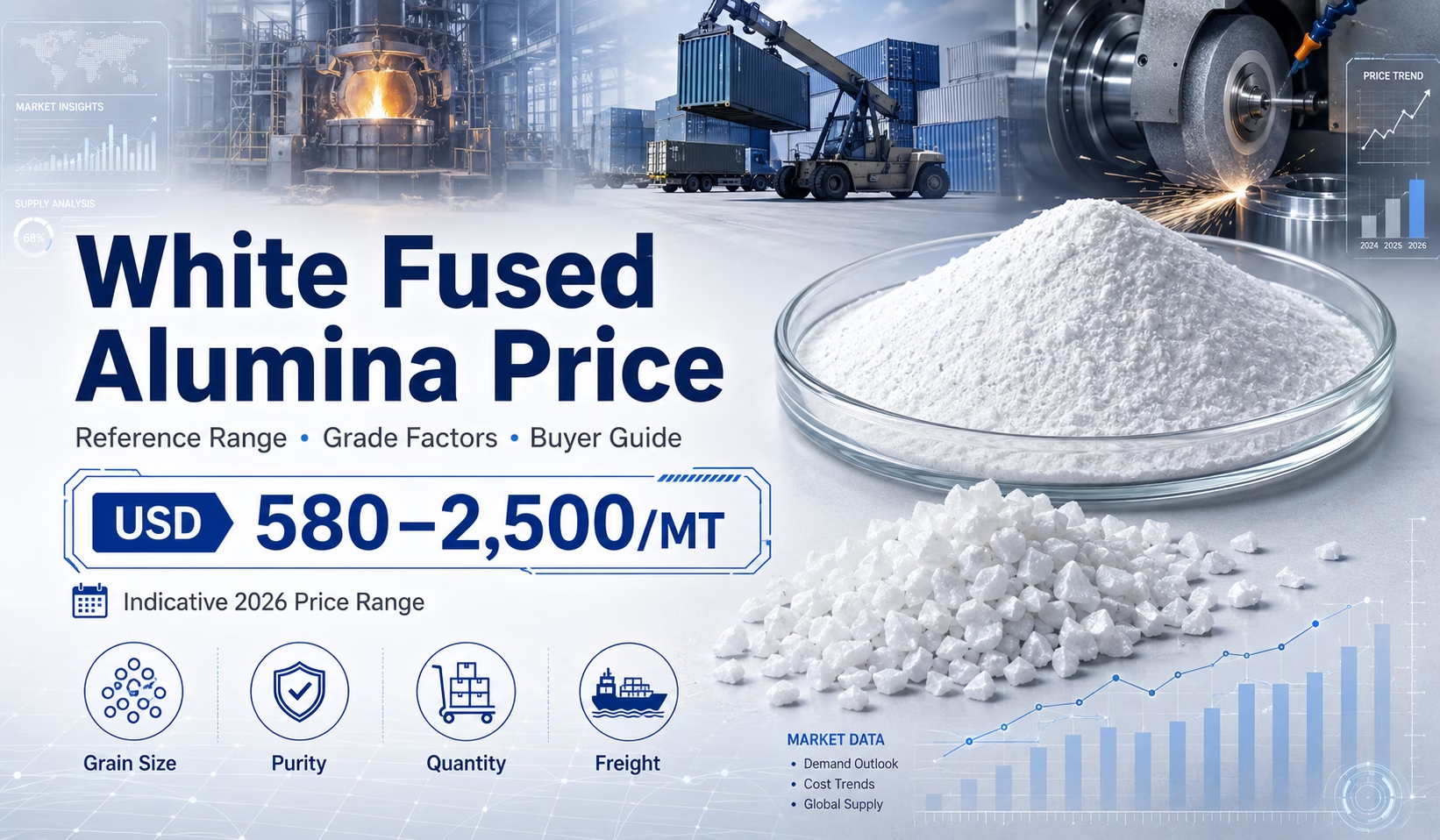
2026 White Fused Alumina Price Table
The following table provides a more detailed breakdown.
| Product Type | Typical Size or Grade | Estimated Price, USD/MT | Common Applications |
| Refractory coarse grain | 0–1 mm, 1–3 mm, 3–5 mm | 580–800 | Castables, bricks and furnace linings |
| Standard abrasive grain | F12–F80 | 700–900 | Blasting and heavy grinding |
| Medium and fine abrasive grain | F90–F220 | 750–1,000 | Grinding wheels and surface finishing |
| Standard microgrit | F230–F600 | 850–1,300 | Precision grinding and lapping |
| Fine micro powder | F800–F1200 | 1,000–1,600 | Fine polishing and ceramic processing |
| Ultra-fine powder | F1500–F2000 and finer | 1,200–2,000 | Precision polishing |
| Specialty low-sodium WFA | Customized | 1,300–2,200 | Ceramics and high-purity refractories |
| Surface-treated WFA | Customized | 1,500–2,500+ | Coated and bonded abrasives |
| Small-volume customized orders | Any special specification | Variable | Laboratory or trial production |
FEPA treats fused aluminum oxide macrogrits for bonded abrasives as controlled particle distributions from F4 to F220. Finer bonded-abrasive grains continue from F230 to F2000. Because finer grades require additional milling and classification, their production cost is generally higher.
Important Pricing Note
The ranges above combine public FOB references, supplier listing prices and general export indications. They are not a formal commodity index.
Professional market services also track white fused alumina benchmarks, including monthly CIF Europe assessments and FOB China price series. However, exact current benchmark values are frequently available only to subscribers.
For a reliable purchasing decision, buyers should request a written quotation based on the exact size, standard, quantity, destination and delivery term.
What Does “White Fused Alumina Price per Ton” Include?
A supplier may quote WFA using several different commercial terms.
EXW Price
EXW means the quoted amount normally covers the material at the supplier’s factory.
The buyer may still need to arrange:
- Factory pickup
- Inland transportation
- Export customs handling
- Port charges
- International freight
- Insurance
- Import clearance
- Local delivery
An EXW quotation may look cheaper than an FOB or CIF quote, but it includes fewer services.
FOB China Price
FOB normally includes the product and export-related costs until the goods are loaded aboard the vessel at the agreed Chinese port.
The buyer generally pays for:
- Ocean freight
- Cargo insurance
- Destination port charges
- Import duty
- Customs clearance
- Local transportation
FOB is commonly used when comparing export quotations because the buyer can arrange international freight separately.
CIF Price
CIF normally includes:
- Product cost
- Export handling
- Ocean freight
- Cargo insurance to the named destination port
It does not necessarily include import duty, customs clearance, destination handling or delivery to the buyer’s factory.
DDP Price
A DDP quotation may include transportation, import clearance and delivery to the buyer’s specified destination.
DDP is convenient but normally produces a much higher price per ton than an EXW or FOB quotation.
Therefore, two white fused alumina quotations cannot be compared properly unless they use the same Incoterm, destination and packaging basis.
Why Does White Fused Alumina Price Vary So Much?
White fused alumina is not one standardized commodity with one universal price.
It is available in different chemical compositions, grain sizes, shapes, density ranges and application grades. The following factors can significantly affect the final cost.
1. Particle Size and Grit Standard
Particle size is one of the most important price factors.
Coarse refractory aggregates generally require less precision classification than micro powders. Fine WFA must go through additional crushing, milling, separation and quality inspection.
Producing micro powder may require:
- Multiple grinding stages
- Air classification
- Water classification
- Removal of oversized particles
- Removal of ultra-fine particles
- Drying
- Deagglomeration
- Repeated particle-size testing
White fused alumina micro powder is produced through precision crushing, milling and classification after the fused block has been formed. These extra processing stages explain why micro powder is normally priced above standard coarse grain.
For precision purchasing, the buyer should specify the grading system rather than submitting only a grit number.
Common standards include:
- FEPA F-grit
- FEPA P-grit
- JIS
- ANSI
- Chinese GB standards
- Micron-based distributions
- Customer-specific particle limits
FEPA separately defines F-grits for bonded abrasives and P-grits for coated abrasives, so similar numerical designations should not automatically be treated as identical products.
2. Purity and Chemical Composition
White fused alumina is made by fusing high-purity calcined alumina in an electric arc furnace. Commercial products are commonly designed for applications requiring relatively high purity and low contamination.
The price may rise when the buyer requires tighter limits for:
- Al₂O₃
- Na₂O
- Fe₂O₃
- SiO₂
- TiO₂
- Magnetic material
- Moisture
- Loss on ignition
A standard product may meet the needs of general blasting or refractory manufacturing. Precision ceramics, advanced polishing or contamination-sensitive grinding may require a more tightly controlled composition.
A specification such as “Al₂O₃ ≥99%” is not sufficient by itself. Sodium, iron, magnetic impurities and particle-size distribution may have a stronger effect on performance in certain processes.
3. Low-Sodium White Fused Alumina
Low-sodium WFA generally costs more than a conventional grade.
Sodium-bearing phases can affect crystal structure, refractoriness and performance in selected high-temperature or ceramic applications. Producing low-sodium WFA may require more carefully controlled raw materials and processing.
Buyers should specify the required Na₂O limit instead of only requesting “high purity.”
A supplier may offer different prices for:
- Standard-sodium WFA
- Low-sodium WFA
- Ultra-low-sodium WFA
The tighter the limit, the more important batch testing and certificate accuracy become.
4. Grain Shape
White fused alumina grains can be processed into different shapes.
Common descriptions include:
- Sharp
- Angular
- Blocky
- Dense
- Plate-like
- Irregular
- Custom-shaped
Sharp grains may provide more aggressive cutting, while blocky grains may offer different durability and packing characteristics.
Producing a controlled grain shape can involve specialized crushing, reshaping and classification. This may increase the price compared with standard crushed grain.
5. Micro Powder Distribution
For fine grinding and polishing, buyers should not evaluate only the average particle size.
Important parameters may include:
- D10
- D50
- D90
- Maximum particle size
- Oversized-particle content
- Undersized-particle content
- Distribution width
- Agglomeration
A standard micro powder with a broad distribution will normally cost less than a narrowly classified powder with strict oversized-particle control.
This difference is especially important in precision polishing. One oversized particle can create scratches even when the average particle size meets the buyer’s target.
6. Surface Treatment
Some abrasive manufacturers require WFA grains with a surface treatment.
Examples may include:
- Silane treatment
- Ceramic coating
- Resin-compatible treatment
- Hydrophobic treatment
- High-temperature treatment
- Bond-enhancing treatment
Surface treatment can improve compatibility between the abrasive grain and the bonding system, but it adds extra materials, processing steps and quality control.
Public listings for treated or specialized white fused alumina commonly show broader pricing than untreated standard grain.
7. Order Quantity
Order volume directly affects the price per ton.
A supplier must distribute fixed costs across the order, including:
- Production setup
- Laboratory testing
- Packaging preparation
- Export documentation
- Pallet preparation
- Customs declaration
- Bank charges
A one-ton order will normally have a higher unit price than a 20-ton or 100-ton contract.
One public WFA powder listing, for example, showed approximately USD 900 per ton at five tons and USD 800 per ton at 25 tons or more. Another F150–F220 listing showed USD 999 per ton at 25 tons and USD 980 per ton at 100 tons or more.
The lowest advertised price may also require a very high MOQ. Buyers should always check the quantity associated with the published figure.
8. Packaging
Standard industrial packaging may include:
- 25 kg paper bags
- 25 kg woven bags
- 25 kg bags on pallets
- 1 MT bulk bags
- Double-layer moisture-resistant bags
- Customized printed bags
Packaging affects both material cost and shipping efficiency.
Palletized 25 kg bags are easier to handle but usually cost more than basic one-ton bulk bags. Moisture barriers, custom labels, batch coding and reinforced export pallets can also increase the final price.
For micro powder, packaging quality is especially important because contamination, moisture or bag damage can affect downstream processing.
9. Testing and Documentation
Standard commercial orders may include a certificate of analysis.
More demanding buyers may request:
- Third-party inspection
- SGS testing
- Particle-size distribution report
- Magnetic-content testing
- Bulk-density testing
- Moisture testing
- Sample retention
- Pre-shipment inspection
- Batch traceability
- Customized COA format
FEPA maintains standards covering abrasive grain size, bulk density and chemical analysis of oxide-based abrasive grains. Requirements based on recognized standards make comparison easier, but additional testing can increase the order cost.
10. Raw Materials and Electricity
WFA production requires high-purity alumina and electric arc furnace processing at temperatures above 2,000°C. Raw alumina and electricity are therefore major production-cost components.
The price can be influenced by changes in:
- Calcined alumina costs
- Electricity prices
- Furnace operating rates
- Environmental restrictions
- Production maintenance
- Supply and demand
- Exchange rates
A supplier procurement guide published by Yumo similarly identifies raw material cost, processing expense and market demand as key influences on white fused alumina pricing.
Because these inputs can change, a quotation may remain valid for only a limited period.
11. Freight and Destination
International freight can substantially change the landed white fused alumina price.
The final logistics cost depends on:
- Shipping origin
- Destination port
- Container availability
- Order weight
- Full-container or less-than-container shipment
- Pallet requirements
- Port charges
- Fuel surcharges
- Inland transportation
A full container generally has a lower freight cost per ton than a small LCL shipment.
Buyers should not assume that a low FOB quotation will produce the lowest landed cost. Poor loading efficiency, expensive packaging or a distant loading port can offset a lower material price.
Typical Price by Application
White Fused Alumina for Refractories
Indicative price: USD 580–850 per ton
Refractory WFA is commonly supplied as:
- 0–1 mm
- 1–3 mm
- 3–5 mm
- 5–8 mm
- 200 mesh
- 325 mesh
- Mixed aggregate grading
Standard coarse aggregates tend to be less expensive than precision abrasive grains because particle classification requirements may be less demanding.
Public supplier listings for refractory and common WFA products frequently fall between approximately USD 500 and USD 800 per ton.
Low-sodium or specially graded refractory products can cost more.
White Fused Alumina for Sandblasting
Indicative price: USD 700–1,000 per ton
Common blasting sizes include:
- F12
- F16
- F24
- F36
- F46
- F54
- F60
- F80
- F100
- F120
The price depends on grain shape, bulk density, purity and whether the material is suitable for reuse.
Public listings for high-purity blasting-grade WFA show prices around USD 750–950 per ton, although small orders may be quoted above USD 1,000 per ton.
White Fused Alumina for Grinding Wheels
Indicative price: USD 750–1,200 per ton
Grinding-wheel manufacturers may require:
- Controlled friability
- Specific bulk density
- Defined grain shape
- Stable chemical composition
- FEPA-compliant particle distribution
- Bond-compatible surface treatment
Untreated standard grains normally cost less than surface-treated or specially shaped abrasive grains.
White Fused Alumina Micro Powder
Indicative price: USD 850–2,000 per ton
Typical grades include:
- F230
- F320
- F400
- F500
- F600
- F800
- F1000
- F1200
- F1500
- F2000
Public micro powder listings range from approximately USD 700 to USD 2,000 per ton, with individual products around USD 850–1,200, USD 980–999 or USD 1,600 depending on size and order quantity.
WFA for Precision Polishing
Indicative price: USD 1,200–2,500+ per ton
Precision polishing powder costs more when the buyer requires:
- Narrow particle distribution
- Strict top-cut control
- Minimal agglomeration
- Low magnetic content
- High chemical purity
- Stable batch-to-batch performance
- Application-specific surface treatment
A low advertised price is not necessarily economical if the powder produces scratches, inconsistent removal rates or a high rejection rate.
White Fused Alumina Price vs Brown Fused Alumina Price
White fused alumina is normally more expensive than brown fused alumina.
The difference is primarily associated with:
- Higher-purity alumina feedstock
- Different furnace processing
- Lower levels of iron and titanium impurities
- Tighter classification for precision applications
- Greater use in contamination-sensitive processes
Yumo positions white fused alumina as the higher-purity choice for precision grinding, polishing and applications requiring contamination control, while brown fused alumina is generally positioned as a tougher and more economical material.
Brown fused alumina may offer better value for aggressive blasting and heavy grinding where high purity is not necessary.
White fused alumina may provide better value when:
- Low iron contamination matters
- A white material is required
- Surface finish must be controlled
- The workpiece is stainless steel or a sensitive alloy
- Precision grinding is required
- High-purity refractory performance is needed
The lowest material price should not be the only selection criterion.
How to Get a More Accurate WFA Quote
Send the supplier a complete request rather than asking only, “What is your white fused alumina price?”
A professional inquiry should include:
- Product application
- Required grit or particle size
- FEPA, JIS, ANSI or GB standard
- Chemical-composition limits
- Required bulk density
- Grain-shape requirement
- Surface-treatment requirement
- Monthly or annual quantity
- Packaging format
- Destination port
- Required Incoterm
- Sample requirement
- Testing and documentation requirements
Example RFQ
We require white fused alumina F120 for vitrified grinding wheels.
Required Al₂O₃: ≥99.2%.
Please quote for 20 metric tons in 25 kg bags on pallets, FOB Qingdao and CIF Hamburg.
Please provide the technical data sheet, certificate of analysis, particle-size report, lead time and sample availability.
This inquiry gives the supplier enough information to prepare a meaningful quotation.
How to Reduce White Fused Alumina Purchasing Costs
Consolidate Orders
A full-container order normally reduces packaging, documentation and freight cost per ton.
Use the Correct Grade
Do not purchase an expensive polishing grade for general blasting or a specialized low-sodium grade when the application does not need it.
Compare Landed Cost
A lower factory price does not always create a lower delivered cost.
Test Before Bulk Purchasing
A representative sample can identify particle-size, cutting or contamination problems before a large shipment is approved.
Use Long-Term Supply Agreements
Stable purchasing volumes may help buyers negotiate:
- Better unit pricing
- Reserved production capacity
- Consistent specifications
- More predictable lead times
- Improved payment terms
Avoid Over-Specification
Extremely narrow particle limits and unnecessary purity requirements can increase cost without improving the finished product.
The specification should be based on actual process performance.
Red Flags in Very Low WFA Quotations
A quotation far below the normal market range should be checked carefully.
Possible issues include:
- Brown fused alumina mixed into the material
- Recycled or reclaimed abrasive
- Incorrect grit distribution
- High magnetic content
- Excessive sodium
- Inaccurate chemical analysis
- High moisture
- Uncontrolled oversized particles
- Underweight packaging
- EXW pricing presented as a delivered price
- Price based on an unrealistic MOQ
- Outdated online listing
Request a sample, batch certificate and particle-size report before placing a production order.
For critical applications, consider independent inspection or laboratory verification.
Conclusion
The white fused alumina price normally ranges from approximately USD 580 to USD 2,500 per metric ton.
A practical 2026 reference is:
- USD 580–800/MT: refractory aggregates and coarse grain
- USD 700–950/MT: standard abrasive macrogrits
- USD 850–1,600/MT: fine powder and common microgrits
- USD 1,200–2,000/MT: precision polishing powder
- USD 1,600–2,500+/MT: specialty and tightly controlled grades
The final price depends on particle size, purity, sodium level, grain shape, classification accuracy, treatment, packaging, order volume and delivery terms.
Buyers should compare complete specifications rather than choosing the lowest headline price. The most useful comparison is not simply the price per ton, but the total cost of achieving the required grinding, polishing, blasting or refractory performance.
For an accurate quotation, provide the supplier with the application, grit standard, chemical limits, quantity, packaging and destination.


