
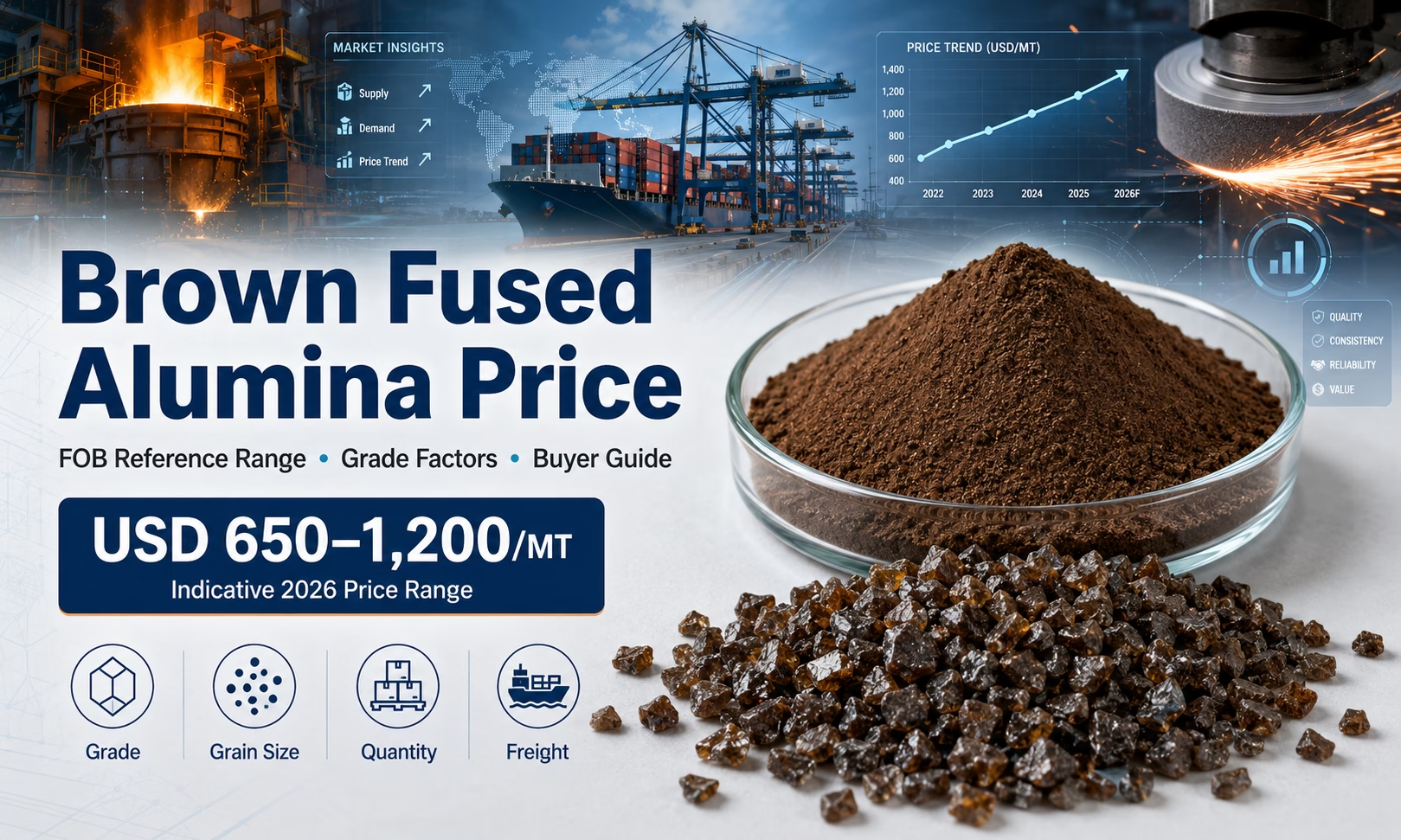
The brown fused alumina price generally ranges from approximately USD 650 to USD 1,200 per metric ton for standard industrial products.
For commercial full-container orders of standard 95% Al₂O₃ material, a practical FOB China reference is approximately:
USD 680–850 per metric ton
Refractory aggregates and common blasting grains are normally found near the lower end of the range. Bonded-abrasive grains, coated-abrasive P-grits, fine powders and treated products generally cost more.
Public market data showed 95% minimum Al₂O₃ brown fused alumina in 1–3 mm size at approximately USD 718.81/MT EXW China on July 21, 2026. Asian Metal also marked Chinese 1–3 mm, F36 and F46 brown fused alumina prices as unchanged in mid-July 2026. Earlier in March, refractory-grade material was reported around USD 700–750/MT FOB China. Together, these figures support a late-July budgeting range of roughly USD 680–850/MT FOB China for standard commercial orders, although they do not represent a binding quotation.
Current Brown Fused Alumina Price Range
| BFA Product Type | Indicative 2026 Price |
|---|---|
| Refractory aggregate | USD 650–800/MT |
| Standard blasting grain | USD 680–900/MT |
| Bonded-abrasive F-grit | USD 720–950/MT |
| Coated-abrasive P-grit | USD 850–1,200/MT |
| Fine powder and microgrit | USD 900–1,300/MT |
| Treated or customized grade | USD 1,000–1,400+/MT |
These prices are intended for preliminary budgeting. The actual quotation will depend on chemical composition, grit size, application, order quantity, packaging and delivery terms.
Fastmarkets maintains separate active monthly benchmarks for 95% minimum Al₂O₃ refractory-sized BFA and FEPA F8–F220 abrasive grain, both quoted FOB China. This confirms that refractory aggregate and abrasive grit should not be compared as though they were the same commercial product. The current numerical benchmark values are normally available only through its subscription service.
Quick Price Summary
For buyers who need a fast budgeting answer:
- Standard 95% BFA, full-container order: USD 680–850/MT FOB China
- Refractory aggregate: USD 650–800/MT
- Blasting grain: USD 680–900/MT
- Grinding-wheel grain: USD 720–950/MT
- Coated-abrasive grain: USD 850–1,200/MT
- Fine or treated grade: USD 900–1,400+/MT
Prices below USD 650/MT may be available for very large orders, lower-purity grades, secondary material or basic aggregate. Small orders and customized products can cost considerably more than the ranges above.
Brown Fused Alumina Price by Grade
Refractory-Grade Brown Fused Alumina
Typical price: USD 650–800/MT
Refractory BFA is commonly supplied in sizes such as:
- 0–1 mm
- 1–3 mm
- 3–5 mm
- 5–8 mm
- 180 mesh
- 200 mesh
- 325 mesh
It is used in refractory castables, bricks, ramming mixes, furnace linings and precast shapes.
The price is mainly influenced by:
- Al₂O₃ content
- Aggregate grading
- Magnetic material
- Bulk density
- Furnace source
- Packaging
Coarse refractory aggregate generally costs less than precision abrasive grain because it normally requires less exact particle classification.
Blasting-Grade Brown Fused Alumina
Typical price: USD 680–900/MT
Common blasting sizes include:
- F12–F36 for heavy surface preparation
- F46–F80 for general blasting
- F100–F220 for finer surface finishing
Brown fused alumina is selected for blasting because it is hard, tough and capable of aggressive cutting. Commercial blasting grades are designed to remove coatings, rust, scale and surface contamination while creating a controlled anchor profile. Washington Mills describes brown aluminum oxide blasting media as fast-cutting and durable, with some products designed for repeated recycling in reclaim systems.
The cheapest blasting material is not necessarily the most economical. Buyers should compare:
- Cleaning speed
- Media consumption
- Dust generation
- Recycling rate
- Surface-profile consistency
Bonded-Abrasive BFA
Typical price: USD 720–950/MT
Bonded-abrasive BFA is used in:
- Grinding wheels
- Cutting wheels
- Mounted points
- Grinding segments
- Sharpening stones
These applications may require tighter control over grain shape, bulk density, toughness, magnetic content and particle-size distribution.
Commercial bonded-abrasive ranges include standard, low-titania, heat-treated, high-density, low-density, iron-oxide-coated and silane-coated brown fused alumina. Specialized processing usually adds a premium over standard untreated grain.
Coated-Abrasive BFA
Typical price: USD 850–1,200/MT
Coated-abrasive grain is used in:
- Sandpaper
- Sanding belts
- Flap discs
- Fibre discs
- Abrasive cloth
This grade may cost more because it can require:
- FEPA P-grit classification
- Controlled angular grain shape
- Surface or heat treatment
- Stable coating behavior
- Low dust
- Consistent electrostatic application
FEPA uses F-grit designations for bonded abrasives and P-grit designations for coated abrasives. The two systems should not be treated as interchangeable even when the grit number looks similar.
Fine Powder and Specialty BFA
Typical price: USD 900–1,400+/MT
Fine brown fused alumina is used in:
- Lapping
- Polishing
- Buffing compounds
- Wear-resistant coatings
- Fine refractory matrices
- Industrial fillers
Additional milling and classification increase production costs. Prices rise further when buyers require:
- Narrow particle-size distribution
- Strict maximum-particle limits
- Low magnetic content
- Special surface treatment
- Customized chemistry
- Small trial quantities
What Affects Brown Fused Alumina Price?
Six factors account for most differences between supplier quotations.
1. Product Grade and Al₂O₃ Content
Standard first-grade BFA is commonly specified at approximately 95% minimum Al₂O₃.
However, two products both described as “95% BFA” may still differ in:
- TiO₂
- SiO₂
- Fe₂O₃
- Magnetic material
- Moisture
- Dust content
- Grain strength
A significantly cheaper quotation may represent a lower grade, reclaimed abrasive or material with less consistent chemistry.
FEPA maintains a dedicated standard for chemical analysis of oxide-based abrasive grains, including fused alumina. Buyers can use recognized test methods to make supplier results more comparable.
2. Grit Size and Classification
Coarse aggregate is normally less expensive to produce than a tightly classified abrasive grain or fine powder.
Fine products require more:
- Crushing
- Screening
- Air classification
- Magnetic separation
- Oversized-particle control
- Laboratory testing
The quotation should state the exact grading system:
- FEPA F-grit
- FEPA P-grit
- ANSI
- JIS
- GB
- Mesh
- Millimeter size
- Customized particle distribution
A request for “BFA F60” is more useful than asking only for “brown alumina powder,” but the intended standard should still be confirmed.
3. Grain Shape and Treatment
Standard crushed BFA can be processed into blocky, angular, elongated or density-controlled grains.
Different grain shapes are selected for different results:
- Blocky grain for toughness and durability
- Sharp grain for aggressive cutting
- Elongated grain for selected grinding behavior
- High-density grain for certain bonded tools
Surface treatments such as silane coating, heat treatment or iron-oxide coating add production stages and usually increase the price.
4. Order Quantity
A full-container order normally receives a lower price per ton than a one-ton trial order.
A supplier must spread the following fixed costs across the shipment:
- Production setup
- Testing
- Export documentation
- Customs declaration
- Pallet preparation
- Banking and handling charges
When comparing prices, confirm whether the quotation is based on:
- One metric ton
- Five metric tons
- One 20-foot container
- One 40-foot container
- Monthly contract volume
- Annual purchasing volume
A low advertised price may apply only to an unusually high minimum order quantity.
5. Packaging
Typical packaging options include:
- 25 kg woven bags
- 25 kg paper bags
- 25 kg bags on pallets
- One-ton bulk bags
- Small bags inside bulk bags
- Customized branded packaging
One-ton bulk bags are usually more economical than palletized 25 kg bags.
Waterproof liners, treated wooden pallets, custom printing, barcodes and batch-specific labels will increase the final cost.
6. Freight and Incoterm
A brown fused alumina price may be quoted as:
- EXW
- FOB
- CFR
- CIF
- DAP
- DDP
These prices cannot be directly compared unless the commercial terms are the same.
For example:
- EXW normally covers the product at the factory.
- FOB normally covers export handling and loading at the named port.
- CIF normally includes ocean freight and insurance to the destination port.
- DDP generally includes delivery and import handling to the agreed destination.
The most useful figure for a buyer is the total landed cost at the receiving factory.
Brown Fused Alumina vs White Fused Alumina Price
Brown fused alumina is generally less expensive than white fused alumina.
| Factor | Brown Fused Alumina | White Fused Alumina |
| Main raw material | Calcined bauxite | High-purity calcined alumina |
| Typical Al₂O₃ | About 95% | Commonly above 99% |
| Toughness | Higher | Lower |
| Friability | Lower | Higher |
| Typical use | Heavy grinding and blasting | Precision and cleaner processing |
| Relative price | Usually lower | Usually higher |
BFA is often the better-value choice when the application prioritizes:
- Toughness
- Long grain life
- Heavy stock removal
- Aggressive blasting
- General refractory performance
WFA may justify its higher price when the application requires greater purity, lower iron contamination, white color or more friable cutting behavior.
The decision should be based on total processing cost rather than raw material price alone.
How to Calculate the Landed Cost
Use this formula:
Landed cost per ton = Product price + packaging + Chinese inland transport + export charges + international freight + insurance + import costs + destination delivery
Example
A buyer orders 25 metric tons of BFA:
| Cost Item | Amount |
| FOB material price | USD 750/MT |
| Product value | USD 18,750 |
| Freight and insurance | USD 2,500 |
| Destination handling and delivery | USD 2,000 |
| Total before import duty | USD 23,250 |
Estimated landed cost:
USD 23,250 ÷ 25 MT = USD 930/MT
This example excludes country-specific duties, taxes and storage fees.
Important Note for EU Buyers
The European Union imposed definitive anti-dumping measures on fused alumina originating in China from January 16, 2026. The regulation also established a duty-free tariff-rate quota, with imports outside the available quota potentially subject to the applicable anti-dumping duty. EU buyers should therefore confirm the current TARIC code, exporter rate and quota availability before calculating their landed cost.
How to Request an Accurate BFA Quote
A supplier cannot provide a reliable final price from the product name alone.
Include the following information in your inquiry:
- Application
- Required grit or aggregate size
- FEPA, ANSI, JIS or GB standard
- Required Al₂O₃ content
- Magnetic-content limit
- Grain shape
- Surface-treatment requirement
- Order quantity
- Packaging
- Destination port
- Required Incoterm
- Documentation and sample requirements
Example RFQ
We require first-grade brown fused alumina F36 and F60 for pressure blasting.
Required Al₂O₃: minimum 95%.
Quantity: 25 metric tons.
Packaging: one-ton bulk bags.Please quote FOB Qingdao and CIF Rotterdam and include your technical data sheet, certificate of analysis, particle-size report, lead time and sample availability.
This type of inquiry allows suppliers to quote the same specification and makes price comparison more reliable.
How to Compare Supplier Quotations
Do not compare only the headline price.
Check the following items:
| Item | What to Confirm |
| Grade | First-grade, secondary or reclaimed |
| Chemistry | Al₂O₃, TiO₂, SiO₂ and Fe₂O₃ |
| Particle size | Standard and full distribution |
| Magnetic material | Maximum allowed level |
| Grain shape | Blocky, sharp or customized |
| Treatment | Untreated, heat-treated or coated |
| Packaging | Bag size, pallet and liner |
| Quantity | MOQ and container load |
| Incoterm | EXW, FOB, CIF or DDP |
| Documentation | COA, TDS and particle-size report |
| Lead time | Production and shipping schedule |
A supplier that is USD 20–30/MT cheaper may still create a higher operating cost if the grain produces more dust, breaks down faster or fails to meet the required particle distribution.
Warning Signs in Very Low Quotations
Investigate a quotation that is substantially below the normal market range.
Possible explanations include:
- Lower-purity BFA
- Secondary or reclaimed abrasive
- Mixed product grades
- Excessive dust
- High magnetic content
- Incorrect particle distribution
- Underweight packaging
- An outdated online price
- EXW pricing presented without explanation
- A price tied to an unrealistic MOQ
Before approving a bulk order, request:
- A representative sample
- Current certificate of analysis
- Particle-size report
- Packaging details
- Batch traceability
- Pre-shipment inspection when necessary
Conclusion
The brown fused alumina price generally ranges from approximately USD 650 to USD 1,200 per metric ton in 2026.
For standard 95% Al₂O₃ material purchased in full-container quantities, a practical FOB China budgeting range is approximately USD 680–850/MT.
Prices vary according to:
- Product grade
- Particle size
- Grain shape
- Surface treatment
- Quantity
- Packaging
- Freight and Incoterm
Buyers should compare complete specifications and landed costs rather than selecting the lowest advertised price.
For an accurate quotation, provide the application, grit standard, chemical limits, quantity, packaging and destination. Test a representative sample before approving a large production order.
Pricing disclaimer: The values in this article are indicative budgeting references based on public market information reviewed on July 29, 2026. They are not a binding sales offer or formal commodity assessment. Actual prices may change according to specifications, quantity, production costs, freight, trade measures and market conditions.


