
Choosing the right abrasive grain for stainless steel grinding plays an important role in achieving consistent material removal, controlling heat generation, and maintaining surface quality. Aluminum oxide, zirconia alumina, and ceramic alumina are common choices for stainless steel grinding, while silicon carbide may suit selected specialized finishing applications. The best option depends on the stainless steel grade, grinding operation, required surface finish, and contamination-control requirements.
When I compare abrasive materials for stainless steel, I look beyond hardness and cutting speed. Stainless steel presents several challenges that manufacturers must consider, including heat buildup, surface discoloration, work hardening, and the risk of iron contamination. A grain that performs well during heavy weld removal may not deliver the same results during fine surface finishing.
In this guide, I will explain the main abrasive grain types used for stainless steel grinding, compare their characteristics, and discuss how to choose suitable materials for different industrial applications. I will also cover grain-size specifications, common grinding problems, and the technical requirements buyers should confirm before purchasing abrasive materials.
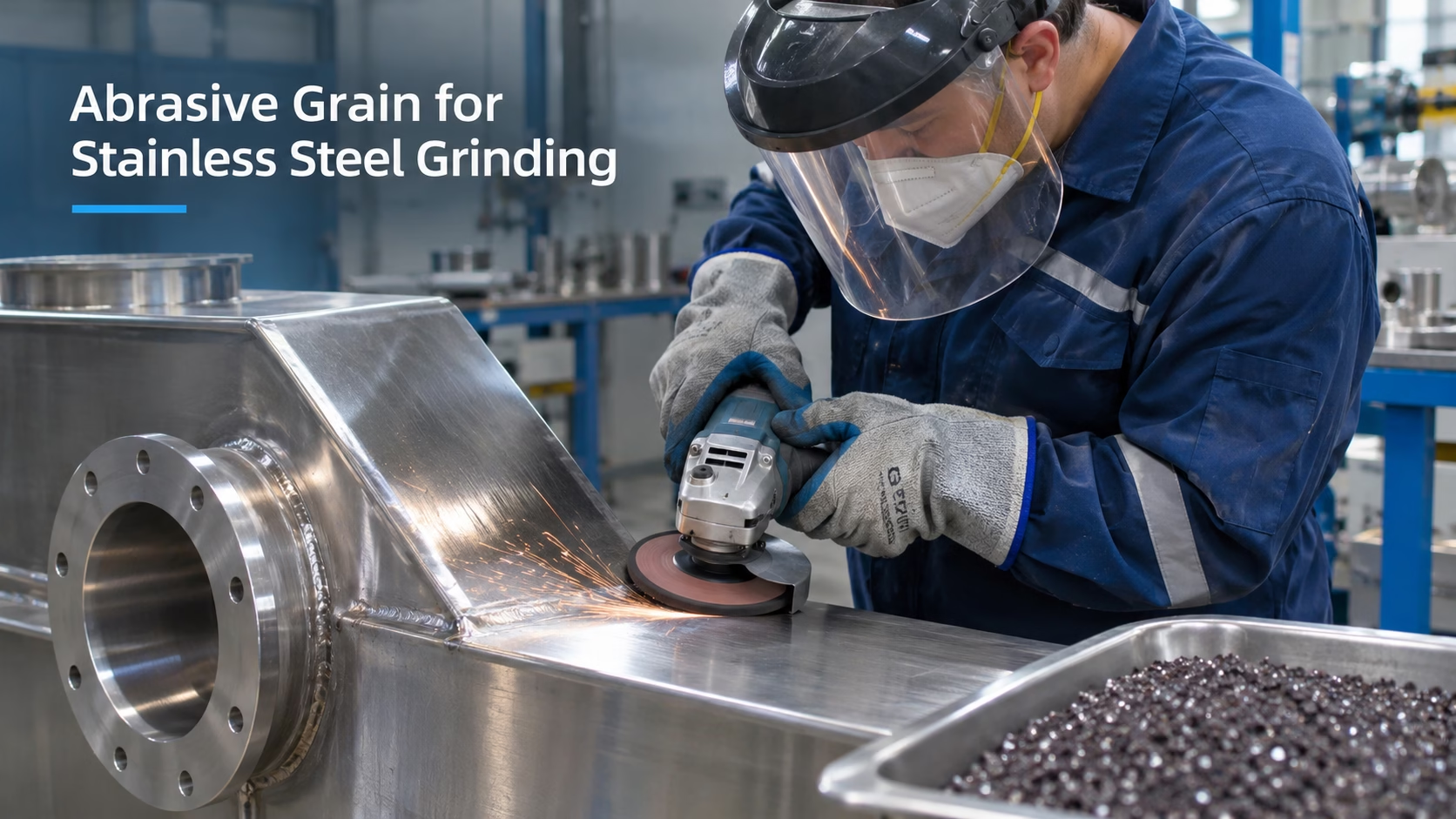
1. Why Stainless Steel Requires Special Abrasive Selection
Stainless steel offers excellent corrosion resistance, strength, and durability, making it a common material in food processing equipment, chemical plants, construction, automotive manufacturing, and industrial machinery. However, its properties also create specific challenges during grinding and surface finishing.
Understanding Stainless Steel Grinding Characteristics
One important characteristic of stainless steel is its protective passive film, which consists primarily of chromium oxide. This thin surface layer helps the material resist corrosion, but unsuitable grinding practices can damage the surface or introduce contaminants that affect its performance.
Different stainless steel grades also behave differently during machining. Austenitic grades such as 304 and 316 can work-harden under certain processing conditions. If an abrasive rubs against the surface instead of cutting efficiently, operators may experience additional heat, surface damage, and reduced productivity.
Other important considerations include:
- Heat generation: Excessive grinding heat can cause surface discoloration and increase rework.
- Work hardening: Some stainless steel grades become harder in areas that experience excessive deformation during processing.
- Abrasive loading: Removed metal can accumulate between abrasive grains and reduce cutting efficiency.
- Surface contamination: Foreign iron particles can compromise the corrosion resistance of stainless steel.
- Surface finish: Different applications require different levels of smoothness, scratch consistency, and visual appearance.
Why Abrasive Compatibility Matters
When grinding stainless steel, I recommend paying particular attention to abrasive compatibility and contamination control. Tools previously used on carbon steel can transfer iron particles to stainless steel surfaces. These particles may eventually rust and create localized corrosion problems.
The American Welding Society’s guide to cutting and grinding stainless steel with bonded abrasives explains why manufacturers should select suitable low-contamination abrasive products and avoid cross-contamination between carbon steel and stainless steel.
For high-quality stainless steel components, the abrasive grain, bonding materials, complete tool construction, and workshop handling procedures all deserve attention.
2. Common Types of Abrasive Grains for Stainless Steel Grinding
Different abrasive materials offer different combinations of hardness, toughness, cutting ability, and fracture behavior. Understanding these differences helps manufacturers choose suitable abrasive grains for their grinding operations.
| Abrasive grain | Main characteristics | Typical applications |
|---|---|---|
| Brown fused alumina | Tough, durable, and versatile | General industrial grinding |
| White fused alumina | High purity and sharp cutting characteristics | Selected precision grinding and finishing |
| Zirconia alumina | High toughness and good performance under heavy loads | Heavy-duty stainless steel grinding and weld removal |
| Ceramic alumina | Engineered grain structure and controlled self-sharpening behavior | High-performance stainless steel grinding |
| Silicon carbide | Very hard, sharp, and relatively brittle | Selected specialized finishing applications |
These materials do not perform identically. Manufacturers should evaluate the complete abrasive-tool formulation, workpiece, and operating conditions before selecting a grain.
Aluminum Oxide Abrasive Grain
Aluminum oxide is one of the most widely used abrasive materials in industrial grinding. Its combination of hardness, toughness, and versatility makes it suitable for many metalworking applications.
Two important varieties include brown fused alumina (BFA) and white fused alumina (WFA).
Brown fused alumina offers a practical balance between toughness, cutting performance, and cost. Manufacturers use it in grinding wheels, coated abrasives, blasting media, and other industrial abrasive products.
YUMO supplies Brown Fused Alumina Abrasive Materials in different grain sizes for industrial applications. When evaluating BFA for stainless steel grinding, buyers should confirm the grain specification and ensure that the complete abrasive tool meets the required contamination limits.
White fused alumina comes from high-purity alumina and offers high hardness, chemical stability, and relatively friable grain characteristics. Manufacturers may consider WFA for selected precision grinding and finishing formulations where material purity and particle-size consistency matter.
You can explore YUMO’s White Fused Alumina Abrasive Products for available grain and powder specifications.
One important distinction: high-purity white fused alumina does not automatically make a finished grinding wheel suitable for stainless steel. The bond, fillers, manufacturing process, and final chemical requirements also determine contamination performance.
Zirconia Alumina and Ceramic Alumina
Zirconia alumina and ceramic alumina deserve particular attention in demanding stainless steel grinding operations.
Zirconia alumina combines toughness with controlled grain breakdown, making it a suitable candidate for heavy material removal, weld grinding, and demanding metalworking conditions.
Ceramic alumina uses an engineered grain structure that supports controlled fracture and self-sharpening behavior. As the grain gradually fractures, it exposes fresh cutting edges and helps maintain cutting performance. This characteristic makes ceramic abrasive products attractive for high-performance stainless steel grinding.
According to the American Welding Society, ceramic grains can help operators maintain cutting performance with lighter or medium pressure, reducing the risk of excessive heat buildup when operators use the correct abrasive product and technique.
These engineered abrasive grains are not part of every standard alumina product range, so buyers should distinguish between conventional fused alumina and ceramic abrasive technology when comparing suppliers.
Silicon Carbide for Specialized Finishing
Silicon carbide (SiC) is a hard synthetic abrasive with sharp cutting characteristics. Compared with conventional aluminum oxide, it generally offers greater hardness but lower toughness.
Manufacturers commonly use silicon carbide for glass, ceramics, stone, and non-ferrous metal processing. It can also support selected specialized finishing applications involving metal components.
However, I would not automatically recommend silicon carbide as the first choice for heavy stainless steel grinding. Aluminum oxide, zirconia alumina, and ceramic alumina generally offer more relevant options for many conventional stainless steel grinding operations.
YUMO provides Silicon Carbide Abrasive Materials in different industrial grades for customers who require specialized abrasive materials.
3. How to Choose Abrasive Grain for Different Stainless Steel Applications
The best abrasive grain depends on the operation rather than the stainless steel material alone. I recommend starting with the actual manufacturing task and identifying the required balance between material removal, heat control, and surface appearance.
Stainless Steel Weld Grinding
Weld grinding requires effective material removal without unnecessarily damaging the surrounding base metal. Manufacturers commonly use grinding wheels, flap discs, and abrasive belts to remove excess weld material and blend transitions.
Zirconia alumina and ceramic alumina are worth considering for demanding weld-grinding operations because of their cutting characteristics and performance under mechanical loading.
Operators should avoid excessive pressure and prolonged contact in one location. Consistent movement helps control heat and reduces the risk of surface discoloration.
Stainless Steel Stock Removal and Grinding
Manufacturers use stainless steel grinding to remove machining marks, correct surface irregularities, and prepare components for subsequent processing.
For heavy stock removal, zirconia alumina and ceramic alumina may offer suitable solutions when manufacturers match the grain to the abrasive tool and machine conditions. Aluminum oxide can also provide a practical option for general grinding applications.
The selection should consider the stainless steel grade, component thickness, machine power, abrasive-tool construction, and required removal rate.
Stainless Steel Surface Blending and Satin Finishing
Surface blending and satin finishing focus more on appearance and scratch consistency than aggressive material removal.
In these operations, manufacturers often move through several abrasive stages, starting with material removal and gradually refining the surface. Consistent grain size, suitable backing flexibility, and controlled operating pressure help produce a more uniform finish.
The abrasive sequence should match the original surface condition and the required final appearance. A finer grain cannot always remove deep scratches left by an unsuitable earlier grinding stage.
Grinding Different Stainless Steel Grades
Stainless steel grades have different mechanical and processing characteristics, so manufacturers should consider the exact material before selecting abrasive grains.
- Austenitic stainless steel: Grades 304 and 316 often require careful heat management and attention to work hardening.
- Ferritic stainless steel: Grades such as 430 require selection according to their hardness, surface condition, and processing requirements.
- Martensitic stainless steel: Heat-treatment condition and material hardness influence abrasive selection and grinding conditions.
- Duplex stainless steel: Its specific mechanical properties and manufacturing requirements call for appropriate tool selection and process control.
The stainless steel grade provides an important starting point, but the actual grinding conditions determine the final abrasive choice.
4. How Abrasive Grain Size Affects Stainless Steel Grinding
Abrasive grain size directly influences material removal and surface texture. Coarse grains generally provide more aggressive cutting action, while finer grains help manufacturers achieve more controlled surface refinement.
Coarse, Medium, and Fine Abrasive Grains
| Grain category | General cutting behavior | Typical application |
|---|---|---|
| Coarse | Aggressive material removal | Heavy weld grinding |
| Medium | Balanced cutting and finishing | Weld blending and stock removal |
| Fine | Controlled surface refinement | Stainless steel surface finishing |
| Very fine | Specialized finishing | Fine surface refinement |
This table provides a general application guide rather than a universal particle-size conversion chart. The exact grit specification depends on the abrasive product and applicable grading standard.
Understanding FEPA F-Grit and Micron Sizes
When purchasing abrasive grains for stainless steel grinding, buyers should distinguish between different particle-size grading systems.
FEPA uses F-grit designations for bonded abrasives, including grinding-wheel grains, and P-grit designations for coated abrasives such as sanding belts and abrasive sheets.
For example, a manufacturer producing bonded grinding wheels may specify an F-grade, while a coated abrasive manufacturer may request a P-grade. Buyers should never assume that F80 and P80 represent identical particle-size distributions.
The FEPA official abrasive standards explain these classifications and the particle-size control principles behind them.
Microns provide another way to describe particle size, especially for fine abrasive powders. However, a nominal micron value does not necessarily describe the complete particle-size distribution.
How Grain Size Influences Surface Roughness
Coarse abrasive grains generally create deeper surface marks and remove material more aggressively. Fine abrasive grains produce shallower scratches and help refine the surface during later processing stages.
However, grain size alone cannot determine the final Ra or Rz value. Abrasive shape, grinding pressure, machine speed, contact area, workpiece properties, and finishing sequence all influence surface roughness.
For demanding stainless steel applications, I recommend defining the required surface finish first and then validating the abrasive sequence through actual production testing.
For more information about particle-size classification, see our guide to Abrasive Grain Sizes Explained: FEPA, ANSI and JIS.
5. How to Control Heat, Contamination and Grinding Quality
Choosing the correct abrasive grain is only part of the solution. Manufacturers also need to control operating conditions, tool cleanliness, and surface quality throughout the grinding process.
Preventing Heat Discoloration
Excessive grinding heat can cause visible discoloration on stainless steel. It can also create additional finishing work and affect the condition of the surface.
To reduce heat buildup, I recommend:
- Selecting abrasive products designed for stainless steel.
- Using appropriate grinding pressure instead of forcing the tool against the workpiece.
- Maintaining continuous, smooth movements.
- Avoiding prolonged grinding in one location.
- Choosing suitable equipment speed and cooling methods where necessary.
The AWS stainless steel grinding guidance also highlights the importance of fluid movements, appropriate pressure, and abrasive products that maintain cutting efficiency.
Preventing Cross-Contamination
Cross-contamination is one of the most important quality risks in stainless steel fabrication.
When workers use a grinding wheel or abrasive tool on carbon steel, iron particles can remain on its surface. Reusing that tool on stainless steel may transfer those particles and create rust-related problems.
I recommend maintaining separate tools and storage areas for stainless steel and carbon steel operations. Manufacturers should also use clean, dedicated grinding accessories and avoid placing stainless steel components on contaminated work surfaces.
The term INOX commonly identifies finished bonded abrasive products designed for stainless steel applications. AWS explains that these products typically contain very low levels of iron, sulfur, and chlorine. Buyers should confirm the complete product’s chemical requirements rather than assume that an individual abrasive grain automatically meets an INOX specification.
For additional technical guidance, the Cedinox guide to post-fabrication surface treatment of stainless steels discusses surface contamination, grinding, polishing, and the importance of maintaining stainless steel’s protective passive layer.
Maintaining Consistent Surface Quality
Consistent surface quality requires more than a suitable abrasive material. Manufacturers should also monitor grain distribution, tool condition, grinding pressure, and the appearance of the finished component.
For critical applications, I recommend checking the surface after each important processing stage. This helps operators identify deep scratches, heat discoloration, or contamination before they move to the next finishing operation.
6. How to Select and Buy Abrasive Grain for Stainless Steel Grinding
A clear purchasing specification helps manufacturers compare suppliers and obtain abrasive materials that match their production requirements.
Define Your Grinding Requirements
Before requesting a quotation, I recommend confirming the following information:
| Specification | Buyer requirements |
|---|---|
| Stainless steel grade | 304, 316, 430, duplex, or other grades |
| Abrasive material | Aluminum oxide, zirconia alumina, ceramic alumina, or SiC |
| Grain size | Required FEPA F-grit or other specified grade |
| Application | Grinding, weld removal, blending, or fine finishing |
| Surface requirements | Roughness, appearance, and contamination limits |
| Equipment | Grinding wheel, belt, disc, or other abrasive tool |
| Quantity | Trial order or regular production volume |
| Packaging | Standard or customized packaging |
Common Purchasing Mistakes
One common mistake is comparing abrasive suppliers only by price per kilogram. A cheaper abrasive may require more frequent replacement or create inconsistent grinding results. I recommend evaluating the total cost of achieving the required surface quality rather than focusing only on the purchase price.
Another mistake is selecting abrasive grain based entirely on hardness. Toughness, fracture behavior, particle distribution, and compatibility with the complete abrasive tool also influence performance.
Finally, buyers sometimes overlook contamination requirements. A high-purity raw material does not automatically guarantee that the finished grinding wheel or disc meets stainless steel processing requirements.
Before placing a bulk order, request technical specifications, confirm the applicable grain-size standard, and test samples under representative production conditions.
Final Thoughts: Choosing the Right Abrasive Grain for Stainless Steel Grinding
Choosing the right abrasive grain for stainless steel grinding requires a clear understanding of the workpiece, grinding operation, particle-size requirements, and surface-quality expectations.
Ceramic alumina and zirconia alumina offer valuable options for demanding grinding operations, while brown fused alumina and white fused alumina serve different industrial abrasive requirements. Silicon carbide also supports selected specialized finishing applications. The important point is to match the material to the actual process instead of choosing an abrasive based on hardness or price alone.
Heat management, contamination control, and consistent particle-size specifications deserve equal attention. When manufacturers consider these factors together, they can make better purchasing decisions and achieve more predictable finishing results.
Need Abrasive Grain for Stainless Steel Grinding? YUMO Can Help
At YUMO, we supply brown fused alumina, white fused alumina, and silicon carbide in different abrasive grades for industrial applications. Our product range includes coarse abrasive grains, standard grit sizes, and fine powders for different manufacturing requirements.
If you manufacture grinding wheels, coated abrasives, or other industrial abrasive products, our team can discuss your required material, grain size, grading standard, chemical specifications, packaging, and estimated quantity.
We understand that every manufacturing process has different technical requirements. Rather than recommending a material based only on its name, we encourage buyers to share their actual application and product specifications so we can help identify a suitable abrasive grade.
Contact YUMO to discuss your stainless steel grinding abrasive requirements and request product specifications or a quotation.
Frequently Asked Questions About Abrasive Grain for Stainless Steel Grinding
What Is the Best Abrasive Grain for Stainless Steel Grinding?
Ceramic alumina and zirconia alumina are strong candidates for demanding stainless steel grinding, particularly heavy stock removal and weld grinding. Aluminum oxide also offers a versatile option for general applications. The best choice depends on the workpiece, grinding conditions, and required surface finish.
Is Aluminum Oxide Suitable for Stainless Steel Grinding?
Yes. Aluminum oxide can support many stainless steel grinding applications. Manufacturers should select an appropriate abrasive-tool formulation with suitable contamination controls, rather than judging compatibility from the grain material alone.
Is Zirconia Alumina Better Than Aluminum Oxide for Stainless Steel?
Zirconia alumina can offer advantages in demanding grinding operations that require toughness and sustained material removal. Aluminum oxide provides a versatile alternative for many general applications. Actual performance depends on grain quality, tool construction, operating pressure, and workpiece material.
What Grit Size Should I Use for Stainless Steel Grinding?
Coarse grains generally suit heavy material removal and weld grinding, while medium grains support blending and finer grains help refine the surface. Always confirm the applicable grading system and validate the finishing sequence against the required surface quality.
How Can I Prevent Contamination When Grinding Stainless Steel?
Use dedicated stainless steel grinding tools, keep carbon steel and stainless steel accessories separate, and maintain clean storage and handling areas. For critical applications, confirm the finished abrasive product’s iron, sulfur, and chlorine requirements with the manufacturer.


