
Abrasive Manufacturers Worldwide: Supplier Types and Buyer Guide
Searching for abrasive manufacturers worldwide produces a mixture of raw-material producers, abrasive-tool brands, converters, processors and distributors. A useful shortlist begins by separating these supplier types and matching their capabilities to the product and application you actually need.
This guide focuses on industrial abrasive materials and explains how international buyers can evaluate a global supplier base without treating a promotional list as a performance ranking.
Understand the Abrasive Supply Chain
An abrasive product may pass through several specialized businesses before it reaches the end user:
- Raw-material producer: makes fused alumina, silicon carbide or another abrasive mineral.
- Grain processor: crushes, shapes, purifies, grades or classifies abrasive particles.
- Formulated-product manufacturer: blends powders, slurries, compounds or refractory mixes.
- Abrasive-tool manufacturer: makes grinding wheels, belts, discs, papers or blasting products.
- Distributor or importer: holds local inventory and provides regional commercial support.
A company may perform several roles. Buyers should verify which stages are controlled directly and which are handled by partners.
Choose the Supplier Category by Application
Bonded and Coated Abrasives
Grinding-wheel and coated-abrasive manufacturers generally require controlled grain shape, size distribution, toughness or friability, surface treatment and bond compatibility. Repeat-lot behavior can be more important than a single high-purity number.
Blasting and Surface Preparation
Blasting users consider cutting speed, surface profile, breakdown rate, dust, recyclability and contamination risk. Media should be selected for the substrate and equipment, not only by nominal grit.
Lapping and Polishing
Fine-finishing applications depend on narrow particle-size distribution, oversize control, dispersion and surface-finish performance. A supplier with strong micron-powder classification may be more relevant than a large macrogrit producer.
Refractory and Ceramic Applications
Refractory buyers may prioritize chemistry, bulk density, particle packing, thermal behavior and reliable large-lot supply. The required grain is not always identical to abrasive-tool grade.
Common Abrasive Material Families
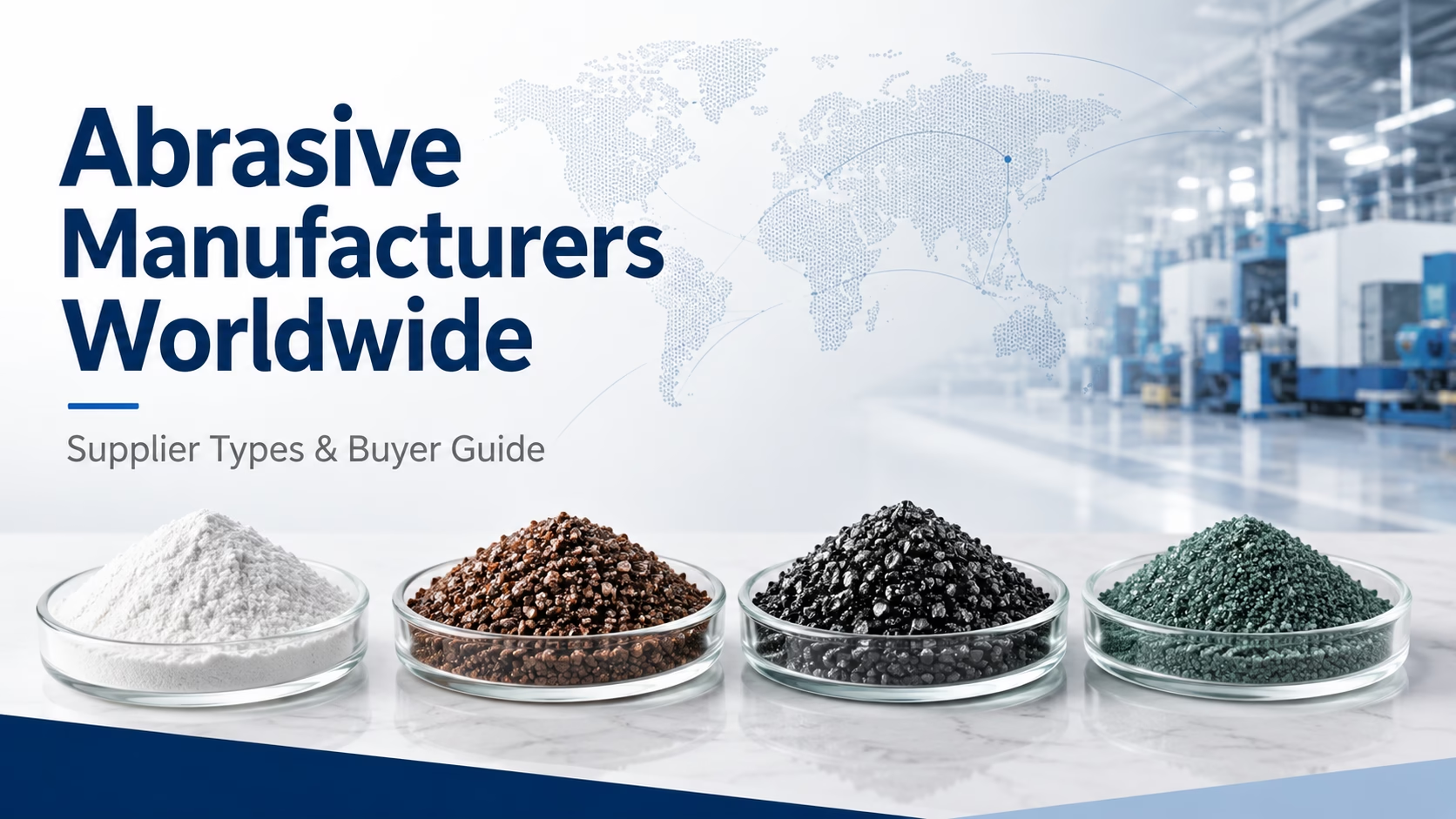
- Fused alumina: includes white, brown and other alumina grades used across grinding, blasting and refractory markets.
- Silicon carbide: black and green grades provide high hardness and sharp cutting behavior for abrasives, refractory and technical ceramic uses.
- Natural mineral abrasives: include garnet, emery and other mined materials whose properties depend on deposit and processing.
- Superabrasives: synthetic diamond and cubic boron nitride serve specialized high-performance grinding applications.
Each family has its own production economics, test methods and supplier structure. Do not compare companies from different categories as if they offer interchangeable products.
How Global Sourcing Regions Differ
Supplier capability varies more by company and plant than by country, but geography affects energy cost, raw-material access, specialization, local inventory, logistics and technical support.
- Asia: broad production and processing capacity across fused minerals, silicon carbide, abrasive tools and precision powders.
- Europe: established technical suppliers, specialty grains, engineered abrasive systems and regional distribution.
- North America: strong local distribution, application engineering, abrasive-tool manufacturing and specialty materials.
- Other regions: mineral-based products, local conversion, refractory supply and market-specific distribution networks.
A balanced sourcing strategy may combine an efficient primary producer with local safety stock or a regional distributor.
Build a Shortlist Based on Evidence
Instead of starting with a top-ten list, use evidence that relates to your order:
- relevant product range and routine size standards;
- documented chemistry and particle-size capability;
- application knowledge and technical communication;
- representative samples and repeat-lot consistency;
- traceability and retained-sample process;
- packaging appropriate for the transport route;
- realistic capacity and lead time;
- export documentation and after-sales response.
A Global Supplier Qualification Process
1. Write the Technical Specification
Define the material, application, size standard, chemistry, physical properties, test methods, packaging and acceptance limits. If the process is sensitive, include the approved reference sample or performance test.
2. Issue the Same RFQ to Every Candidate
Standardizing the inquiry prevents suppliers from quoting different grades under the same product name. Request clear exceptions when a supplier cannot meet a requirement.
3. Verify the Business and Production Role
Confirm the legal entity, production location, controlled process steps and subcontracted operations. A distributor can be valuable, but the buyer should know where the material is produced and tested.
4. Compare Samples in the Real Process
Laboratory data is necessary but may not predict cutting rate, finish, wheel behavior, dust or refractory performance. Use a controlled application trial and record the result.
5. Review Total Landed Cost
Include material, packaging, inland freight, ocean or air freight, duty, finance cost, inventory, inspection and risk of production disruption. The lowest unit price is not always the lowest operating cost.
6. Start with a Pilot Lot
Use a first commercial shipment to validate bulk quality, packaging, documents and delivery. Increase volume after more than one lot demonstrates consistency.
Single Sourcing vs Multiple Sourcing
A single strategic supplier simplifies specification control and communication. Multiple suppliers reduce continuity risk and can provide regional flexibility. The best model depends on annual volume, qualification cost, production criticality and storage capacity.
For critical products, approve a secondary source before a disruption occurs. Keep specifications and test methods consistent so material from different sources can be compared fairly.
Warning Signs in Online Supplier Lists
- Numbers imply a ranking but no scoring method is disclosed.
- The publisher includes itself without a conflict disclosure.
- Semiconductor SiC companies are mixed with industrial abrasive suppliers.
- Capacity, certification or purity claims have no source.
- Company descriptions are copied without checking current product scope.
A supplier list is a research starting point, not a substitute for qualification.
Questions for a Worldwide Supplier Search
- Which applications and products are routine for your plant?
- Which international or customer-specific size standards can you control?
- Which results are tested for every lot?
- Can you provide a representative sample and lot-specific COA?
- What is the normal lead time to our destination?
- How do you notify customers of process or raw-material changes?
- What local inventory or backup plan is available?
Include Yumo in Your Supplier Evaluation
Henan Yumo supplies fused alumina and silicon carbide materials for grinding, blasting, refractory, lapping and polishing applications. Buyers can compare Yumo using the same specification, sample and performance criteria described in this guide.
Contact Yumo with your application and specification. We can review the target grade, particle-size standard, sample requirements, packaging and delivery terms for your market.


