
When buyers ask me “What Is Abrasive Grain?」, 通常、議論は非常に迅速に、より現実的な質問に移ります。: what does the grit size actually mean? A material may be described as white fused alumina F80, brown fused alumina P120, 炭化ケイ素 #1000, or simply “80 grit,” but those descriptions are not always interchangeable.
This is where abrasive purchasing becomes more complicated than it first appears. A grit number is not simply a universal measurement like millimeters or inches. The meaning of that number depends on the grading standard, the abrasive product, and sometimes the method used to measure the particles.
産業用バイヤー向け, this distinction matters. Ordering the wrong abrasive grain size can change the cutting rate, grinding efficiency, surface roughness, blasting profile, polishing result, and even the performance of the finished abrasive product.
このガイドでは, I will explain abrasive grain sizes through the three systems I encounter most often in international business: 餌, ANSI, およびJIS. I will also explain why two products carrying the same grit number may not have exactly the same particle-size distribution, how F-grit and P-grit differ, and what information I recommend including in an abrasive grain RFQ.
If you are still comparing abrasive materials before selecting a size, our guide on how to choose abrasive grain for industrial applications provides a useful starting point.
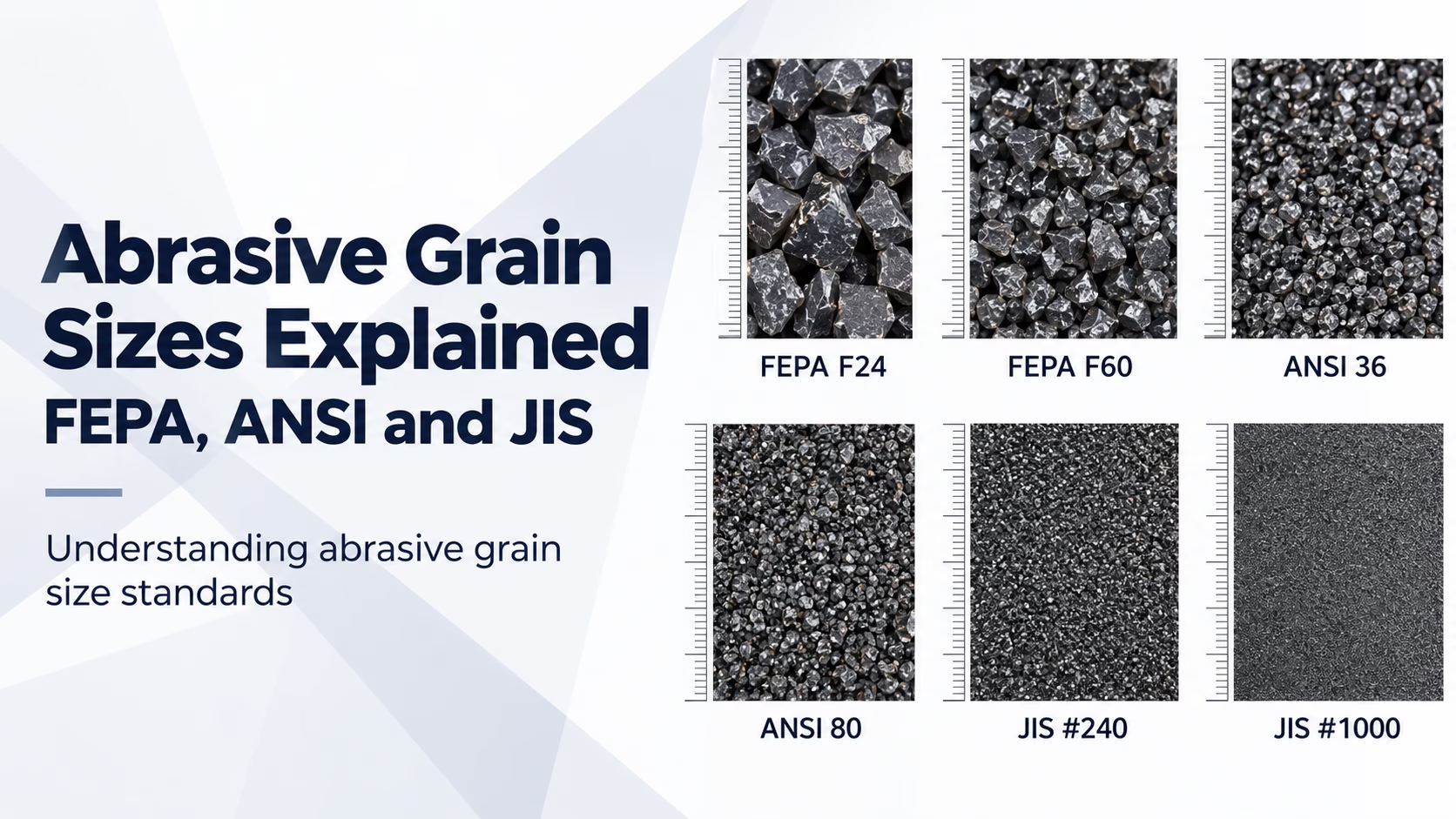
What Is Abrasive Grain Size?
Before comparing standards, it helps to clarify what we actually mean by abrasive grain size.
An abrasive grain is a hard particle used to grind, cut, blast, lap, polish, or modify another surface. Materials such as fused aluminum oxide and silicon carbide are manufactured, crushed, cleaned, and classified into controlled particle-size ranges.
The important word here is range.
When I see an abrasive specification such as F80, I do not interpret it as saying that every particle has exactly the same diameter. Industrial abrasive grades contain a controlled distribution of particles. The relevant standard determines how coarse particles, main particles, and finer particles are distributed within acceptable limits.
That difference is important for understanding 砥粒とは from a purchasing perspective. Buyers are not really purchasing one exact particle diameter; they are purchasing an abrasive grade produced to a defined particle-size distribution.
This is why a good supplier should be able to tell you not only the grit number but also the standard behind it.
Why Abrasive Grain Size Matters
Grain size has a direct effect on how an abrasive behaves against the workpiece. Coarse particles generally create deeper cuts and remove material quickly, while finer particles produce shallower scratches and a smoother finish.
In blasting, 例えば, larger abrasive particles can create a deeper surface profile. In grinding wheels, grain size affects stock removal, wheel behavior, and surface finish. In lapping and precision polishing, excessive coarse particles can create scratches that may be difficult to remove in later processing stages.
I therefore treat grit size as part of the process specification rather than simply a product label.
A useful general rule is:
| Grain Size | General Behavior | 代表的な用途 |
|---|---|---|
| Coarse | High removal rate, deeper cutting | Heavy grinding, 爆破, rough surface preparation |
| Medium | Balance between removal and finish | General grinding, deburring, 表面の準備 |
| 大丈夫 | Lower removal rate, smoother finish | Fine grinding and finishing |
| Microgrit | Controlled fine cutting | 精密研削, ラッピングと研磨 |
These categories are useful for understanding the application, but they should not replace the actual FEPA, ANSI, 彼, ISO, or customer-specific specification.
例えば, YUMO’s brown fused alumina abrasive-grade size range covers F-grit abrasive specifications used in grinding wheels, コーティングされた研磨材, 爆破, 研磨, and related industrial processes.
What Is the FEPA Abrasive Grain Standard?
FEPA stands for the 欧州研磨材生産者連盟. It is one of the most widely recognized abrasive grading references in Europe and international abrasive trade.
One of the most important things I explain to buyers is that FEPA uses different grit designations depending on the type of abrasive product.
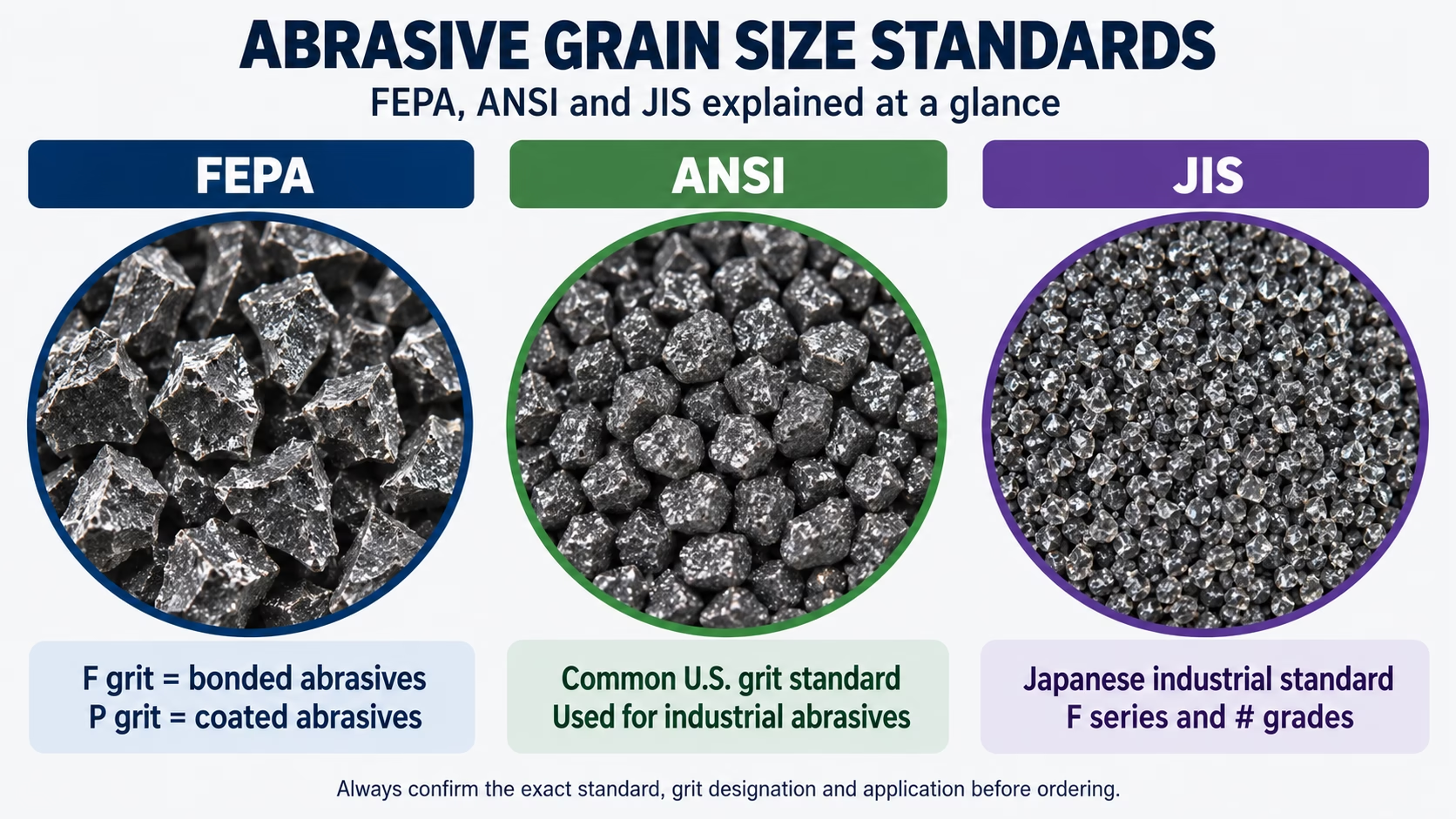
According to the official FEPA abrasive standards overview, F-grit sizes are associated with bonded abrasives, その間 P-grit sizes are associated with coated abrasives. FEPA also defines grit sizes as particle-size distributions rather than treating each number as one exact particle diameter. Fepa Abrasives
This gives us two important families.
FEPA F-Grit
F-grits are normally associated with bonded abrasive products such as grinding wheels, sharpening stones, grinding segments, and other bonded abrasive tools.
FEPA lists macrogrits from F4 to F220 and microgrits extending from F230 to F2000 for bonded abrasive grains. Fepa Abrasives
Typical designations include:
- F24
F36
F46
F60
F80
F120
F220
F320
F600
F1000
As the number increases, the abrasive generally becomes finer.
A coarse F24 grain, 例えば, is intended for a very different cutting condition from F220 or F600. The correct specification depends on the abrasive tool, workpiece, bond system, grinding pressure, and required finish.
FEPA P-Grit
P-grits are used primarily for coated abrasives such as sandpaper, sanding belts, abrasive cloth, flap discs, and coated abrasive sheets.
Common specifications include P40, P60, P80, P120, P180, P240, P400, and finer grades.
Current FEPA grain ranges include coated-abrasive macrogrits from P12 to P220, with finer P-grits extending from P240 to P5000. Fepa Abrasives
This leads to one of the most common specification mistakes I see:
F80 and P80 should not automatically be treated as the same abrasive specification.
The number looks identical, but F and P are different grading systems developed for different abrasive product categories. Their particle distributions and control requirements are not necessarily identical.
If a customer sends me only “80 grit,” my next question is therefore usually: F80, P80, ANSI 80, 彼, or another standard?
FEPA F-Grit vs P-Grit
For industrial purchasing, this distinction is worth remembering.
| 仕様 | Mainly Used For | Typical Example |
|---|---|---|
| FEPA F | Bonded abrasives | F24, F80, F220, F400 |
| FEPA P | コーティング研磨材 | P40, P80, P120, P400 |
| Coarse grades | Faster cutting and removal | 研削, 爆破 |
| Fine grades | Finer surface finishing | 微研削, 研磨 |
A buyer producing grinding wheels may specify white fused alumina F80, while a manufacturer producing abrasive belts may request P80.
These are not simply different ways of writing the same order.
This distinction is particularly relevant for materials such as white fused alumina. Our guide to white fused alumina uses and grade selection explains how F-grits, P-グリット, マイクログリット, and refractory sizes are used for different applications.
What Is the ANSI Abrasive Grain Standard?
ANSI refers to the American National Standards Institute, although abrasive specifications in the United States are closely associated with standards developed through the Unified Abrasives Manufacturers’ Association, or UAMA.
For abrasive grains used in grinding wheels, 研磨, pressure blasting, and general industrial applications, an important U.S. reference is ANSI/UAMA B74.12.
The current UAMA publication list identifies B74.12-2018 as the American National Standard specification for the size of abrasive grain used in grinding wheels, 研磨, and general industrial applications. UAMA
You can review the relevant standards through the UAMA publications directory.
ANSI/UAMA specifications define more than the name of a grit. They provide requirements relating to grit designations, size limits, sieves, and testing procedures. Accuristech Store
In North American purchasing, I sometimes receive orders written simply as:
Aluminum Oxide – 80 Grit ANSI
That is already better than “80 grit,” but for production I still prefer the customer to identify the exact standard if the particle distribution is critical.
This becomes especially important when the material will be incorporated into another manufactured product rather than used only as general-purpose blasting media.
Is ANSI Grit the Same as FEPA Grit?
Not necessarily.
This is probably the most important answer in the entire article.
Abrasive grit numbers from different standards should not be converted simply by matching the number.
例えば, a buyer may see 80, 120, 240, または 400 in several abrasive charts and assume the materials are equivalent. In reality, 餌, ANSI/UAMA, and JIS can define their distributions differently.
The difference becomes particularly important as the abrasive becomes finer.
For rough industrial processes, small differences may sometimes be manageable after production testing. In precision finishing, ラッピング, 研磨, optical processing, or technical ceramics, しかし, a relatively small change in particle distribution can noticeably affect the surface.
When exact performance matters, I prefer to compare the actual particle-size distribution or test specification rather than relying on a generic online “grit conversion chart.”
What Is the JIS Abrasive Grain Standard?
JIS refers to the Japanese Industrial Standards system.
For abrasive grain used in bonded abrasives, an important current reference is the JIS R 6001 series.
The Japanese Standards Association currently lists JIS R 6001-1:2017 for macrogrits and JIS R 6001-2:2017 for microgrits. JIS R 6001-1 covers artificial abrasive macrogrits from F4 to F220, while JIS R 6001-2 covers microgrits including F230 to F2000 and precision microgrits from #240 に #8000. 日本規格協会 JSA GROUP Webdesk
This is an important detail because many buyers assume that JIS abrasive specifications always use a “#” designation. In reality, current JIS standards also include F-series abrasive grain classifications.
Another point worth noting is that JIS R 6001-2 specifically defines its scope for bonded abrasive microgrits; the standard itself states limitations concerning coated abrasives and loose abrasive applications. 日本規格協会 JSA GROUP Webdesk
So, once again, the application matters.
If a Japanese customer sends a specification such as #1000, I do not automatically translate that into FEPA F1000, FEPA P1000, or ANSI 1000. I first confirm which JIS specification or customer standard is being referenced.
FEPA vs ANSI vs JIS: What Is the Main Difference?
The easiest way I explain the three systems is that they are different frameworks for controlling abrasive particle-size distribution.
| 標準 | Common Designations | Typical Market / 応用 | Important Point |
|---|---|---|---|
| FEPA F | F24, F80, F220, F400 | Bonded abrasives | F and P are different systems |
| FEPA P | P40, P80, P240, P1000 | コーティング研磨材 | Used for sanding and coated products |
| ANSI/UAMA | 24, 80, 120, 等. | U.S. industrial abrasives | Confirm the exact B74 standard |
| 彼 | F-series and # series | Japanese industrial applications | Fine JIS grades can differ substantially from other systems |
| Micron | µm | Precision powders | More direct size information, but distribution still matters |
This is why I do not recommend telling a supplier only:
“I need 400 grit.”
A better specification would identify the material, standard, size, and application.
Why Grit Conversion Charts Can Be Misleading
Search for “abrasive grit size chart” online and you will find many tables converting FEPA, ANSI, 彼, メッシュ, and micron values.
These charts can be useful as a rough reference, but I would not use them alone to approve industrial material.
The reason is simple: abrasive standards describe distributions, while many conversion charts reduce each grade to one representative micron value.
Imagine two abrasive grades that have similar median particle sizes but different limits on oversized particles. In a rough blasting operation, the difference may be relatively minor. In precision polishing, those oversized particles might create scratches.
That is why I pay close attention to terms such as particle-size distribution, median size, coarse-particle limit, maximum particle size, and test method when evaluating fine abrasive powders.
For buyers working with fused aluminum oxide products, YUMO’s fused alumina product range includes coarse grain, standard abrasive grit, 粉, and micro-powder specifications for different industrial applications.
Macrogrit vs Microgrit
Another important distinction is the difference between macrogrits and microgrits.
Macrogrits are relatively coarse abrasive particles that can usually be classified using controlled sieving methods. They are commonly used in grinding, 爆破, bonded abrasive tools, コーティングされた研磨材, and general surface preparation.
Microgrits are finer particles. As the grain becomes smaller, conventional sieving becomes less suitable, and other measurement or classification methods become important.
FEPA itself notes that macrogrit and microgrit particle-size distributions are handled differently within its grain standards. Fepa Abrasives
For the buyer, this means that a supplier’s classification equipment becomes increasingly important as particle size decreases.
Producing a reasonable F36 blasting grit is a different classification challenge from producing a tightly controlled fine powder for precision polishing.
Does the Abrasive Material Change the Grit Size?
The abrasive material and grit size are two separate parts of the specification.
例えば:
White fused alumina F80 and black silicon carbide F80 may use the same nominal grading system, but they will not perform the same way because their hardness, 靭性, fracture behavior, 化学, and grain shape differ.
Likewise, brown fused alumina P120 and white fused alumina P120 may have comparable grading requirements but very different cutting characteristics.
This is why I normally build an abrasive specification in this order:
| Specification Item | 例 |
|---|---|
| Abrasive Material | 白い融合アルミナ |
| 標準 | 餌 |
| Grain System | Fグリット |
| サイズ | F80 |
| 応用 | Bonded Grinding Wheel |
| Required Chemistry | Customer specification |
| 包装 | 25 kg袋 |
| 量 | 5 MT |
The grit number should never replace the material specification.
The same principle applies to silicon carbide abrasive materials, where black and green silicon carbide can be supplied in different abrasive sizes according to grinding, 爆破, ラッピング, 研磨, and refractory requirements.
How I Read an Abrasive Grain Specification
When I receive an RFQ, I normally look for four pieces of information first: material, standard, size, and application.
Consider these two requests:
白色電融アルミナ, 80 グリット.
そして:
White fused alumina F80, FEPA grading, for vitrified bonded abrasive production.
The second request gives the supplier far more useful information.
Likewise:
茶色の融合アルミナ, 120 グリット.
leaves questions unanswered.
A stronger industrial specification would be:
Brown fused alumina P120, FEPA coated-abrasive grade, for abrasive belt manufacturing.
The more demanding the final process, the more important this becomes.
For precision applications I would also ask whether the customer requires a particle-size report, maximum coarse-particle limit, chemical analysis, magnetic-content control, bulk-density range, or a sample for production testing.
Which Abrasive Grain Size Should I Choose?
I do not choose grit size from the workpiece material alone.
Instead, I begin with the required processing result.
If the objective is aggressive stock removal or heavy blasting, coarse abrasive grains are usually the logical starting point. If the goal is controlled grinding or surface preparation, a medium-size abrasive may offer a better balance between productivity and finish.
For fine grinding and polishing, the specification normally moves toward finer grains or microgrits. At this stage, particle distribution becomes increasingly important.
The equipment must also be considered. 噴射圧力, nozzle size, grinding wheel bond, sanding backing, wheel speed, polishing slurry, and contact pressure can all influence how a particular grain performs.
The correct question is therefore not simply:
“What grit is best?」
A better question is:
“Which abrasive material, grading standard, and particle-size distribution will produce the required result in my process?」
Common Abrasive Grain Specification Mistakes
The most common mistake I see is ordering by grit number alone. “120 grit” looks specific, but it may not be specific enough for an international supplier.
The second mistake is assuming F120 equals P120 because both contain the number 120. FEPA uses the two designations for different abrasive product systems.
A third mistake is converting FEPA, ANSI, and JIS purely through an online chart without checking the underlying particle distribution.
Another common issue is confusing mesh size with abrasive grit size. Mesh numbers originate from sieve openings and should not automatically be treated as interchangeable with FEPA, ANSI, or JIS abrasive designations, particularly in finer grades.
Finally, buyers sometimes specify an extremely fine abrasive simply because they want a smooth finish. Finer is not always better. An unnecessarily fine grain may reduce the material-removal rate, increase processing time, and raise the total cost without producing a meaningful improvement in the finished surface.
最終的な考え
When buyers first ask 砥粒とは, the answer seems straightforward: it is a hard particle used for cutting, 研削, 爆破, ラッピング, or polishing. Once we move into actual industrial purchasing, しかし, the specification becomes much more important.
A grit number by itself does not tell the complete story.
FEPA F, FEPA P, ANSI/UAMA, and JIS specifications should not automatically be treated as interchangeable. Each system defines how abrasive particles are classified and controlled for particular applications.
For general applications, an approximate comparison may be enough to begin sample testing. For grinding-wheel production, コーティングされた研磨材, precision finishing, セラミックス, ラッピング, or polishing, I recommend confirming the exact grading standard before placing a bulk order.
When possible, include the abrasive material, standard, size designation, 応用, 化学, and any special particle-size requirements in the RFQ. That small amount of additional information can prevent a surprisingly large number of purchasing and production problems.
Need FEPA, ANSI or JIS Abrasive Grain? YUMO Can Support Your Requirements
If your project requires abrasive grain according to 餌, ANSI, 彼, micron, or customer-specific particle-size requirements, YUMO can help you identify a suitable material and grading specification based on your actual process.
We supply 白い融合アルミナ, 茶色の融合アルミナ, black fused alumina, 黒色炭化ケイ素, and green silicon carbide in coarse grains, standard abrasive grits, 微粉末, and micro-powder forms. Depending on the product and application, different F-grit, P-グリット, segmented-size, メッシュ, and fine-powder specifications can be discussed.
When customers contact us, I recommend sending the abrasive material, required grit size, grading standard, end application, expected quantity, and any technical requirements you already have. If the original specification is unclear—for example, an RFQ that only says “120 grit”—our team can discuss the application with you before confirming the appropriate grade.
For grinding wheels, コーティングされた研磨材, サンドブラスト, ラッピング, 研磨, 耐火物, テクニカルセラミックス, or other industrial uses, YUMO can support both standard abrasive grain sizes and customized grading requirements. Our goal is not simply to supply a grit number, but to help ensure that the abrasive material matches the particle-size specification and processing result you actually need.
Frequently Asked Questions About Abrasive Grain Sizes
What does F80 mean in abrasive grain?
F80 normally indicates an F-series abrasive grain size used within the FEPA bonded-abrasive grading system. It represents a controlled particle-size distribution rather than every particle having one exact diameter.
Are F80 and P80 the same?
いいえ. F80 and P80 should not automatically be considered equivalent. F-grits are primarily associated with bonded abrasives, while P-grits are used for coated abrasives, and their grading requirements differ.
Is ANSI grit the same as FEPA grit?
Not necessarily. ANSI/UAMA and FEPA specifications use different grading standards. Similar grit numbers may have different particle distributions, especially in finer sizes.
Is JIS #1000 the same as FEPA P1000?
It should not be assumed to be equivalent. JIS and FEPA use different standards and distribution requirements. For precision applications, always confirm the actual standard and particle-size specification before substitution.
What information should I send when requesting abrasive grain?
At minimum, I recommend giving the supplier the abrasive material, required standard, grit size, 応用, and quantity. For demanding applications, also provide chemical requirements, particle-distribution requirements, 梱包, and any customer-specific quality limits.


One Response