
Choosing the best abrasive grain for sandblasting is not as simple as buying the hardest material or selecting the lowest price per ton. A blasting abrasive has to match the substrate, the material you want to remove, the required surface profile, the blasting equipment and the condition you expect after the job is complete.
A coarse, angular abrasive can strip heavy scale quickly, but the same material may leave a profile that is too deep for a thin coating system. A clean, high-purity abrasive may make sense for stainless steel or aluminum, while using it for routine structural-steel cleaning may add unnecessary cost. Reusability also changes the economics. An abrasive that costs more per ton can still be less expensive per square meter if it lasts longer and reduces blasting time.
For industrial buyers, the better question is therefore not:
“What is the best sandblasting abrasive?”
It is:
“Which abrasive gives me the required cleaning level and surface profile at the lowest practical total processing cost?”
This guide compares the most common abrasive grain options for sandblasting, explains when white fused alumina, brown fused alumina and silicon carbide make sense, and shows what buyers should specify before requesting a quotation.
If you need a broader introduction to abrasive materials first, see our 砥粒とは? 種類, サイズ & アプリケーション guide. 砥粒とは? 種類, サイズ & アプリケーション.
What Makes a Good Abrasive Grain for Sandblasting?
An effective blasting abrasive must transfer enough energy to the surface to remove contamination or create the required profile without causing unnecessary damage, excessive dust or avoidable media consumption.
Five characteristics usually matter most.
硬度
Hard abrasive grains cut into the substrate and remove scale, coatings or surface material efficiently. Materials such as fused aluminum oxide and silicon carbide are very hard and can produce aggressive cutting action.
Hardness alone, however, does not determine blasting performance. A very hard but highly brittle abrasive may fracture quickly under high pressure, while a tougher material may survive more recycling cycles.
Grain Shape
Angular particles cut and create surface profile more aggressively than rounded media. This is why crushed aluminum oxide is commonly used when the goal is surface preparation rather than simply cosmetic cleaning.
Rounded media such as glass beads behave differently. Instead of cutting deeply into the surface, they tend to produce a more uniform satin or peened finish.
Toughness and Breakdown Rate
If you operate a blast cabinet or recycling system, grain durability becomes economically important. A material that breaks down rapidly creates fines and eventually needs to be replaced.
A tougher abrasive may cost more initially but provide better value if it can be recycled effectively. 一方で, friable grain can be useful when a continuously sharp cutting edge is required.
粒子サイズ
Particle size affects both cutting rate and the surface profile left behind. Coarse particles generally produce more aggressive removal and a deeper profile, while finer particles create a more controlled finish.
The relationship is not fixed, because air pressure, nozzle size, stand-off distance, blasting angle and media velocity all influence the actual result.
AMPP’s Surface Preparation standards work specifically covers abrasive media, surface cleanliness and the depth and density of surface profile, which is an important reminder that a blasting specification should define the required result rather than only naming the abrasive.
Purity and Contamination
For ordinary carbon steel, minor contamination from the blasting media may not be the primary concern. For stainless steel, aluminum, titanium or precision components, it can become much more important.
The lowest-cost abrasive is therefore not always the right abrasive. Buyers should consider what the grain may leave behind on the surface as well as how fast it cuts.
Which Abrasive Grain Is Best for Sandblasting?
There is no single winner for every application. The most useful comparison is to match each abrasive with the type of work it does best.
| Abrasive | Cutting Character | Reusability | Surface / Contamination Considerations | Best Fit |
|---|---|---|---|---|
| 白い融合アルミナ | Sharp, aggressive, relatively friable | Good in controlled recycling systems | 低鉄汚染, clean blasting | ステンレス鋼, aluminum, precision parts, clean surface preparation |
| 褐色電融アルミナ | Aggressive and tough | Very good | General industrial blasting | Carbon steel, rust, scale, コーティング, reusable blast systems |
| 黒色炭化ケイ素 | Extremely hard and sharp | Can fracture faster | Very aggressive cutting | Hard materials, セラミックス, ガラス, specialized blasting |
| Garnet | 角度のある, moderately aggressive | Often limited to several cycles depending on grade/process | Non-ferrous mineral media | Field blasting, coating removal, general surface preparation |
| Glass Beads | Mild, rounded | Reusable in cabinets | Smooth/satin finish rather than deep profile | Finishing, クリーニング, cosmetic treatment |
| Steel Grit | Tough, aggressive | Very high in closed systems | Ferrous media; not ideal where iron contamination is unacceptable | Carbon-steel blast rooms and high-volume recycling systems |
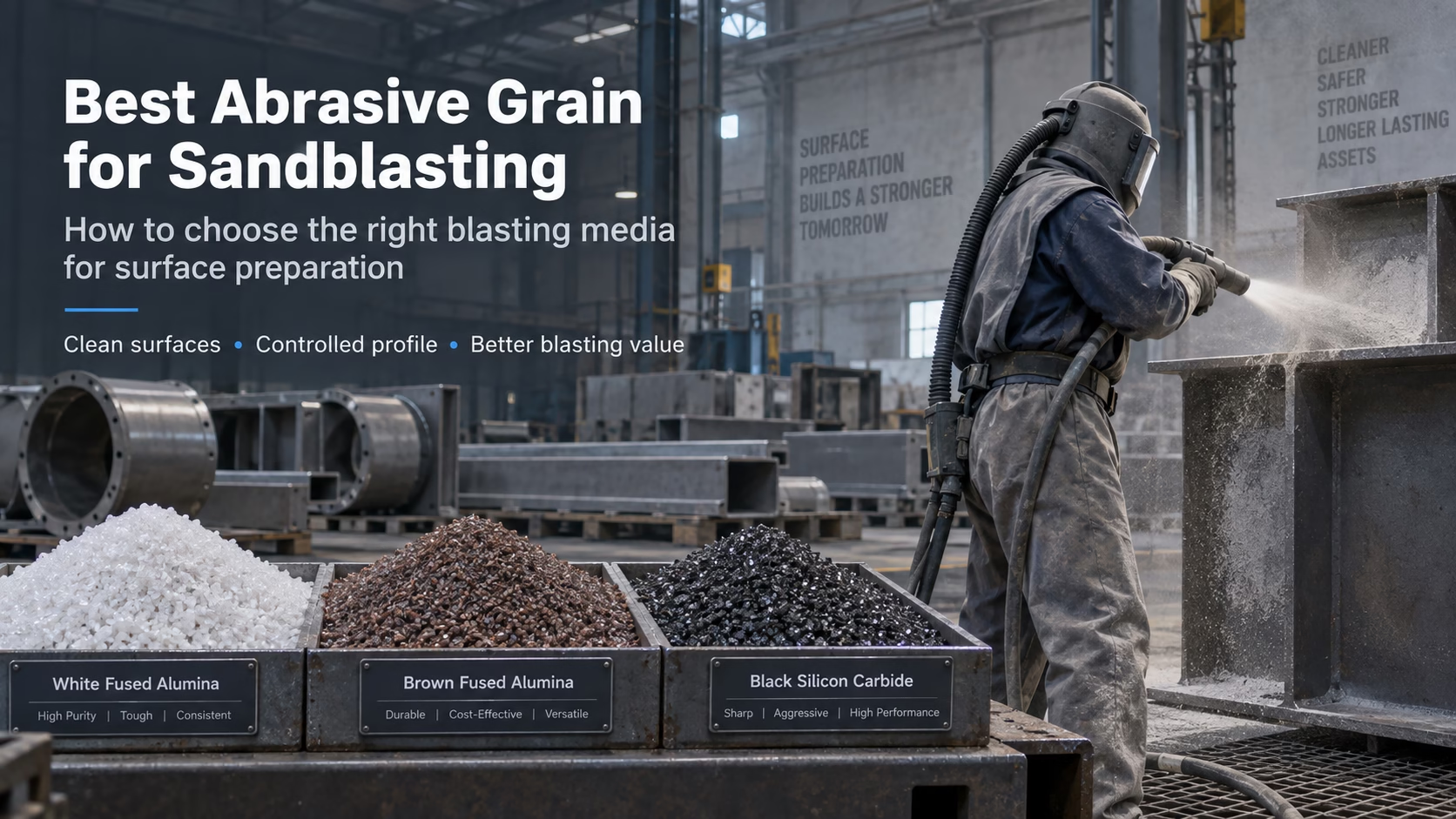
For Yumo’s main product range, 茶色の融合アルミナ, white fused alumina and silicon carbide cover three distinctly different purchasing needs rather than competing for exactly the same application.
1. 褐色電融アルミナ: Best for General Industrial Sandblasting
For many conventional industrial blasting jobs, brown fused alumina is one of the most practical places to start.
It is hard enough to remove rust, mill scale and coatings effectively but also relatively tough, which makes it suitable for applications where the abrasive is recovered and reused. Its angular particles create a distinct surface profile, making it useful for preparing metal before coating, bonding or other finishing operations.
代表的なアプリケーションには次のものがあります。:
- Carbon-steel surface preparation
- 錆取り
- Mill-scale removal
- Paint and coating removal
- バリ取り
- Cleaning castings
- General blast-cabinet work
The main advantage of brown fused alumina is balance. It offers strong cutting action without the higher purity cost associated with white fused alumina or the extreme hardness of silicon carbide.
Yumo’s 褐色電融アルミナ range includes abrasive grains intended for blasting and other abrasive applications. Brown Fused Alumina product range
For buyers processing ordinary carbon steel where iron contamination is not a critical issue, brown fused alumina will often make more economic sense than paying a premium for white fused alumina.
That does not mean every BFA grade performs the same. 粒形状, fines content, bulk density and particle distribution can materially change blasting behavior. A dense, well-classified blasting grain may flow and recycle very differently from a dusty product sold under the same nominal grit designation.
2. 白い融合アルミナ: Best for Clean and Controlled Blasting
White fused alumina becomes more attractive when surface cleanliness and contamination control are important.
It is produced from high-purity alumina and generally contains significantly less iron-bearing material than brown fused alumina. The grains are hard, sharp and relatively friable, giving WFA an aggressive but controlled cutting action.
代表的なアプリケーションには次のものがあります。:
- Stainless-steel blasting
- Aluminum components
- Titanium and specialty alloys
- Precision components
- Aerospace-related parts
- Decorative metal finishing
- Cleaning prior to specialized coatings
- Applications where iron contamination should be minimized
A buyer should not assume that every white abrasive is automatically suitable for contamination-sensitive work. 化学組成, magnetic material and processing cleanliness still need to be controlled.
Our 白色電融アルミナ 物性 guide explains how grain shape, purity, magnetic contamination and particle distribution affect abrasive performance. White Fused Alumina Properties technical guide
There is also a dedicated guide covering White Fused Alumina for Sandblasting, including how grit size and grain shape influence blasting behavior. White Fused Alumina for Sandblasting guide
For heavy structural-steel cleaning, WFA may not provide enough economic advantage to justify the higher material cost. For stainless or precision surfaces, however, that additional cost can be justified by reduced contamination risk and better process control.
3. 黒色炭化ケイ素: Best for Very Aggressive Cutting
Black silicon carbide sits at the more aggressive end of conventional blasting abrasives.
It is harder than fused alumina and has a very sharp grain structure. This makes it effective when the material being processed is hard, brittle or difficult to cut with conventional aluminum oxide.
Possible applications include:
- Glass processing
- セラミックス
- Stone
- Very hard coatings
- Carbide-related materials
- Specialized etching and surface treatment
- Rapid cutting where grain sharpness is important
The trade-off is brittleness. Silicon carbide tends to fracture more readily than tough brown fused alumina, so the purchasing decision should not be based only on hardness.
For ordinary steel rust removal, silicon carbide can simply be more abrasive—and more expensive—than necessary. Its value becomes clearer when the substrate itself is hard or the process benefits from extremely sharp cutting points.
Yumo’s 黒い炭化物の粒状砂 range includes graded silicon carbide for metal, ガラス, ceramics and other industrial processing applications. 黒い炭化物の粒状砂
A buyer moving from aluminum oxide to silicon carbide should run a production trial rather than assuming the harder grain will automatically reduce total cost.
White Fused Alumina vs Brown Fused Alumina for Sandblasting
This is one of the most useful comparisons for industrial buyers.
Both materials are aluminum oxide abrasives, both are hard and angular, and both can be used for surface preparation. Their purchasing logic is different.
Choose Brown Fused Alumina when:
The substrate is general carbon steel or another robust material, aggressive cleaning is required, recycling is important and there is no strict low-iron requirement.
BFA usually provides a strong balance between purchase price, toughness and cutting ability.
Choose White Fused Alumina when:
The workpiece is stainless steel, aluminum or another contamination-sensitive material, or when cleaner blasting and more controlled cutting are worth paying for.
The decision should be based on cost per finished part or treated area, not only cost per ton.
A WFA grade that costs more but prevents contamination or reduces rework may provide better economics than a cheaper general-purpose media.
Aluminum Oxide vs Silicon Carbide for Sandblasting
Another common buyer question is whether silicon carbide is better than aluminum oxide.
For most general industrial blasting, aluminum oxide is the more practical option. Brown fused alumina provides durability and aggressive cleaning, while white fused alumina provides a cleaner high-purity alternative.
Silicon carbide becomes more interesting when the workpiece is extremely hard or when maximum cutting sharpness is needed. Because SiC is more brittle, it may generate fines more rapidly under certain blasting conditions, which should be included in a recycling and consumption test.
The selection therefore looks more like this:
General steel blasting → Brown Fused Alumina
Clean / contamination-sensitive blasting → White Fused Alumina
Very hard or brittle workpiece → Silicon Carbide
That rule is useful for initial selection, but it should still be verified under actual production conditions.
What Grit Size Is Best for Sandblasting?
There is no universal grit size because the desired surface profile varies by application.
A useful purchasing framework is:
| Relative Size | Typical Result | Common Purchasing Objective |
|---|---|---|
| Coarse | High removal, deeper profile | Heavy rust, scale, thick coatings |
| Medium | Balanced cleaning and profile | General surface preparation |
| Fine | Controlled removal, finer finish | Precision parts, thin coatings, cosmetic work |
With fused alumina, suppliers commonly offer blasting grades using familiar grit designations such as 24, 36, 46, 60, 80, 100 そして 120.
One technical point deserves attention here. FEPA formally uses F-grit designations for bonded abrasives and P-grit designations for coated abrasives. FEPA also defines grit sizes as particle distributions rather than one exact particle diameter.
In the commercial blasting market, suppliers may still describe loose alumina media using familiar F-size terminology. For procurement purposes, do not rely only on the word “F60” or “80 grit.” Ask the supplier to state the actual grading standard and particle-size distribution being supplied.
For a detailed comparison of white aluminum oxide sizes, see our White Aluminium Oxide Grit Sizes Selection Guide. White Aluminium Oxide Grit Sizes Selection Guide
Match the Abrasive to the Substrate
The substrate should always come before the abrasive.
Carbon Steel
For general carbon-steel blasting, brown fused alumina is usually a logical starting point where a non-metallic reusable abrasive is desired.
The goal may be removing rust or scale before painting, but the required cleanliness level still needs to come from the coating or project specification.
AMPP maintains recognized surface preparation standards covering White Metal, Near-White Metal, Commercial and Industrial Blast Cleaning.
A buyer should therefore define both the abrasive and the required prepared surface.
Stainless Steel
Contamination control becomes more important on stainless steel.
White fused alumina is frequently considered because of its lower iron content compared with conventional brown fused alumina. If iron contamination limits are critical, specify actual Fe₂O₃ or magnetic-content requirements rather than relying solely on the phrase “white aluminum oxide.”
AMPP also maintains a specific brush-off blast-cleaning standard covering stainless steels, aluminum and other non-carbon-steel metallic substrates.
Aluminum
Aluminum is softer than steel, so overly aggressive media or excessive pressure can distort the surface or produce a profile deeper than required.
Fine or medium white fused alumina may be useful when a clean etched finish is needed. Glass beads may be preferable when the target is a uniform cosmetic finish rather than aggressive material removal.
Glass and Ceramics
These materials are hard but brittle.
Silicon carbide can provide very fast cutting and is worth considering for etching or aggressive processing. Aluminum oxide can still be used when less aggressive cutting is desired.
The process should always be tested on representative parts because blasting pressure and particle size can dramatically change the final appearance.
Surface Profile Matters as Much as Surface Cleanliness
A surface can look perfectly clean and still have the wrong profile for the coating that follows.
Protective coatings often rely on mechanical anchoring. If the abrasive creates too little profile, adhesion may suffer. If it creates an unnecessarily deep profile, additional coating may be required to cover the peaks properly.
AMPP specifically treats surface profile depth and density as part of surface-preparation quality, and its PA 17 procedure addresses verifying whether steel profile falls within a specified range.
This is why changing abrasive size without testing is risky.
The final profile is influenced by:
- Abrasive particle size
- Particle shape
- 硬度
- Air pressure
- Nozzle condition
- Nozzle distance
- Impact angle
- Media velocity
- Substrate hardness
When a coating supplier specifies a required profile range, start with that requirement and work backward toward abrasive selection.
Dry vs Wet Abrasive Blasting
The choice of abrasive also interacts with the blasting method.
Dry abrasive blasting provides strong cutting action and is widely used in controlled blast rooms, cabinets and field surface preparation. Its biggest operational challenge is dust.
Wet abrasive blasting introduces water into the process. According to AMPP, water binds fine particles and can significantly reduce airborne dust compared with dry blasting. The cleaned surface then needs appropriate rinsing and treatment, particularly because metal surfaces can be susceptible to flash rust.
This means the “best abrasive” can also depend on whether the process is dry or wet.
A media that works well in a closed dry cabinet may behave differently when introduced into a wet blasting system.
Avoid Choosing Blasting Media by Price per Ton Alone
Price per ton is easy to compare because it appears directly on a quotation. Unfortunately, it is rarely the best measure of abrasive economics.
Consider two blasting media:
Abrasive A costs 15% less per ton but breaks down faster.
Abrasive B costs more but requires less media per square meter and reduces blasting time.
The actual cost comparison should include:
purchase cost + consumption + リサイクル + blasting time + labor + machine time + dust handling + disposal + rework
For reusable blasting media, track consumption over several cycles rather than judging the abrasive after one pass.
A proper trial should record:
- Kilograms of abrasive added
- Area blasted
- Blasting time
- Surface profile
- Dust generation
- Number of recycling cycles
- Finish consistency
This turns the purchasing decision from a quotation comparison into a production-cost comparison.
For a broader discussion of abrasive purchasing economics, see our 産業用砥粒の選び方 guide. 産業用砥粒の選び方
ほこり, Silica and Worker Safety
Safety needs to be part of abrasive selection, not an afterthought.
Abrasive blasting generates dust from both the abrasive itself and the substrate or coating being removed. OSHA notes that blasting can expose workers to hazardous dust and toxic metals, and that media selection depends on factors including job specifications, environment, worker health and cost.
Crystalline silica deserves particular attention. OSHA has long identified significant respiratory hazards associated with silica-containing blasting media and lists alternative abrasive materials including aluminum oxide.
Replacing silica sand does not eliminate every blasting hazard. Dust collection, containment, ventilation, appropriate PPE and the composition of the coating being removed still need to be evaluated.
For buyers, the practical lesson is simple: request the material’s safety documentation and do not select abrasive media based only on cutting speed.
What Should You Check Before Buying Sandblasting Abrasive?
A quotation for blasting media should contain enough information for you to compare equivalent products.
At minimum, confirm:
Abrasive Material
白色電融アルミナ, 茶色の融合アルミナ, silicon carbide or another defined medium.
Grit / 粒子サイズ
Do not accept only “medium grit.” Request a recognized designation and particle-size information where required.
Grain Shape
角度のある, blocky, rounded or another controlled morphology.
化学組成
Especially important for contamination-sensitive work.
Fines and Oversize Control
Excess fines influence dust and flow, while oversized particles can alter the surface profile.
かさ密度
Useful for understanding feed characteristics and comparing products.
包装
25 kg袋, jumbo bags or other packaging suitable for your blasting system.
COA and TDS
Ask for technical documentation before approving recurring purchases.
Sample
A representative production sample is much more useful than choosing a blasting abrasive from specifications alone.
If you are qualifying a new supplier, our 信頼できる砥粒サプライヤーの選び方 guide covers COAs, batch consistency, sample testing and supplier due diligence in more detail. 信頼できる砥粒サプライヤーの選び方
Example RFQ for Sandblasting Abrasive
A clear RFQ might look like this:
製品: 白い融合アルミナ
応用: 研磨剤ブラスト
Substrate: 304 Stainless Steel
Required Size: 80 grit — supplier to confirm standard and particle distribution
Process: Dry blast cabinet
Required Result: Uniform matte finish / controlled surface profile
Contamination Requirement: Low iron / magnetic material controlled
Quantity: 5 MT trial order
包装: 25 kg bags on pallets
Documents: TDS, COA, SDS
Sample: Required before bulk order
Destination: Port / City / Country
This gives the supplier enough information to discuss suitability instead of simply sending the cheapest 80-grit material available.
Final Thoughts
The best abrasive grain for sandblasting is the one that produces the required surface condition consistently without creating unnecessary material consumption, contamination or rework.
For most industrial buyers, the initial decision can be simplified into three paths.
茶色の融合アルミナ is a strong starting point for general industrial blasting, especially carbon steel, rust removal and reusable blast systems.
白色電融アルミナ becomes more attractive when clean cutting, low contamination and controlled surface treatment are important.
黒色炭化ケイ素 is a specialized, highly aggressive option for hard materials where extreme grain sharpness provides a real process advantage.
From there, particle size needs to be matched to the required surface profile. The final choice should then be verified in your own blasting equipment, because pressure, nozzle condition, distance, angle and recycling system can change the behavior of the same abrasive grain.
Do not approve a bulk purchase based solely on hardness, grit number or price per ton. Define the substrate, target cleanliness, required profile and contamination limits first. Then compare representative samples based on consumption, blasting time, surface quality and total cost per treated area.
That approach usually leads to a much better purchasing decision than simply asking a supplier for “the best sandblasting abrasive.”
Frequently Asked Questions About Sandblasting Abrasive Grain
What is the best abrasive grain for sandblasting?
There is no single best abrasive for every job. Brown fused alumina is a strong general-purpose option for aggressive industrial blasting, while white fused alumina is better suited to clean or contamination-sensitive surfaces. Silicon carbide is generally considered when extremely sharp cutting action is required on hard materials.
Is aluminum oxide good for sandblasting?
はい. Aluminum oxide is widely used for industrial abrasive blasting because it is hard, angular and suitable for creating a controlled surface profile. Brown fused alumina is commonly selected for general industrial work, while white fused alumina is preferred where lower iron contamination and cleaner blasting are important.
What grit size should I use for sandblasting?
Coarser particles are generally selected for heavy rust, scale and coating removal, while medium sizes provide a balance between cleaning rate and profile. Finer particles are used where the surface finish needs to be more controlled. Always match the final grit to the required surface profile and verify it with a production test.
Is white aluminum oxide better than brown aluminum oxide for sandblasting?
Not necessarily. White aluminum oxide is cleaner and generally more friable, making it useful for stainless steel, aluminum and precision blasting. Brown aluminum oxide is tougher and often more economical for carbon-steel surface preparation and reusable blasting systems.
Is silicon carbide better than aluminum oxide for sandblasting?
Silicon carbide is harder and sharper, but that does not make it universally better. It can be advantageous for glass, ceramics and hard surfaces. Aluminum oxide generally provides better economics for many metal-blasting applications because it combines high hardness with greater toughness.
What abrasive should I use for stainless steel sandblasting?
White fused alumina is commonly considered for stainless steel because its lower iron contamination can reduce the risk of transferring unwanted ferrous material to the surface. Buyers should still specify actual impurity or magnetic-content limits when cleanliness is critical rather than relying on the product name alone.
Can sandblasting abrasive be reused?
Many blasting abrasives can be recycled in suitable closed systems, but the number of useful cycles depends on grain toughness, blast pressure, equipment, contamination and the acceptable level of fines. Instead of relying on a supplier’s reuse claim, measure consumption and particle breakdown during a production trial.
Is silica sand safe for sandblasting?
Crystalline silica can present serious respiratory hazards during abrasive blasting. OSHA has identified silica-containing blasting media as a significant worker-exposure concern and recognizes several alternative media, including aluminum oxide. Appropriate engineering controls, PPE and hazard assessment are still necessary with alternative abrasives.


