
Choosing the right white aluminium oxide grit is not as simple as ordering the most common size your supplier has in stock.
F24, F36, F60, F80, F120 and F220 are all white aluminium oxide, but they can produce very different cutting rates, surface profiles and finishes.
A coarse grit can remove material quickly, but it may leave a surface that is too aggressive for the next processing step. A finer grit can create a smoother finish, but using it for heavy stock removal may reduce productivity and increase processing time.
For an industrial buyer, the better question is therefore not:
“Which white aluminium oxide grit is best?」
It is:
“Which grit size is right for my material, process and required surface finish?」
このガイドでは, I will explain how common white aluminium oxide grit sizes are used in sandblasting, 砥石, 結合した研磨剤, コーティングされた研磨材, 表面の準備, ラッピングと精密仕上げ, and what information you should provide to a manufacturer before placing an order.
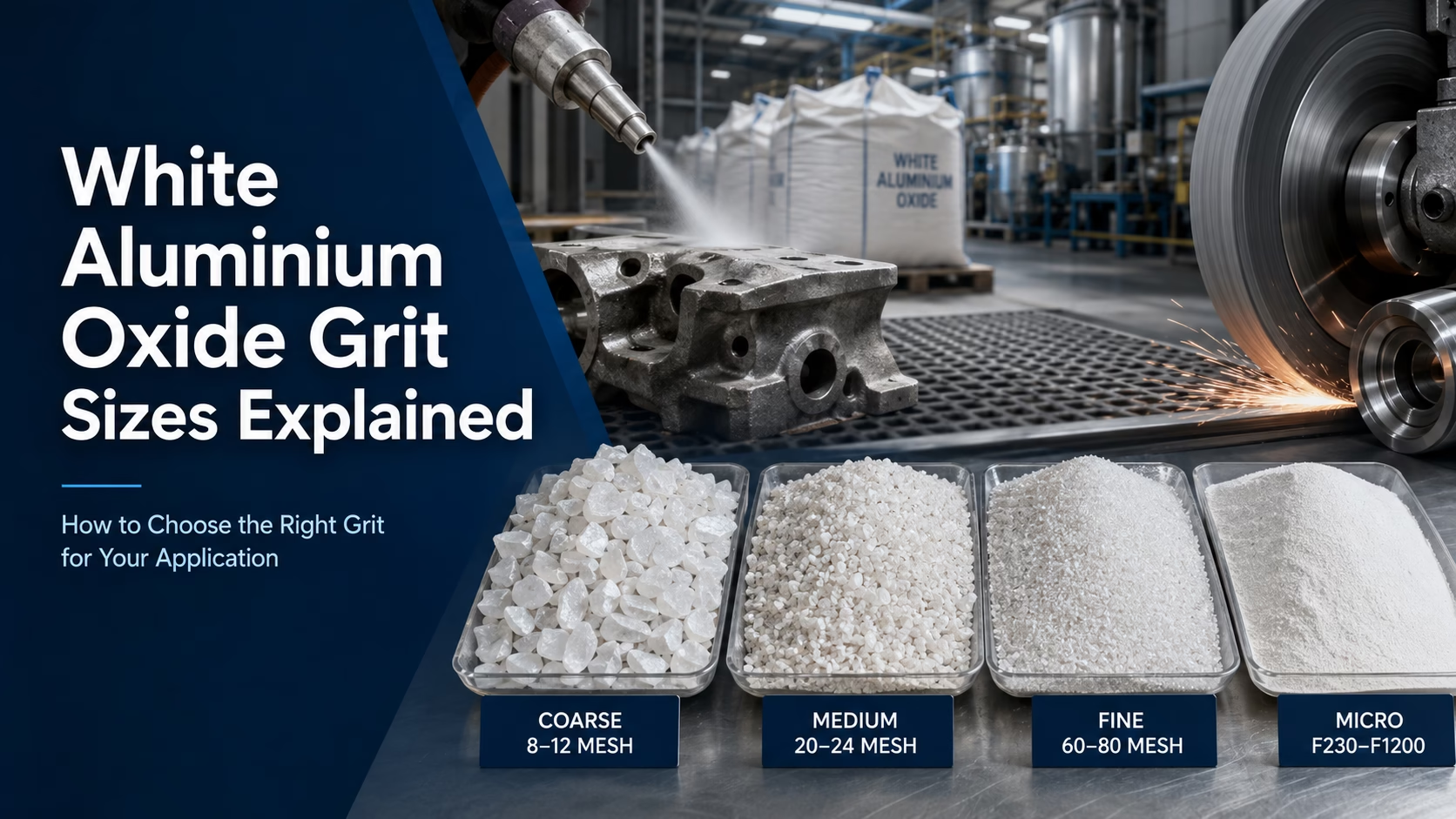
What Is White Aluminium Oxide Grit?
White aluminium oxide, also called 白い融合アルミナ (WFA) or white aluminum oxide, is a synthetic abrasive produced by melting high-purity alumina in an electric arc furnace.
After fusion and cooling, the material is crushed, cleaned and classified into controlled particle-size fractions for different industrial applications. CUMI describes white fused alumina as a high-purity synthetic mineral manufactured from Bayer alumina at temperatures above 2,000°C and subsequently crushed, magnetically cleaned and classified according to end-use requirements.
White aluminium oxide is valued for its combination of:
- 高硬度
- 高純度
- 鋭い刃先
- 破砕性
- 化学的安定性
- Relatively low contamination
- Controlled particle sizes
Because the grain fractures during use and exposes new cutting edges, white fused alumina is particularly useful where a clean and relatively cool cutting action is required. It is widely used in bonded abrasives, コーティングされた研磨材, 表面処理, 爆破, ラッピング, ceramics and other industrial applications.
Understanding White Aluminium Oxide Grit Sizes
One of the first things buyers should understand is that a lower grit number generally represents a coarser abrasive, while a higher grit number represents a finer abrasive.
例えば:
- F24 is relatively coarse.
- F60 is a medium grit.
- F120 is considerably finer.
- F220 is used where finer cutting and finishing are required.
しかし, the grit number should not be treated as a single particle diameter.
FEPA explains that abrasive particle sizes are controlled through defined grain standards, and that macrogrit size specifications represent particle-size distributions rather than a single particle diameter. FEPA also distinguishes between F-grits for bonded abrasives そして P-grits for coated abrasives.
For bonded abrasives and many general industrial applications, the FEPA macrogrit standard covers F4~F220.
That distinction matters when requesting quotations.
Simply writing:
White aluminium oxide 80 グリット
may not always be sufficient.
A better purchase specification might say:
White Fused Alumina F80, FEPA standard, for bonded abrasive production.
White Aluminium Oxide Grit Size Chart
The following table provides a practical starting point for industrial buyers.
| White Aluminium Oxide Grit | General Classification | 代表的な用途 | Expected Effect |
|---|---|---|---|
| F12–F24 | Very coarse | Heavy grinding, aggressive blasting, heavy stock removal | Fast cutting, rougher surface |
| F30–F46 | Coarse | サンドブラスト, 表面の準備, 砥石 | Strong cutting and surface profiling |
| F54–F80 | Medium | General grinding, 爆破, 研磨工具, surface finishing | Balance between removal rate and finish |
| F90–F120 | 大丈夫 | ファインブラスト, 精密研削, finishing | Lower profile, smoother surface |
| F150–F220 | Very fine | 微研削, lapping preparation, precision finishing | Fine surface and controlled removal |
These ranges should be treated as selection guidelines rather than fixed rules.
Actual performance will also depend on:
- 噴射圧力
- Nozzle size
- Workpiece material
- Abrasive flow rate
- Grinding wheel bond
- Machine speed
- Contact pressure
- 粒形状
- Recycling cycles
- Required surface roughness
This is why sample testing is important when changing grit sizes or suppliers.
Which White Aluminium Oxide Grit Should I Use for Sandblasting?
Sandblasting is one of the most common applications for white aluminium oxide grit.
White aluminium oxide is particularly useful when buyers want an aggressive mineral abrasive but also want to minimize contamination from the blasting media.
Washington Mills describes its high-purity white aluminum oxide blasting grain as sharp and friable and specifically positions it for applications where surface contamination is unacceptable.
For blasting, I would normally start by dividing applications into three groups.
F24–F46: Aggressive Surface Preparation
Coarser white aluminium oxide grits are usually considered when the priority is:
- Fast scale removal
- Heavy surface cleaning
- Strong surface profiling
- Removing stubborn coatings
- Preparing durable metal surfaces
Typical starting choices include:
F24, F30, F36 and F46.
These grains strike the workpiece with greater individual particle mass and can create a more pronounced surface profile.
The trade-off is that the final surface will usually be rougher.
If your next process requires a fine coating or highly controlled surface finish, going too coarse may create unnecessary rework.
F54–F80: General Industrial Blasting
For many industrial buyers, this is the most useful range to investigate first.
Typical sizes include:
F54, F60 and F80.
They are often selected when the buyer needs a compromise between:
Cleaning speed + surface profile + finish quality
Potential applications include:
- Stainless steel surface preparation
- Aluminum component cleaning
- General metal finishing
- Preparing parts before coating
- Cleaning cast components
- Industrial surface treatment
CUMI notes that fused abrasive grains are used in blasting for surface preparation before processes such as thermal spraying, electroplating and coating, as well as for cleaning castings and industrial components.
If a buyer contacts me without knowing the exact grit but says:
“We need white aluminium oxide for general metal blasting.”
F60 or F80 would normally be useful reference points for sample testing, depending on the required profile.
F90–F120: Fine Blasting and Controlled Finishing
When the priority moves from aggressive cleaning toward a more controlled finish, finer grit becomes more attractive.
Typical choices include:
F90, F100 and F120.
These may be suitable for applications such as:
- Fine surface finishing
- Light cleaning
- バリ取り
- Controlled matte finishing
- Smaller precision components
- Applications where an excessively rough surface is undesirable
Washington Mills also lists high-purity white aluminum oxide for sensitive blasting applications, including cleaning and deburring applications where contamination control matters.
What White Aluminium Oxide Grit Is Best for Stainless Steel?
White aluminium oxide is frequently considered for stainless steel because buyers often want to avoid unnecessary contamination during blasting or finishing.
The right grit depends on what you want the stainless steel surface to look like afterward.
For relatively aggressive preparation, buyers may begin testing around:
F36–F60
For more controlled surface finishing:
F60–F100
For finer cosmetic or precision finishing:
F100–F180
しかし, the required surface roughness or profile should be specified whenever possible.
Instead of telling a supplier:
I need white aluminium oxide for stainless steel.
it is much more useful to say:
Material: 304 stainless steel
Process: pressure blasting
Purpose: surface preparation before coating
Current grit: F80
Required finish: uniform matte surface
That gives the manufacturer enough information to make a meaningful recommendation.
Choosing White Aluminium Oxide Grit for Grinding Wheels
White fused alumina is also an important raw material for 結合した研磨剤, including grinding wheels, mounted points, honing stones and related tools.
FEPA specifically uses the F designation for bonded abrasive grains, while coated abrasives use P-grit designations.
CUMI notes that white fused alumina is used in vitrified bonded abrasives where cool, fast cutting action is important, while its bonded abrasive products are used for applications including tool grinding, internal grinding, gear grinding, roll grinding and centerless grinding.
A simplified starting point looks like this:
F24–F46
Better suited to:
- Heavy grinding
- Fast stock removal
- Coarser grinding wheels
The emphasis is cutting speed rather than fine finish.
F54–F80
Useful for:
- General-purpose grinding
- Tool grinding
- Surface grinding
- Medium stock removal
This range provides a more balanced relationship between cutting efficiency and finish.
F90–F120
More suitable for:
- 微研削
- Sharpening
- Precision tool finishing
- Controlled stock removal
F150–F220
Used where the process requires:
- 微研削
- Precise finishing
- Lower material removal
- Improved surface finish
But grit size is only one part of grinding wheel performance.
The wheel manufacturer also needs to consider:
grain type + grit size + bond + hardness grade + structure + operating speed
So purchasing the finest available white aluminium oxide does not automatically produce the best wheel.
White Aluminium Oxide Grit for Coated Abrasives
If you manufacture:
- サンドペーパー
- 研磨布
- Abrasive belts
- フラップディスク
- Fibre discs
you should pay particular attention to the difference between F grit and P grit.
FEPA states that P-grit sizes are used for coated abrasives, with standards covering ranges such as P12–P220 and finer grades beyond this range.
したがって:
F80 and P80 should not automatically be treated as identical purchase specifications.
When requesting white aluminium oxide for coated abrasives, specify:
- FEPA P grit
- Backing/application type
- Required grain shape
- Coating method
- Desired cutting behavior
CUMI notes that coated abrasive grain characteristics such as grain shape, size, density and electrostatic behavior can influence adhesion and cutting performance in coated abrasive products.
What Grit Should I Use for Precision Grinding?
For precision grinding, the basic rule is straightforward:
As the required finish becomes finer, the abrasive grit usually needs to become finer as well.
例えば:
F80–F120
May be considered for intermediate precision grinding where some material still needs to be removed efficiently.
F150–F220
May be more appropriate when surface finish and dimensional control become increasingly important.
For extremely fine finishing, buyers may need to move beyond conventional macrogrits into white fused alumina microgrits.
CUMI produces white fused alumina microgrits by grinding and classifying selected macrograin feedstock and notes that these products are used in applications including bonded abrasives, コーティングされた研磨材, lapping and micro-blasting.
This is an important distinction.
If your process requires extremely fine polishing, simply asking for “F220 grit” may not be sufficient.
You may actually need a micro powder specification.
White Aluminium Oxide for Lapping and Polishing
Lapping is different from ordinary grinding.
Instead of aggressively removing a large amount of material, lapping is often used to control:
- Flatness
- Parallelism
- Thickness
- Surface finish
CUMI describes lapping as a precision machining process using fine abrasive grains and identifies particle-size distribution and friability as important factors in achieving uniform stock removal and surface finishing.
このため, buyers doing precision lapping should pay less attention to the simple grit number and more attention to:
- 中央粒子径
- Oversize control
- 粒度分布
- 純度
- 粒形状
- 凝集
- Consistency between batches
For highly sensitive polishing operations, an occasional oversized particle can affect the finished surface.
That is why micro powder classification quality becomes increasingly important as the required finish becomes finer.
Coarse vs Fine White Aluminium Oxide Grit
A simple way to understand the difference is:
Coarser Grit
Provides:
- Faster stock removal
- Stronger cutting action
- Deeper surface profile
- Higher productivity in heavy cleaning
But may also create:
- Rougher surfaces
- Deeper scratches
- More aggressive material removal
Finer Grit
Provides:
- Smoother surface finish
- Shallower profile
- Better control
- Better suitability for precision work
But usually means:
- Slower stock removal
- More processing time for heavy cleaning
So there is always a trade-off.
The goal is not to choose the finest grit possible.
The goal is to choose the coarsest grit that can still achieve the required final surface condition efficiently.
A Simple White Aluminium Oxide Grit Selection Guide
If I were helping an industrial buyer make an initial selection, I would start here:
Heavy material removal
Start testing:
F12–F24
Aggressive sandblasting
Start testing:
F24–F46
General sandblasting
Start testing:
F46–F80
General grinding
Start testing:
F46–F80
Fine surface preparation
Start testing:
F80–F120
精密研削
Start testing:
F100–F180
Fine finishing
Start testing:
F150–F220
ラッピング / very fine finishing
Consider:
Microgrit / マイクロパウダー
These ranges are not substitutes for production testing.
If surface roughness is critical, I would always test two or three adjacent grit sizes before committing to a large order.
5 Factors I Would Check Before Choosing a Grit Size
1. What Material Are You Processing?
The workpiece may be:
- ステンレス鋼
- Carbon steel
- Aluminum
- Titanium
- Ceramic
- ガラス
- 工具鋼
- Non-ferrous alloy
Different materials respond differently to the same abrasive size.
2. How Much Material Do You Need to Remove?
If you need aggressive stock removal, using F180 instead of F36 will dramatically change productivity.
Likewise, using an unnecessarily coarse grain for fine finishing can damage the surface.
3. What Surface Finish Do You Need?
Whenever possible, define the required:
- Surface profile
- Roughness
- Appearance
- Scratch level
“Smooth” and “rough” are subjective descriptions.
A measurable specification is much more useful.
4. What Equipment Are You Using?
For blasting, tell the supplier whether you use:
- Pressure blasting
- Suction blasting
- Wet blasting
- Automated blasting
For grinding, provide information about the grinding tool and process.
Equipment conditions can change how the same grit performs.
5. Will the Abrasive Be Recycled?
In blasting applications, recyclability can affect total operating cost.
Do not compare abrasives only by the price of one kilogram.
Compare:
Cost per kg ÷ useful working cycles + processing performance
A more expensive abrasive that lasts longer may have a lower real operating cost.
How I Would Specify White Aluminium Oxide Grit to a Manufacturer
A common problem I see in B2B inquiries is that the buyer sends only:
Need white aluminium oxide. Please quote.
That forces the supplier to ask several questions before giving an accurate quotation.
A much better inquiry would look like this:
- 製品: 白い融合アルミナ
Grit: F60
標準: 餌
応用: Stainless steel sandblasting
量: 5 MT
包装: 25 kg袋 + pallet
行き先: Hamburg, Germany
Required documents: TDS + COA
サンプル: Required before bulk order
With these details, manufacturers can provide a much more useful quotation.
What Should You Check on the COA?
Before purchasing white aluminium oxide grit in bulk, I would review at least:
- Al₂O₃含有量
- Na₂O
- Fe₂O₃
- SiO₂
- Magnetic content where relevant
- 粒度分布
- Bulk density where required
- Moisture where applicable
The exact requirements depend on your application.
For a standard blasting operation, some parameters may have limited influence.
For precision abrasive tools, advanced ceramics or fine finishing, tighter controls may be necessary.
Why Sample Testing Matters
Two suppliers can both label a product:
White Aluminium Oxide F80
but the products may not perform identically.
Differences can come from:
- 粒形状
- Crushing method
- Classification accuracy
- Oversized particles
- 破砕性
- Impurity levels
- かさ密度
- Batch consistency
したがって, for repeat industrial purchasing, I recommend the following process:
Confirm Specification
↓
Request TDS and COA
↓
Receive Sample
↓
Run Production Test
↓
Compare Surface Finish / Cutting Rate
↓
Place Trial Order
↓
Evaluate Batch Consistency
↓
Move to Regular Supply
That is much safer than choosing a supplier entirely on price.
Where Yumo Fits for White Aluminium Oxide Grit Sourcing
For buyers sourcing white aluminium oxide grit from China, 河南ユモ新素材 can supply white fused alumina for abrasive, 研削, 爆破, polishing and related industrial applications.
For an inquiry, I would recommend providing Yumo with the required:
- F grit or P grit
- 応用
- Annual consumption
- Required chemical specification
- 包装
- Destination port
If you are unsure whether your process should use F46, F60, F80, F120 or another size, the better approach is to describe the workpiece and required finish first, then compare samples of the most suitable adjacent grit sizes.
For industrial purchasing, getting the right specification is usually more important than simply finding the lowest price per ton.
最終的な考え
Choosing the right white aluminium oxide grit size is ultimately a balance between cutting speed and surface finish.
If the grit is too coarse, you may remove material quickly but create an unnecessarily rough profile.
If it is too fine, you may achieve a smoother finish but lose productivity.
As a practical starting point:
F24–F46 → heavy grinding and aggressive blasting
F54–F80 → general grinding and surface preparation
F90–F120 → fine blasting and finishing
F150–F220 → precision grinding and fine finishing
マイクログリット → lapping, micro-blasting and very fine applications
But I would never place a large order based on this table alone.
The final selection should consider the workpiece material, process, required surface finish, equipment, abrasive standard and production test results.
産業用バイヤー向け, the best white aluminium oxide grit is not necessarily the coarsest, finest or cheapest option.
It is the grit that gives you the required finish at the most efficient overall processing cost.


One Response