
연삭 휠용 연마 입자: 유형, Sizes and Selection Guide
Abrasive grain is the primary cutting component of a grinding wheel. It determines how the wheel interacts with the workpiece, removes material, and maintains cutting performance during operation. Different abrasive materials, including aluminum oxide, 실리콘 카바이드, zirconia alumina, and ceramic alumina, offer different combinations of hardness, 강인함, and fracture characteristics. Choosing the right abrasive grain is therefore essential for grinding wheel manufacturers who need consistent performance and reliable product quality.
When I look at grinding wheel specifications, I pay particular attention to more than the abrasive material itself. Grain size, 입자 모양, bond type, wheel structure, and grinding conditions all influence the final result. A material that performs well when grinding carbon steel may not be the best choice for cast iron, 스테인레스 스틸, or carbide.
이 가이드에서는, I will explain the main types of abrasive grains used in grinding wheels, how their properties affect grinding performance, and how manufacturers can select suitable materials for different applications. I will also clarify important technical terms such as F-grit, wheel grade, 구조, and bond, which often create confusion among abrasive material buyers.
1. What Is Abrasive Grain in a Grinding Wheel?
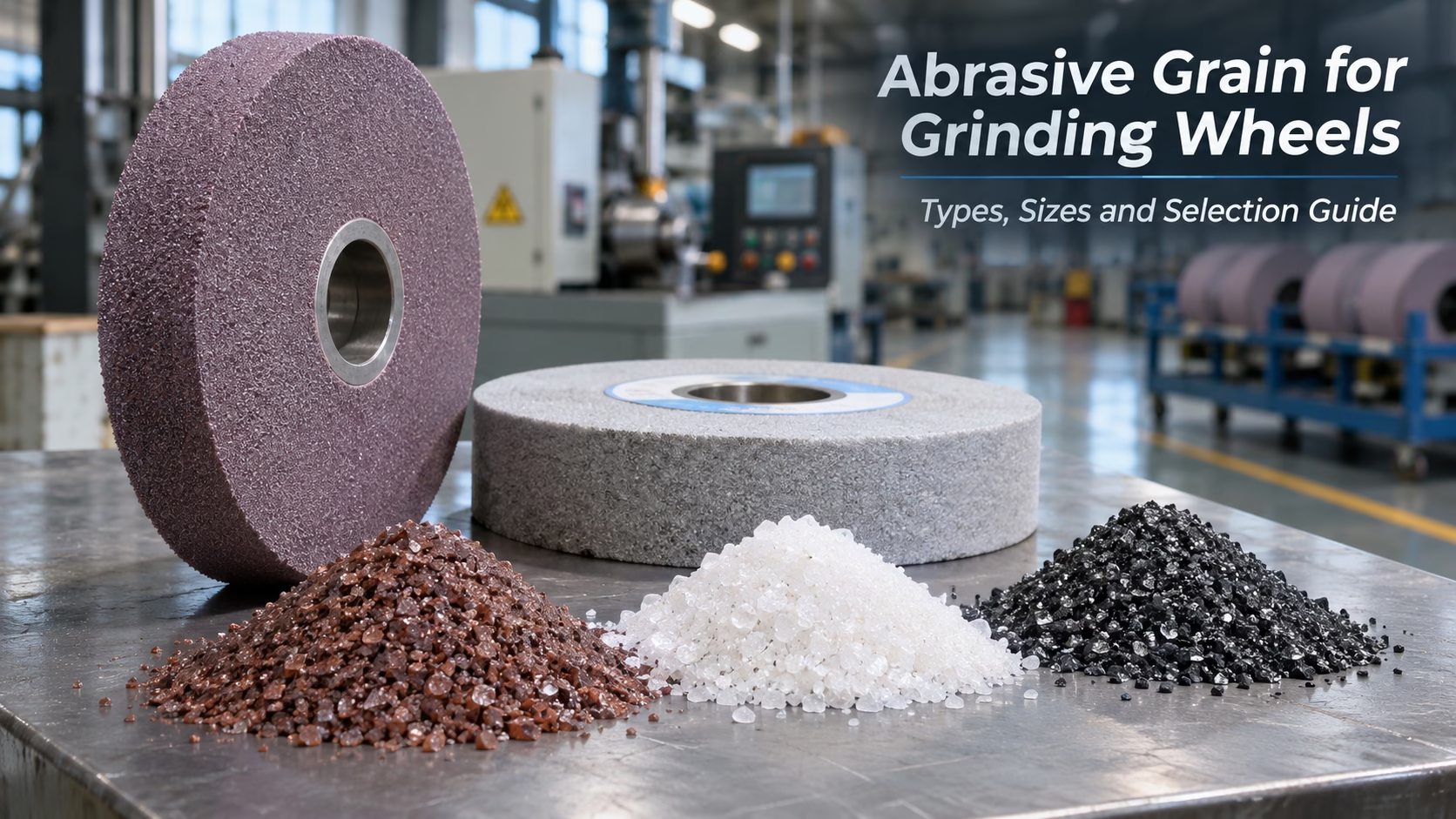
Abrasive grain refers to hard mineral or synthetic particles that remove material from a workpiece through mechanical cutting and abrasion. In a grinding wheel, these particles act as thousands of microscopic cutting edges. As the wheel rotates and contacts the workpiece, individual grains penetrate the surface, form small chips, and gradually remove unwanted material.
하지만, abrasive grain is only one component of a grinding wheel. Manufacturers combine abrasive particles with bonding materials and create a controlled internal structure to achieve the required grinding characteristics.
Understanding Grinding Wheel Composition
Most conventional grinding wheels contain three main components:
- Abrasive Grain: The cutting material that removes metal or other workpiece materials.
- Bonding Agent: The material that holds abrasive grains together and provides mechanical strength.
- Pores: Empty spaces that accommodate grinding chips and help maintain coolant circulation.
Some formulations also contain fillers and other additives that modify specific wheel properties.
Manufacturers select different bonding systems according to their production requirements. Vitrified bonds use ceramic-based materials and provide rigidity and dimensional stability. Resinoid bonds use organic resin materials and offer different levels of flexibility, impact resistance, and cutting characteristics.
According to Norton Abrasives’ Grinding Wheel Basics, 연마 입자, bonding agents, and air spaces form the three fundamental components of conventional grinding wheels.
The Role of Abrasive Grain in Grinding
The abrasive grain performs the actual cutting work. Its hardness helps it resist wear, while its toughness and fracture characteristics influence how long it maintains effective cutting edges.
As grinding continues, individual grains gradually wear, fracture, or become dull. Depending on the grain and bond design, these changes expose fresh cutting edges and help the wheel maintain its cutting ability.
This behavior explains why manufacturers cannot evaluate grinding wheel performance through abrasive hardness alone. They must consider how the grain interacts with the bond and the workpiece throughout the grinding process.
2. Common Types of Abrasive Grains Used in Grinding Wheels
Grinding wheel manufacturers use several abrasive materials to process different metals, 도예, and other industrial materials. Each material offers particular advantages, and the best choice depends on workpiece properties and grinding conditions.
| Abrasive grain | Main characteristics | Typical applications |
|---|---|---|
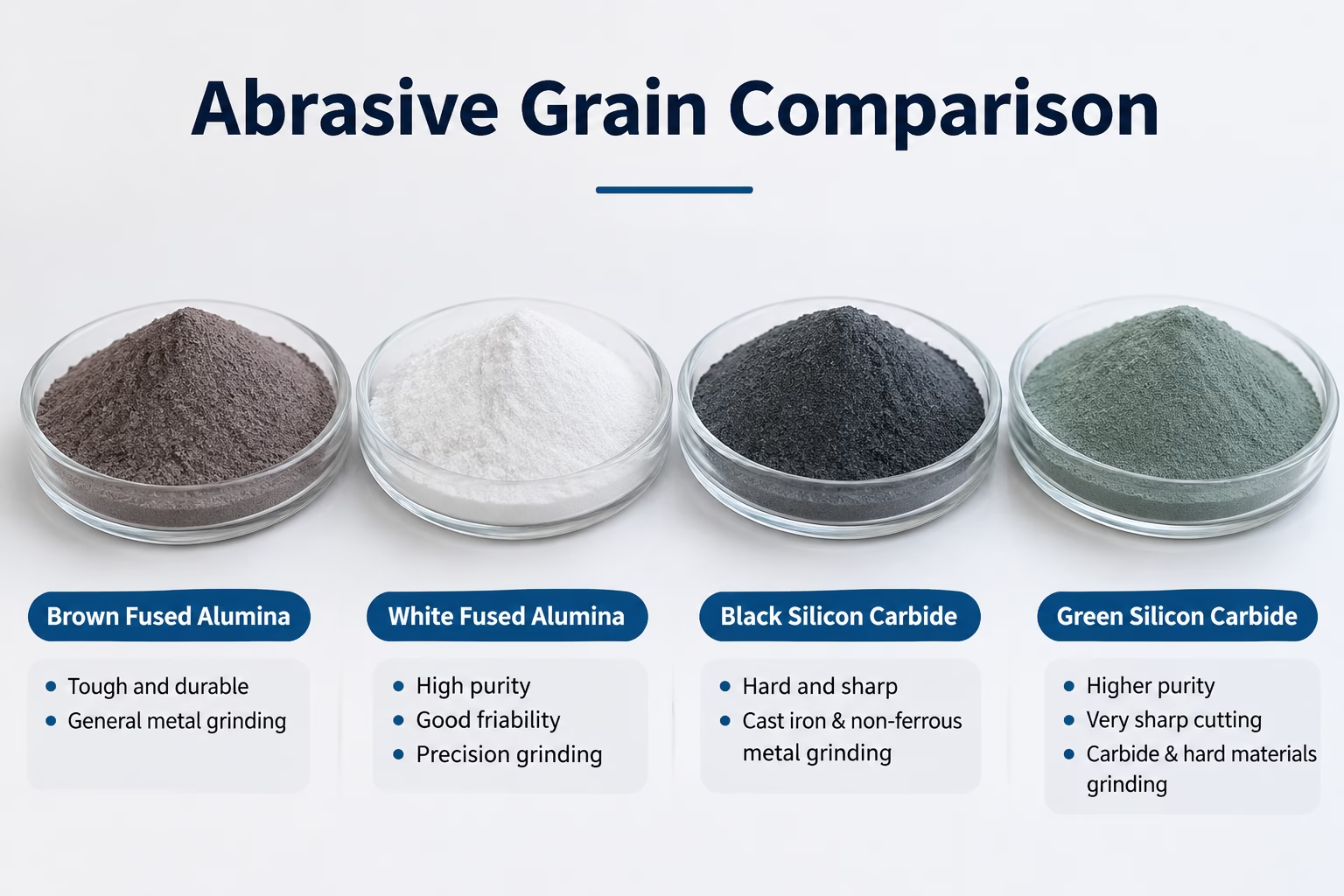
| 브라운 융합 알루미나 | Tough, durable, and versatile | General steel grinding |
| 백색 용융 알루미나 | High purity and relatively friable | Precision grinding and selected tool steels |
| 검은 실리콘 카바이드 | Hard and sharp cutting characteristics | Cast iron and non-ferrous materials |
| 녹색 실리콘 카바이드 | High hardness and sharp cutting characteristics | Carbide and selected brittle materials |
| Zirconia alumina | Tough grain structure | Heavy-duty metal grinding |
| Ceramic alumina | Engineered grain and controlled fracture | High-performance grinding |
| 다이아몬드 | Extremely hard superabrasive | Carbide, 도예, and other suitable hard materials |
| CBN | High-temperature hardness and wear resistance | Hardened steels and selected ferrous alloys |
These descriptions provide general selection guidance. The complete wheel formulation and actual operating conditions determine final performance.
Aluminum Oxide Abrasive Grain
Aluminum oxide is one of the most widely used abrasive materials in conventional grinding wheels. Its combination of hardness, 강인함, and versatility makes it suitable for numerous industrial metalworking applications.
Two important varieties are brown fused alumina (격아) and white fused alumina (WFA).
Brown fused alumina offers a practical balance of toughness, 내구성, and cutting performance. Manufacturers commonly use it to produce grinding wheels for carbon steel, general metal grinding, and other industrial abrasive applications.
When sourcing this material, I recommend checking its chemical composition, grain-size distribution, magnetic content, and consistency between production batches.
YUMO supplies Brown Fused Alumina Abrasive Grades in different FEPA grain specifications, including F8, F10, F14, F16, F20, F24, F30, F36, F40, F46, F54, F60, F70, F80, F90, F100, F120, F150, F180, and F220.
White fused alumina comes from high-purity alumina and offers relatively high purity, 경도, and friability. Its grain structure makes it a useful option for selected precision grinding applications, including operations involving tool steels and other materials that require controlled cutting behavior.
For manufacturers who prioritize grain purity and particle-size consistency, White Fused Alumina Abrasive Materials provide another option for grinding wheel formulations.
Although BFA and WFA both belong to the aluminum oxide abrasive family, manufacturers should not treat them as interchangeable materials. Their chemical composition, grain characteristics, and grinding behavior can differ.
Silicon Carbide Abrasive Grain
실리콘 카바이드 (SiC) is a synthetic abrasive with high hardness, sharp cutting edges, and relatively brittle grain characteristics. Manufacturers often choose it when processing materials that require a sharp and aggressive abrasive.
Black silicon carbide commonly supports grinding and processing of cast iron, non-ferrous metals, and selected non-metallic materials. Green silicon carbide offers high purity and sharp cutting characteristics, making it suitable for carbide, 도예, and other specialized applications.
For grinding wheel manufacturers, the distinction between black and green silicon carbide matters because different production requirements call for different material specifications.
YUMO provides Black Silicon Carbide Abrasive Grain for industrial grinding and other abrasive applications. Buyers should confirm the required SiC content, 입자 크기 분포, and chemical specifications before ordering.
Zirconia Alumina and Ceramic Alumina
Zirconia alumina and ceramic alumina serve more demanding grinding operations.
Zirconia alumina combines toughness with controlled grain breakdown. Manufacturers often consider it for heavy-duty grinding, particularly when the operation involves high grinding pressure and substantial material removal.
Ceramic alumina uses engineered grain structures to support controlled fracture and self-sharpening behavior. When the grinding conditions suit the grain, this process exposes fresh cutting edges and helps maintain cutting efficiency.
These engineered abrasives can offer advantages in high-performance grinding, but their benefits depend on the complete wheel design, bond formulation, and operating conditions.
Diamond and CBN Superabrasives
Diamond and cubic boron nitride (CBN) belong to the superabrasive category rather than the conventional fused alumina and silicon carbide family.
Diamond offers exceptional hardness and works well for grinding cemented carbide, 도예, 유리, and other suitable hard materials. 하지만, its chemical interaction with iron at elevated grinding temperatures makes it generally unsuitable for conventional grinding of ferrous steels.
CBN provides excellent hardness and thermal stability for demanding grinding applications involving hardened steels and selected ferrous alloys.
These materials require specialized wheel construction and manufacturing techniques, so buyers should evaluate them separately from conventional aluminum oxide and silicon carbide grains.
3. How Abrasive Grain Properties Affect Grinding Wheel Performance
Abrasive grain properties influence how a grinding wheel cuts, wears, and maintains its working profile. When I compare abrasive materials, I focus on four important characteristics rather than relying on hardness alone.
Grain Hardness and Toughness
Hardness describes a grain’s resistance to scratching and indentation. Toughness describes its ability to withstand mechanical forces without excessive fracture.
These properties serve different purposes. A tough grain can withstand demanding grinding conditions, while a more friable grain can fracture more readily and expose fresh cutting edges.
Manufacturers need to balance these characteristics according to the workpiece and grinding operation.
Friability and Self-Sharpening
Friability describes how readily an abrasive grain fractures under mechanical loading.
During grinding, controlled grain fracture can expose new cutting edges and help the wheel maintain its cutting performance. 하지만, excessive grain breakdown can shorten wheel life and increase abrasive consumption.
The self-sharpening behavior of a grinding wheel also depends on its bond. The bond must release worn or dull grains at an appropriate rate so that fresh cutting edges can reach the working surface.
Grain Shape and Particle-Size Distribution
Grain shape influences how abrasive particles contact the workpiece and distribute grinding forces. Angular particles generally offer different cutting behavior from more blocky grains.
Particle-size distribution matters just as much. A controlled distribution helps manufacturers maintain consistent cutting behavior and predictable wheel performance.
이러한 이유로, I recommend requesting technical documentation that identifies the grading standard, 입자 크기 분포, and relevant chemical specifications.
4. Understanding Grinding Wheel Grit Sizes and Specifications
Abrasive grain size plays a direct role in grinding performance. It influences cutting behavior, material removal, 표면 마무리, and the number of abrasive particles that contact the workpiece.
What Does F-Grit Mean?
FEPA uses the F-grit system to classify abrasive grains for bonded abrasives, including conventional grinding wheels.
The classification includes two main ranges:
- Macrogrits: F4–F220, which cover conventional coarse and medium abrasive grain sizes.
- 마이크로그리트: F230–F2000, which cover much finer abrasive particles.
FEPA Standard 42-1:2006 covers macrogrits, while FEPA Standard 42-2:2006 covers microgrits.
그만큼 FEPA Abrasive Grain Standards explain how manufacturers classify these particles. Importantly, FEPA defines macrogrit sizes through particle-size ranges rather than assigning one exact diameter to every grit number.
For grinding wheel manufacturers, this distinction matters because a nominal grit designation does not describe the entire particle-size distribution.
How to Read a Grinding Wheel Specification
A grinding wheel specification contains several important elements. Each element describes a different part of the wheel’s construction and performance.
| Specification | Meaning | What it tells buyers |
|---|---|---|
| Abrasive type | Grain material | 산화알루미늄, 실리콘 카바이드, and others |
| Grain size | Abrasive particle classification | 조잡한, medium, or fine cutting characteristics |
| Wheel grade | Bond holding strength | How firmly the bond retains the grains |
| Structure | Grain spacing and porosity | The relative openness of the wheel |
| Bond | Bonding material | Vitrified, resinoid, rubber, or another system |
Consider the illustrative grinding wheel specification:
32A46-I8VBE
A typical interpretation includes:
- 32A: Abrasive type designation.
- 46: Grain-size designation.
- 나: Wheel grade.
- 8: Structure.
- V: Vitrified bond.
- BE: Additional manufacturer-specific designation.
This example follows a conventional marking format described by Norton. 하지만, abrasive manufacturers may use different internal codes, so buyers should always consult the relevant manufacturer’s specification system.
One important distinction deserves special attention:
Abrasive Grain Hardness is not the same as Grinding Wheel Grade.
Abrasive grain hardness describes the physical properties of the abrasive material. Wheel grade describes the bond’s ability to retain abrasive grains during grinding.
A softer wheel grade releases dull grains more readily, while a harder grade holds grains in the wheel for longer. Neither designation directly describes the hardness of the aluminum oxide or silicon carbide particles.
F-Grit vs P-Grit
Buyers sometimes confuse F-grit and P-grit because both systems use numerical particle-size designations.
하지만, FEPA assigns F-grit to bonded abrasives and P-grit to coated abrasives such as sanding belts and abrasive sheets.
The two systems use different grading specifications. 그러므로, F80 and P80 should not automatically be treated as equivalent particle-size distributions.
For more detailed information, read our guide to 연마 입자 크기 설명: 밥을 먹이다, ANSI와 JIS.
5. How to Choose Abrasive Grain for Different Grinding Applications
The right abrasive grain depends on the workpiece, grinding objective, and operating conditions. I recommend matching the material to the actual application rather than selecting an abrasive simply because it has a higher hardness rating.
Steel and Stainless Steel Grinding
Aluminum oxide is a common starting point for grinding carbon steel and many other ferrous metals. Brown fused alumina offers toughness and versatility, while white fused alumina provides an alternative for selected precision grinding applications.
For demanding grinding operations, manufacturers may also consider zirconia alumina and ceramic alumina.
Stainless steel requires additional attention to heat generation and contamination control. Manufacturers should select complete grinding products specifically designed for the intended stainless steel application.
Cast Iron and Non-Ferrous Metal Grinding
Silicon carbide often provides a suitable option for cast iron and selected non-ferrous materials because of its hardness and sharp cutting characteristics.
Manufacturers also use silicon carbide in applications involving aluminum, 구리, 놋쇠, and certain non-metallic materials.
하지만, softer and ductile metals may cause abrasive loading. Buyers should evaluate the complete wheel design and operating conditions to reduce friction and maintain effective cutting.
Tool Steel and Precision Grinding
Tool steel grinding requires careful control of material removal, surface quality, and heat generation.
White fused alumina is a material manufacturers may consider for selected precision grinding formulations. Its relatively friable grain structure can support controlled cutting behavior under suitable conditions.
For demanding applications, the manufacturer must also match the wheel grade, 노예, and structure to the workpiece and machine.
Carbide and Ceramic Grinding
Green silicon carbide is widely associated with grinding cemented carbide and selected ceramic materials.
For more demanding precision applications, diamond abrasives may offer advantages when manufacturers design the complete wheel for the material and operating conditions.
The key is to distinguish between conventional abrasive grains and superabrasives. They serve different applications and require different wheel designs.
6. Seven Factors to Consider When Selecting Abrasive Grain for Grinding Wheels
Selecting abrasive grain requires more than checking a product’s material name and grit number. In its technical guide, Norton identifies seven factors that influence grinding wheel specification.
I recommend using the same framework when evaluating abrasive materials for grinding wheel production.
| Selection factor | What manufacturers should consider |
|---|---|
| 공작물 재료 | Material type, 경도, and grindability |
| Grinding operation | 무거운 재고 제거, surface grinding, or precision grinding |
| 필수 마무리 | Surface roughness and dimensional accuracy |
| Contact area | Size of the contact zone between wheel and workpiece |
| Wheel speed | Required operating speed and wheel rating |
| Coolant | Wet or dry grinding conditions |
| Machine power | Available spindle power and equipment capability |
These factors interact with each other. 예를 들어, a difficult-to-grind material may require a friable grain and a wheel grade that releases dull particles before they cause excessive heat. A heavy grinding operation may require a tougher grain that withstands greater mechanical forces.
Manufacturers should also evaluate the relationship between grit size and surface finish. Coarse grains generally support higher material removal rates, while finer grains can produce more refined surfaces under suitable conditions.
Common Grinding Wheel Selection Mistakes
I often see buyers focus too heavily on abrasive hardness or purchase price while overlooking the complete grinding system.
The most common mistakes include:
- Choosing abrasive grain based only on hardness: Toughness and fracture behavior also influence cutting performance.
- Ignoring wheel grade: The bond’s holding strength affects how quickly the wheel releases worn grains.
- Overlooking wheel structure: Grain spacing and porosity influence chip accommodation and grinding conditions.
- Using an unsuitable bond: Vitrified, resinoid, and other bonding systems serve different operational requirements.
- Ignoring machine specifications: Wheel dimensions, 작동 속도, and equipment compatibility affect safe performance.
Safety should always come first. Manufacturers and operators must follow the grinding wheel’s maximum rated operating speed, machine requirements, guarding instructions, and applicable workplace safety standards. Never exceed the wheel’s rated speed to increase productivity.
최종 생각: Choosing the Right Abrasive Grain for Grinding Wheels
Choosing the right abrasive grain for grinding wheels requires an understanding of both the abrasive material and the complete wheel structure. 산화알루미늄, 실리콘 카바이드, zirconia alumina, ceramic alumina, 다이아몬드, and CBN each offer different characteristics and application possibilities.
For grinding wheel manufacturers, the most important factors include workpiece material, grain size, 경도, 강인함, 부서지기 쉬움, wheel grade, 구조, and bond type. No single specification can guarantee the best performance across every grinding operation.
By evaluating these factors together and confirming particle-size specifications with reliable suppliers, manufacturers can improve product consistency and make more informed material purchasing decisions.
Need Abrasive Grain for Grinding Wheels? YUMO Can Help
At YUMO, we supply brown fused alumina, 흰색 융합 알루미나, and silicon carbide in different abrasive grades for industrial manufacturing applications. Our product range includes coarse abrasive grains, standard FEPA grit sizes, and fine powders for different production requirements.
If you manufacture grinding wheels or source abrasive grains for bonded abrasives, share your required material, F-grit specification, particle-size requirements, 화학 사양, and estimated quantity with our team.
We can help you review available grades and identify suitable abrasive materials according to your production requirements. Whether you need brown fused alumina for general grinding applications, white fused alumina for selected precision grinding formulations, or silicon carbide for specialized abrasive products, our team is ready to discuss your specifications.
Contact YUMO to discuss your grinding wheel abrasive requirements and request product specifications, samples, or a quotation.
Frequently Asked Questions About Abrasive Grain for Grinding Wheels
What Is the Best Abrasive Grain for Grinding Wheels?
There is no single abrasive grain that works best for every grinding wheel. Aluminum oxide suits many steel grinding applications, while silicon carbide often works well for cast iron, non-ferrous metals, and selected non-metallic materials. Zirconia alumina and ceramic alumina offer additional options for demanding grinding operations.
What Is the Difference Between Brown and White Fused Alumina?
Brown fused alumina generally offers toughness, 내구성, and versatile industrial performance. White fused alumina features higher purity and relatively friable grain characteristics. Manufacturers select between them according to workpiece material, grinding conditions, and the required cutting behavior.
What Is the Difference Between F-Grit and P-Grit?
F-grit classifies abrasive particles for bonded abrasives such as grinding wheels. P-grit classifies particles for coated abrasives such as sanding belts and abrasive sheets. Both systems use numerical designations, but their grading specifications differ.
How Does Abrasive Grain Size Affect Grinding Performance?
Coarse abrasive grains generally remove material more aggressively and support higher stock removal rates. Fine grains help manufacturers achieve smoother finishes and greater control during precision grinding. The final result also depends on wheel grade, 구조, 노예, and operating conditions.
What Should Manufacturers Check When Buying Grinding Wheel Abrasive Grain?
Manufacturers should check abrasive composition, grit designation, 입자 크기 분포, 화학 사양, magnetic impurities where relevant, and batch consistency. They should also confirm that the supplied grain meets the applicable FEPA or customer-specific requirements before starting production.


