
Choosing the right abrasive grain for surface preparation is essential for removing rust, mill scale, 오래된 코팅, and other contaminants while achieving the surface condition required for the next manufacturing process. The best abrasive depends on the workpiece material, the type of contamination, the required surface profile, and whether the surface will be painted, 코팅, bonded, or finished in another way. 브라운 융합 알루미나, 흰색 융합 알루미나, 실리콘 카바이드, garnet, and steel grit all have different characteristics, so selecting an abrasive based on hardness or price alone can lead to disappointing results.
When I evaluate an abrasive for surface preparation, I start by asking what the process needs to achieve. Removing heavy rust from a steel component is different from preparing stainless steel for a protective coating or cleaning a softer aluminum surface. The abrasive must provide the required cleaning action without causing unnecessary substrate damage, contamination, or processing costs.
이 가이드에서는, I will explain how to choose abrasive grains for different surface preparation applications, compare commonly used abrasive materials, and discuss how grain size, 표면 프로필, quality control, and safety affect purchasing decisions.
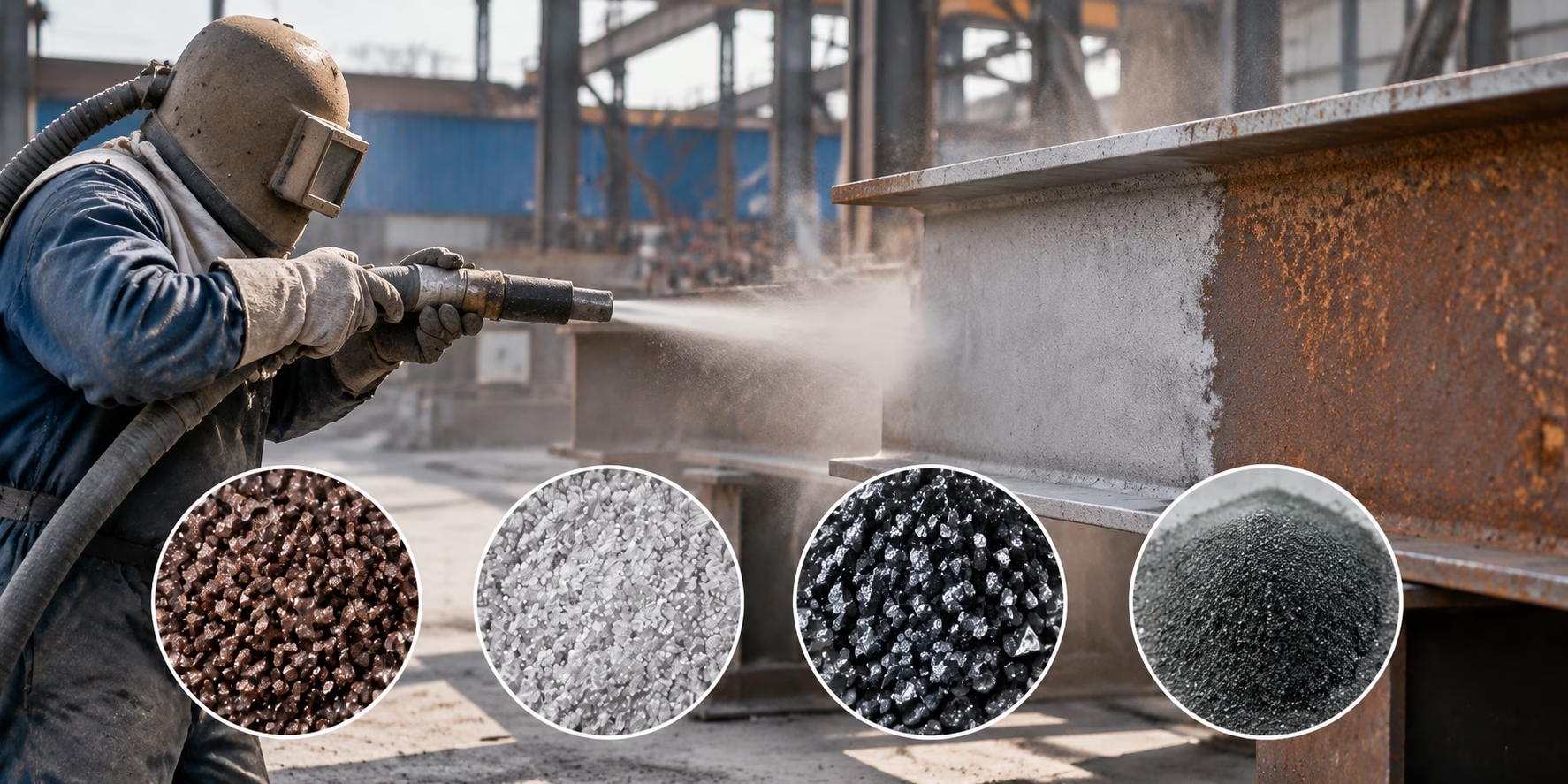
1. What Is Abrasive Grain for Surface Preparation?
Abrasive grain is a hard particle used to clean, abrade, or modify a material’s surface through mechanical action. In surface preparation, abrasive grains are commonly used to remove rust, mill scale, 오래된 코팅, and other contaminants before painting, bonding, or applying a protective finish.
The abrasive may be projected against the workpiece using compressed air or centrifugal equipment, depending on the blasting system. The impact of the particles removes unwanted material and can create a surface profile suited to the next production stage.
Surface Cleaning vs. Surface Profiling
Surface cleaning and surface profiling are related but different objectives. Cleaning focuses on removing unwanted material, while profiling concerns the texture and topography of the surface after treatment.
예를 들어, steel may appear clean after rust removal but still require a specific surface profile before a protective coating can be applied. Conversely, aggressive blasting may create a profile that is too deep for a particular coating system.
For steel substrates, ISO 8501-1 provides visual rust grades and preparation grades for assessing surface cleanliness. A revision draft is under development, so buyers should verify the applicable edition and project specification before using the standard.
ISO+1
When I evaluate abrasive materials, I treat the required cleanliness and surface profile as separate requirements. This helps ensure that the selected abrasive supports the complete finishing process rather than simply making the surface look clean.
2. Common Types of Abrasive Grains for Surface Preparation
Different abrasive materials provide different combinations of hardness, 강인함, 입자 모양, and cutting action. The best option depends on the workpiece and the surface condition required.
| Abrasive material | Typical applications | Main consideration |
|---|---|---|
| 브라운 융합 알루미나 | Industrial blasting and metal surface preparation | 인성, cutting action, and cost |
| 백색 용융 알루미나 | Applications requiring high-purity alumina abrasive | Purity and contamination control |
| 실리콘 카바이드 | Specialized processing of hard or brittle materials | High hardness and sharp cutting action |
| 석류석 | Metal surface preparation and selected blasting applications | Mineral grade and recovery conditions |
| 강철 입자 | Cleaning and profiling steel components | Equipment compatibility and reuse |
| 유리구슬 | Cleaning and finishing where a less aggressive effect is required | Rounded particles and desired surface appearance |
Brown Fused Alumina for Industrial Surface Preparation
Brown fused alumina is a synthetic abrasive produced by melting bauxite-based raw materials in an electric arc furnace, followed by crushing and classification. It is widely used in industrial abrasives because of its hardness, 강인함, and availability in different grain sizes.
For surface preparation, brown fused alumina may be suitable for removing rust, cleaning metal components, and preparing surfaces for subsequent processing. The appropriate grade depends on the substrate, contamination level, blasting conditions, and required surface profile.
YUMO supplies different brown fused alumina abrasive grades and grain sizes 산업용 애플리케이션용. Buyers should confirm the available particle-size distribution and technical specifications before selecting a grade.
White Fused Alumina and Silicon Carbide
White fused alumina is produced from high-purity alumina. It may be suitable for surface treatment applications where abrasive purity and contamination control are important. 하지만, it is not automatically the best choice for every metal-cleaning task; the application and overall processing cost should determine the selection.
You can explore YUMO’s white fused alumina abrasive products for available material forms and specifications.
Silicon carbide is a hard synthetic abrasive with sharp cutting characteristics. It is used for specialized processing involving glass, 도예, 결석, and other hard or brittle materials. For conventional steel surface preparation, other abrasives may offer a more practical balance of performance and cost.
YUMO also supplies silicon carbide abrasive materials for different industrial applications.
The important point is that abrasive materials should not be ranked by hardness alone. Their suitability depends on how they interact with the workpiece and whether they can achieve the required result efficiently.
3. How to Choose Abrasive Grain for Different Surface Preparation Applications
When selecting abrasive grain, I start by identifying the workpiece, the type of contamination, and the condition required after treatment. This approach helps narrow the available materials before comparing grain sizes and costs.
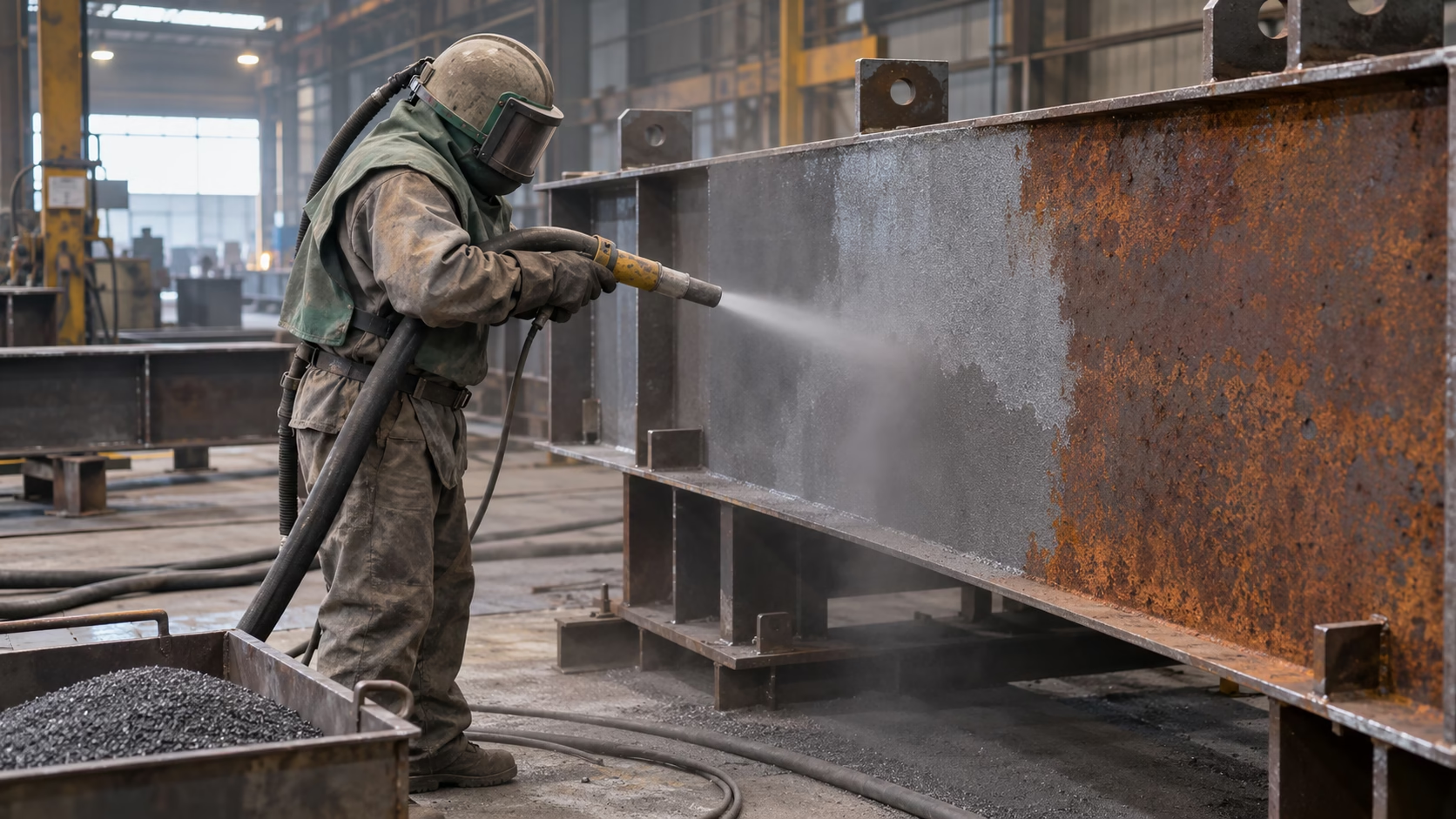
Rust and Mill Scale Removal
Rust removal requires an abrasive that can remove corrosion effectively without causing unacceptable damage to the underlying material. The condition of the surface matters: loose rust, firmly attached corrosion, heavy scale, and old coatings may require different preparation methods.
Coarser or more angular media may provide more aggressive mechanical action, but the result also depends on blasting pressure, nozzle distance, impact angle, and exposure time. A suitable abrasive should remove the unwanted material while leaving the surface in a condition appropriate for the next process.
Surface Preparation Before Painting or Coating
For steel that will receive a protective coating, abrasive selection should be based on the coating manufacturer’s requirements and the project specification.
Three factors deserve particular attention:
Surface cleanliness: How much rust, mill scale, old coating, and other contamination must be removed?
표면 프로필: What degree of surface roughness or anchor pattern is required for the coating system?
표면 오염: Could the abrasive introduce unwanted residues or other contaminants?
A surface that looks clean may still fail to meet the project’s requirements. Where specifications call for a particular cleanliness grade or profile range, the finished surface should be inspected using the appropriate methods.
Stainless Steel, 알류미늄, and Sensitive Materials
Stainless steel and aluminum require careful consideration because the wrong abrasive or process conditions can damage the surface or introduce unwanted contamination. In applications with strict material requirements, buyers should verify the abrasive’s composition, 청결, and suitability for the workpiece.
For stainless steel, for example, the preparation process may need to minimize contamination from other metals. For aluminum, excessive impact can damage the surface or produce an undesirable finish.
In both cases, the abrasive should be selected alongside the equipment settings and quality requirements. A controlled trial is often a practical way to verify the result before full production.
4. How Abrasive Grain Size Affects Surface Preparation
Grain size affects cutting behavior, material removal, and the resulting surface profile. Coarser grains often provide more aggressive mechanical action, while finer grains can support more controlled surface treatment. 하지만, grain size alone cannot predict the final result.
Coarse vs. Fine Abrasive Grains
Coarser abrasives may be appropriate for heavy rust removal, firmly attached contamination, or applications requiring a pronounced surface profile. The trade-off is a greater risk of excessive material removal or an unsuitable finish if the process is poorly controlled.
Finer abrasives may be more appropriate for controlled cleaning or applications where the substrate must be protected from excessive impact. They may, however, be inefficient when heavy corrosion or thick coatings need to be removed.
The best grade depends on the workpiece, the surface condition, the blasting system, and the required finish. Pressure, 입자 모양, impact angle, and nozzle distance also influence the result.
Matching Grain Size to the Required Surface Profile
For coating applications, I recommend establishing the required surface profile before selecting the abrasive grade. The coating manufacturer’s technical documentation or project specification should define the acceptable range where applicable.
FEPA’s official abrasive standards explain that particle-size classifications differ by product category. Bonded abrasives use F-grit designations, 코팅된 연마재는 P-grit 명칭을 사용합니다.. FEPA also defines grain sizes through controlled particle-size distributions rather than a single exact diameter.
Federation of European Producers of Abrasives
For blasting media, buyers should confirm the specification relevant to the actual material and application rather than assuming that a grinding-abrasive grit number defines the blasting grade.
If the surface profile is critical, test the selected abrasive under representative operating conditions and measure the resulting surface using the method required by the project. This is more reliable than choosing a grade based on a generic grit chart alone.
5. Surface Preparation Quality, Safety, and Common Selection Mistakes
Good abrasive selection requires more than choosing a material and grain size. Buyers should also consider quality consistency, equipment compatibility, dust exposure, and the cost of the complete process.
What Should Buyers Check Before Ordering?
주문하기 전에, I recommend confirming the following specifications:
Abrasive material and grade: Identify the material and its intended application.
입자 크기 분포: Confirm the required grading system and any limits on oversized or fine particles.
Workpiece and surface condition: Describe the substrate, contamination, and required preparation result.
Surface profile and cleanliness: Specify the applicable project or coating requirements.
Reuse and recovery: Determine whether the abrasive will be disposable or collected and reused.
Quality documentation: Request relevant technical data, a certificate of analysis where available, and packaging details.
A clear purchase specification reduces misunderstandings and makes it easier to compare suppliers on a like-for-like basis.
Common Mistakes to Avoid
One common mistake is selecting abrasive media based only on the price per kilogram. A low-cost abrasive may require more frequent replacement, increase waste, or produce a surface that needs additional processing. Total cost should account for consumption, labor, equipment wear, recovery, and disposal.
Another mistake is assuming that a rougher surface always produces better coating adhesion. The required profile depends on the coating system and project specification; excessive roughness can be just as unsuitable as insufficient roughness.
Safety also matters. The US Occupational Safety and Health Administration (OSHA) warns that abrasive blasting with silica-containing materials can generate respirable crystalline silica dust, which is associated with serious diseases, including silicosis and lung cancer. See OSHA’s official crystalline silica guidance for information about exposure risks and applicable controls.
Occupational Safety and Health Administration+1
Employers should assess the hazards of both the abrasive and the material being blasted, and use suitable engineering controls, ventilation, exposure assessment, and protective equipment as required. Alternative abrasives also have their own potential hazards and should not be assumed to be risk-free.
6. Frequently Asked Questions About Surface Preparation Abrasives
What is the best abrasive grain for surface preparation?
There is no single best abrasive for every application. 브라운 융합 알루미나, 흰색 융합 알루미나, 실리콘 카바이드, garnet, and steel grit each have different characteristics. The right choice depends on the workpiece, contamination, required surface profile, 장비, safety requirements, and total processing cost.
Which abrasive is best for metal surface preparation?
브라운 융합 알루미나, garnet, and steel grit are options for different metal surface preparation tasks. The most suitable choice depends on the metal, the type of contamination, the required profile, and whether the abrasive will be recovered and reused. Sensitive substrates may require additional attention to contamination and surface damage.
What abrasive grain size is best for removing rust?
The appropriate size depends on the rust condition, substrate, blasting equipment, and required surface finish. Coarser grains may be useful for aggressive removal, while finer grades may suit more controlled work. The final selection should be tested against the required cleanliness and surface profile rather than based on grain size alone.
What is the difference between surface cleaning and surface profiling?
Surface cleaning concerns the removal of unwanted material such as rust, 규모, and coatings. Surface profiling concerns the texture created on the substrate during preparation. A surface may be visually clean but still fail to meet the profile requirements for a particular coating system.
Can abrasive media be reused for surface preparation?
Some abrasive media can be reused in systems designed for recovery and classification. Reuse depends on the abrasive’s durability, particle breakdown, contamination, 장비, and quality requirements. Buyers should establish inspection and replacement criteria rather than assume that every abrasive can be reused the same number of times.
7. 결론: Choose the Right Abrasive Grain for Surface Preparation
Choosing the right abrasive grain for surface preparation requires a clear understanding of the workpiece, the contamination to be removed, and the condition needed for the next manufacturing stage. Brown fused alumina is a versatile option for many industrial applications, while white fused alumina, 실리콘 카바이드, garnet, and steel grit may be appropriate for specific materials and processing requirements.
Before purchasing, confirm the abrasive material, particle-size specification, required surface profile, equipment compatibility, and safety requirements. For critical coating applications, validate the result through appropriate inspection and testing rather than relying on abrasive grade alone.
Need Abrasive Grains for Surface Preparation? YUMO Can Help
YUMO supplies brown fused alumina, 흰색 융합 알루미나, and silicon carbide in different abrasive grades for industrial applications. If you are sourcing abrasive materials for surface preparation, share your workpiece material, target surface profile, required grain size, 애플리케이션, and estimated quantity with our team.
We can help you review the available specifications and identify a suitable abrasive grade for your process. Whether you are preparing metal surfaces, evaluating media for a production line, or sourcing abrasive materials for distribution, our goal is to help you match the product specification to your actual requirements.
Contact YUMO to discuss your surface preparation abrasive requirements and request product specifications or a quotation.


