
연마 입자 공급업체를 찾는 것은 쉽습니다.. Finding one that can provide the same quality, 입자 크기, 청정, and performance from one order to the next is much harder.
산업용 구매자를 위한, abrasive grain is not simply another raw material. The abrasive directly affects grinding efficiency, 표면 마무리, tool life, production speed, and sometimes the overall cost of the manufacturing process. A small difference in grain size or chemical composition can become a much bigger problem once the material is used in large-scale production.
This is especially important when sourcing materials such as white fused alumina, 갈색 용융 알루미나, 실리콘 카바이드, or other industrial abrasive grains. Many companies describe themselves as manufacturers or suppliers, but their production capabilities, quality-control systems, and technical support can be very different.
So how do you choose a reliable abrasive grain supplier?
In my experience, the safest approach is not to start with price. Start with the material specification, manufacturing capability, quality control, samples, and long-term supply stability. Price should come later.
This guide explains the main factors industrial buyers should check before choosing an abrasive grain manufacturer or placing a bulk order.
빠른 답변: What Makes a Reliable Abrasive Grain Supplier?
A reliable abrasive grain supplier should be able to provide more than a competitive quotation.
At a minimum, you should be able to verify:
- Actual manufacturing or processing capability
- Clear abrasive grain specifications
- Consistent particle-size distribution
- Stable chemical composition
- Appropriate industry standards
- Technical Data Sheets (TDS)
- Certificate of Analysis (COA)
- Samples for testing
- Quality-control procedures
- Stable production capacity
- Reliable lead times
- Suitable packaging
- Responsive technical communication
- Long-term supply capability
The most important point is consistency. A supplier that provides an excellent first sample but cannot reproduce the same specification six months later is not necessarily a reliable long-term supplier.
What Is an Abrasive Grain Supplier?
An abrasive grain supplier provides abrasive materials used for cutting, 연마, 폭파, 세련, 랩핑, 표면 처리, refractory production, 도예, and other industrial processes.
Common abrasive materials include:
- 백색 용융 알루미나
- 브라운 융합 알루미나
- 검은 실리콘 카바이드
- 녹색 실리콘 카바이드
- 석류석
- Alumina-based specialty grains
- Other engineered abrasive materials
The products may be supplied as coarse grains, abrasive grit, 미세 분말, or micro powder.
For buyers who want to compare different types of alumina abrasives, the fused alumina product range provides a useful starting point for understanding the differences between white, brown, and black fused alumina.
The key point is that an abrasive grain supplier should be evaluated based on more than the product name. The material, 등급, 입자 크기, 화학, processing method, and intended application all matter.
Abrasive Grain Manufacturer vs. Trading Company
One of the first questions I would ask a potential supplier is simple:
“Are you the manufacturer?”
A manufacturer generally has more direct control over production, raw materials, 처리, quality inspection, and customization. A trading company may purchase material from one or several factories and then resell it.
That does not automatically make a trading company unreliable. In some situations, a distributor can offer useful logistics, smaller quantities, or access to several brands.
하지만, if you are purchasing abrasive grain for regular industrial production, direct communication with a manufacturer can make it easier to solve problems related to particle size, 청정, 포장, production schedules, and repeat orders.
| Factor | 제조업체 | Trading Company |
|---|---|---|
| Production control | 일반적으로 더 높음 | Depends on factory |
| Technical communication | Direct | Often indirect |
| Customization | Usually easier | Depends on supplier |
| Batch traceability | Usually clearer | Depends on source |
| Bulk supply | Often stronger | Depends on factory |
| Small orders | Depends on MOQ | Sometimes more flexible |
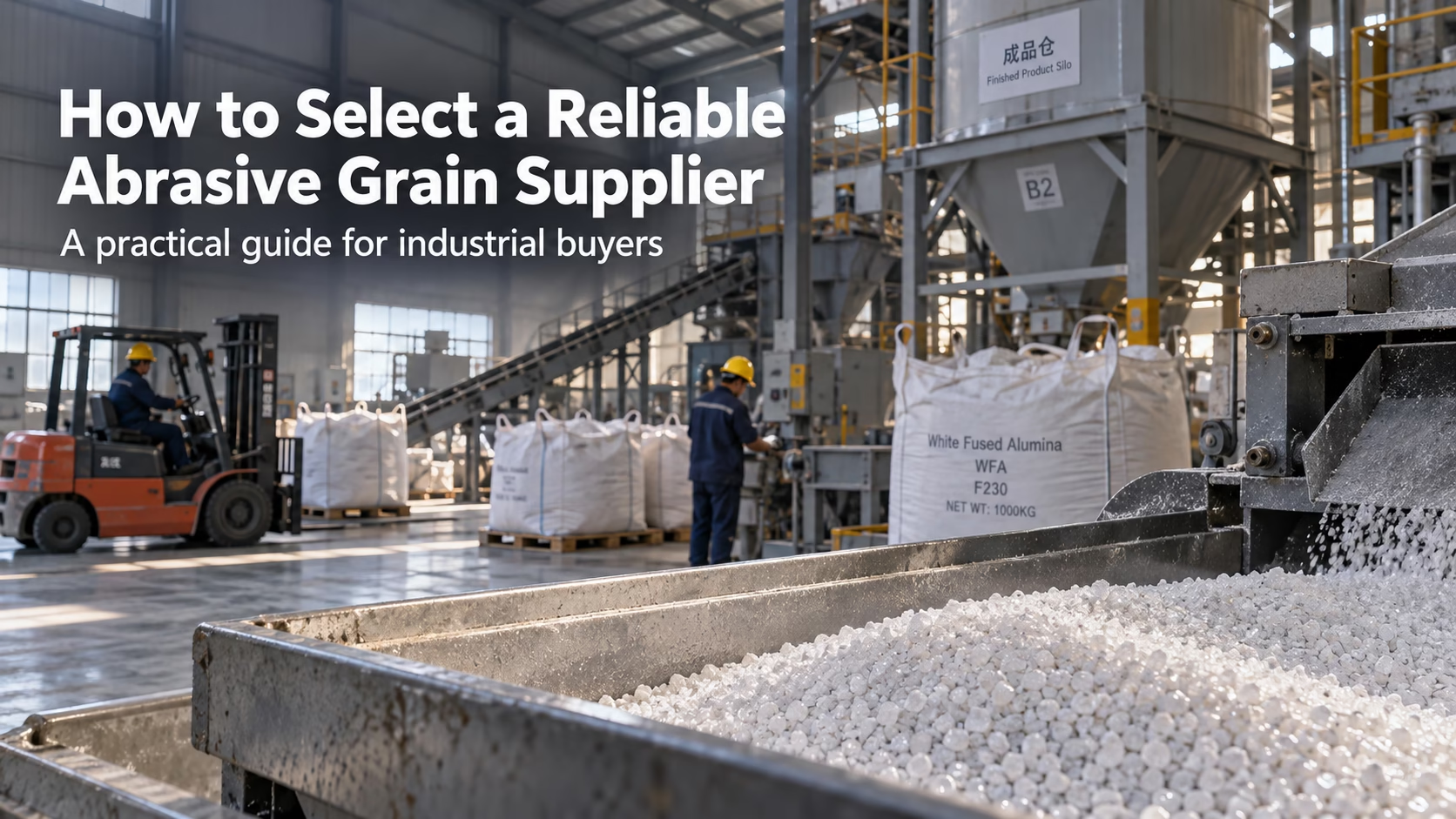
1. Check Whether the Supplier Is a Real Manufacturer
A professional website is not proof that a company owns a factory.
When researching an abrasive grain manufacturer, look beyond product pages.
Look for evidence of actual production, such as:
- Factory location
- Electric arc furnaces
- Crushing equipment
- Screening equipment
- Classification systems
- Washing equipment
- Magnetic separation
- Powder-processing lines
- Laboratory facilities
- Packaging areas
- Warehouse capacity
- Production workers and equipment
For fused alumina, the manufacturing process is particularly important because the raw material and subsequent processing both influence the final abrasive properties.
예를 들어, when evaluating a white fused alumina supplier, it is useful to understand how raw alumina is selected, melted, cooled, crushed, cleaned, 기밀, tested, and packaged. Our guide to the white fused alumina manufacturing process explains these stages in more detail.
Questions to Ask
Before requesting a large quotation, ask:
- Do you operate your own production facility?
- Which parts of the production process are handled in-house?
- What type of furnace or processing equipment do you use?
- Can you provide factory photos or a production video?
- Where does the material come from?
- Do you have your own laboratory or quality-control department?
If the supplier cannot answer basic manufacturing questions, I would be careful about treating it as a direct manufacturer.
2. Check the Abrasive Grain Specification
Never buy abrasive grain based only on the product name.
“White fused alumina” tells you the material family, but it does not tell you enough about how the product will perform in your application.
Before purchasing, define the complete specification.
Important factors include:
- Abrasive material
- Grade
- Grit size
- 입자 크기 분포
- 화학 성분
- 입자 모양
- 경도
- Specific gravity
- 부피 밀도
- Magnetic impurities
- 수분
- 표면 처리, if applicable
예를 들어, F24, F46, F80, and F120 represent different particle-size requirements. A micro powder used for precision polishing has a completely different requirement from coarse abrasive grain used for blasting.
If you want a more detailed explanation of FEPA, 안시, JIS and other grading systems, see our guide to abrasive grain sizes.
The lesson is simple:
Do not compare suppliers until you have defined exactly what material you are comparing.
3. Choose the Right Abrasive Grain for Your Application
The “best” abrasive grain depends on what you are trying to do.
A reliable abrasive grain supplier should not simply ask you:
“How many tons do you need?”
A better supplier will also ask:
“What is the material being processed?”
“What is the application?”
“What surface finish do you need?”
“What abrasive equipment are you using?”
Abrasive Blasting
For blasting applications, buyers may focus on:
- Cutting ability
- 표면 프로필
- Reusability
- Cleanliness
- 입자 모양
- 표면 마무리
White fused alumina is often selected when a high-purity abrasive with sharp cutting characteristics is required. Different grain sizes can produce different surface profiles and finishing results.
For larger abrasive grain applications, you can also compare white fused alumina abrasive grain specifications and available sizes.
연마
Grinding applications can require a very different combination of grain characteristics.
Important considerations include:
- Grain hardness
- 부서지기 쉬움
- 입자 모양
- Bond compatibility
- 입자 크기
- Thermal behavior
The right abrasive grain can influence grinding efficiency and the life of the abrasive tool.
Polishing and Lapping
Fine abrasive powder and micro powder require much tighter attention to particle-size distribution.
For these applications, you may need to compare:
- D10
- D50
- D90
- Oversize particles
- Fine particles
- 청정
- Particle morphology
This is particularly important when purchasing white fused alumina powder for precision grinding, 랩핑, 세련, or other applications where surface finish matters.
For even finer applications, buyers should also evaluate the supplier’s 백색 융합 알루미나 미세 분말 capability, including particle-size control and classification.
Refractory Applications
For refractory materials, chemical purity and thermal performance can become more important than simply having an aggressive abrasive grain.
Depending on the product, buyers may examine:
- Al₂O₃
- Na2O
- Fe₂O₃
- SiO2
- Density
- 결정 구조
- Thermal stability
The same material name does not mean the same specification is suitable for every application.
4. Compare Chemical Purity and Impurity Levels
One common mistake when comparing abrasive grain suppliers is to focus only on the main component.
For white fused alumina, for example, you may see:
Al₂O₃ ≥ 99%
That is useful, but it is not the complete picture.
You should also look at:
- Fe₂O₃
- SiO2
- Na2O
- TiO₂
- CaO
- MgO
- Other trace impurities
The acceptable level depends on your application.
정밀연마용, 도예, 전자 제품, or high-purity refractory applications, impurity control may be particularly important.
동시에, higher purity does not automatically mean “better” for every application. A material should be judged against the requirements of the production process.
예를 들어, if you are comparing a white fused alumina powder manufacturer, look at both the chemical composition and particle-size distribution. A supplier may meet the required Al₂O₃ level while still having particle-size or contamination characteristics that are unsuitable for your process.
This is why I recommend comparing the complete specification, rather than comparing one number.
5. Ask for a TDS and COA
A serious industrial supplier should be able to provide technical documentation.
Two documents are particularly useful.
TDS — Technical Data Sheet
A TDS describes the product specification.
It may include:
- 화학 성분
- Grain size
- 입자 크기 분포
- 물리적 특성
- Density
- Typical applications
- Applicable standards
COA — Certificate of Analysis
A COA is normally related to a specific production batch and reports test results for that batch.
This distinction is important.
| TDS | COA | |
|---|---|---|
| Main purpose | Product specification | Batch verification |
| Describes | Typical or required properties | Actual test results |
| Batch-specific | Usually no | 예 |
| Used for supplier comparison | 예 | 예 |
| Used for incoming inspection | Sometimes | Very useful |
When evaluating an abrasive grain supplier, I would ask for both.
A TDS tells you what the supplier says the product should be.
A COA helps you understand what a particular batch actually tested at.
For WFA buyers, it is also useful to compare the supplier’s published specification with its actual white fused alumina product specifications, including available grit sizes and chemical composition.
6. Check Which Standards the Supplier Can Follow
Different industries and customers may use different abrasive grain standards.
Common systems include:
- 밥을 먹이다
- 그
- 안시
- GB
- Customer-specific specifications
Do not assume that the same grit number automatically means exactly the same particle-size distribution under every standard.
Instead of saying:
“I need 1000 mesh white alumina.”
It is better to provide:
재료: 흰색 융합 알루미나
기준: 그
Grade: #1000
애플리케이션: Precision polishing
The more specific your inquiry, the easier it is for suppliers to give you a meaningful quotation.
For buyers who regularly compare different grading systems, the abrasive grain size guide can also help explain why grit numbers should always be considered together with the relevant standard and test method.
7. Always Request Samples Before Bulk Orders
A sample is one of the simplest ways to reduce purchasing risk.
A supplier may provide a perfect-looking product photograph and an impressive specification sheet, but neither tells you exactly how the abrasive will behave in your production environment.
Before placing a large order, test a sample under your normal operating conditions.
For macro abrasive grains, you may evaluate:
- Grain size
- 입자 모양
- 경도
- 표면 마무리
- Cutting performance
- Dust generation
- Consumption rate
For fine powders and micro powders, you may also examine:
- 입자 크기 분포
- D10
- D50
- D90
- Oversize particles
- 청정
- 표면 마무리
The sample should ideally be identified with a batch number so that you can later compare the production order against the approved sample.
A good abrasive grain manufacturer should understand that industrial buyers often need to validate the material before committing to regular supply.
8. Evaluate Quality Control and Production Consistency
Quality control should not happen only at the end of production.
A reliable abrasive supplier should have control points throughout the process.
For fused alumina, a simplified production flow may look like this:
Raw Material → Fusion → Cooling → Crushing → Magnetic Separation → Washing → Screening → Classification → Testing → Packaging
Each stage can influence the final material.
예를 들어, crushing affects grain shape. Screening and classification affect particle-size distribution. Magnetic separation can help remove magnetic contamination. Washing and cleaning can influence the cleanliness of fine powders.
This is why it is useful to understand the supplier’s actual white fused alumina manufacturing process instead of relying only on the product description.
The question I would ask is not simply:
“Is your product high quality?”
Instead, ask:
“How do you maintain batch-to-batch consistency?”
That question tells you much more about the supplier’s actual quality system.
9. Check Production Capacity and Supply Stability
A supplier may offer an excellent price for your first order but struggle to supply you consistently later.
This is why production capacity should be evaluated together with your expected purchasing volume.
Ask:
- What is your annual production capacity?
- What is your monthly production capacity?
- How many production lines do you operate?
- What is your normal lead time?
- What is your MOQ?
- Can you support repeat orders?
- Can you reserve production capacity for regular customers?
- What happens if demand suddenly increases?
Do not focus only on the supplier’s maximum annual capacity.
The more important question is:
Can the supplier consistently deliver your required specification at your required volume?
예를 들어, Yumo currently describes itself as a China-based abrasive materials manufacturer focused on white fused alumina micro powder and grinding and polishing materials, with two production lines, three JZF precision classification systems, and more than 5,000 tons of annual capacity.
Those figures are useful for understanding production capability, but buyers should still evaluate actual samples, specifications, lead times, and repeat-order performance before making a long-term decision.
10. Compare Price Based on Total Cost, Not Just Price per Ton
Price is important. But the lowest quotation is not necessarily the lowest-cost supplier.
Imagine two suppliers offer the following:
Supplier A: $800/톤
Supplier B: $750/톤
At first glance, Supplier B appears cheaper.
But suppose Supplier B has:
- Less consistent particle size
- More oversize particles
- Higher contamination
- Higher material consumption
- More production downtime
- More rejected material
The actual cost may be higher.
A better way to think about purchasing cost is:
Total Procurement Cost = Material Price + 포장 + Freight + Import Cost + Quality Loss + Rejection + Production Loss
This is especially important for industrial abrasive materials because the abrasive itself can affect production efficiency.
When comparing an abrasive grain supplier, ask yourself:
“What does this material actually cost me after it enters production?”
That is much more useful than simply comparing the price per metric ton.
11. Evaluate Packaging and Shipping
Packaging is easy to overlook until the material arrives damaged, contaminated, or exposed to moisture.
일반적인 포장 옵션은 다음과 같습니다.:
- 25 kg 가방
- 25 kg paper bags
- 500 kg 가방
- 1,000 kg jumbo bags
- Palletized packaging
- Customized export packaging
For fine abrasive powder, packaging should provide appropriate protection against moisture, contamination, and cross-mixing.
You should also check:
- Bag strength
- Inner liner
- Pallet quality
- Product labeling
- Batch number
- Net weight
- Container loading
- Moisture protection
For larger WFA particles and refractory applications, buyers can also compare white fused alumina coarse and segmented sizes and the packaging options available for bulk orders.
For international orders, shipping preparation is part of product quality.
A good abrasive grain supplier should understand that the material needs to arrive in the same condition in which it left the factory.
12. Check Communication and Technical Support
This is one of the easiest factors to underestimate.
Suppose you send a supplier the following message:
“We need white fused alumina micro powder for polishing. Which grade would you recommend?”
A professional supplier should ask about your application, polishing equipment, 필요한 표면 마감, 입자 크기, standard, and expected quantity.
A weak supplier may simply respond:
“Price?”
“MOQ?”
“Yes.”
Technical communication matters because abrasive materials are application-specific.
A reliable supplier should be able to discuss:
- Material selection
- Grit size
- 입자 크기 분포
- FEPA/JIS specifications
- 화학 성분
- 포장
- Samples
- Testing
- Production lead time
If the communication is poor before the order, it usually does not become easier after the order.
Abrasive Grain Supplier Evaluation Checklist
If I were comparing several suppliers, I would use a simple checklist like this:
| Evaluation Factor | What to Check | Importance |
|---|---|---|
| 제조업체 | Own production facility | High |
| 원료 | Source and purity | High |
| Grain Size | FEPA/JIS/ANSI/GB | High |
| Chemistry | Main oxides and impurities | High |
| TDS | Technical specification | High |
| COA | Batch test results | High |
| 견본 | Pre-purchase testing | High |
| QC | Production and inspection process | High |
| Capacity | Production capability | Medium/High |
| MOQ | Minimum order quantity | 중간 |
| Lead Time | Production and delivery time | High |
| 포장 | Bags, 팔레트, protection | 중간 |
| Communication | Technical support | Medium/High |
| Price | Total procurement cost | 중간 |
I would not choose a supplier based on one factor.
A supplier with a slightly higher price but better consistency, technical support, and delivery reliability may be a much better long-term partner.
신뢰할 수 있는 연마 입자 공급업체를 선택하는 방법: A Simple 7-Step Process
If you want to simplify the entire purchasing process, use these seven steps.
Step 1 — Define Your Application
Start with what you are actually trying to accomplish.
연마? 폭파? 세련? 랩핑? 내화 벽돌? 도예?
Step 2 — Define the Abrasive Material
Determine whether you need white fused alumina, 갈색 용융 알루미나, 실리콘 카바이드, or another abrasive.
If you are still comparing different alumina materials, reviewing the fused alumina product range can help you understand the general positioning of different abrasive materials.
Step 3 — Define the Grit and Standard
Specify the required grit size and grading system.
예를 들어:
흰색 융합 알루미나 / FEPA F80
또는:
백색 용융 알루미나 마이크로 파우더 / 그 #1000
Step 4 — Shortlist Real Manufacturers
Check factory information, production capability, technical resources, and export experience.
Step 5 — Request TDS, COA and Samples
Do not rely only on the supplier’s product description.
Step 6 — Test the Material
Use the sample in your actual application whenever possible.
Step 7 — Compare Total Cost and Long-Term Supply
Only after the technical requirements are confirmed should you make the final commercial comparison.
This process may take slightly longer at the beginning, but it can save much more time and money later.
Why Work Directly With an Abrasive Grain Manufacturer?
For companies with recurring industrial requirements, buying directly from a manufacturer can offer several advantages.
You may have more direct communication regarding:
- Product specifications
- Particle-size customization
- Production schedules
- Quality control
- Samples
- 포장
- Technical problems
- Repeat orders
This can be particularly useful when your abrasive material is not a generic commodity but an important part of your production process.
예를 들어, a buyer sourcing white fused alumina powder may need a very different specification from a company purchasing coarse WFA for sandblasting.
A manufacturer with its own processing and classification capabilities can potentially adjust the product more effectively to the customer’s requirements.
Why Consider Yumo for White Fused Alumina?
For industrial buyers looking for a China-based white fused alumina manufacturer, 허난 유모 신소재 유한회사, 주식회사. focuses on fused alumina and silicon carbide materials for abrasive, 내화 물질, 폭파, 연마, 세련, and industrial surface-treatment applications.
Yumo’s product range includes white fused alumina coarse grain, abrasive-grade grain, 미세 분말, and micro powder. Its product information also highlights customized particle-size requirements and sample support for industrial buyers.
For buyers who want to understand the company, factory capabilities, production capacity, and product focus before making an inquiry, the About Yumo page provides additional company information.
If your requirement is specifically white aluminium oxide powder, you can also review the detailed white aluminium oxide powder information, including applications, particle-size control, and supplier capabilities.
For customers comparing abrasive materials for actual production, Yumo also provides abrasive products and related grinding and abrasive tools, allowing buyers to evaluate abrasive materials in the broader context of grinding and finishing applications.
The most useful approach is not to take any supplier’s claims at face value. Request the technical specification, confirm the required grade, test the sample, and compare the results against your current material.


