
哪种磨料最适合喷砂?
喷砂最佳磨粒取决于工件材料, 您需要达到的表面条件, the blasting equipment, and whether the abrasive will be collected and reused. For many industrial applications, brown fused alumina is a practical option because it combines hardness, 韧性, and availability in different grain sizes. 然而, garnet, 白刚玉, 碳化硅, steel grit, and glass-based media may be more appropriate for particular requirements.
I recommend starting with the intended result rather than choosing a material simply because it is widely used. Removing heavy rust from carbon steel requires a different approach from cleaning aluminum components or preparing a surface for a precision coating. The best abrasive must remove unwanted material without causing unacceptable damage, 污染, or surface roughness.
| Abrasive material | Common applications | Main consideration |
|---|---|---|
| 棕刚玉 | Industrial blasting and metal surface preparation | Balance of toughness and cutting action |
| 白刚玉 | Applications requiring high-purity alumina abrasive | Purity and contamination control |
| 碳化硅 | Specialized blasting and hard-material processing | High hardness and sharp cutting action |
| Garnet | Surface preparation and waterjet cutting | Particle quality and recovery requirements |
| Steel grit | Cleaning and profiling steel components | Equipment compatibility and potential contamination |
| Glass beads | Cleaning and finishing with a less aggressive effect | Rounded shape and desired surface appearance |
| Crushed glass | Selected cleaning and surface preparation tasks | Angularity, dust control, and substrate compatibility |
These are general application guidelines, not a universal ranking. The best option should be confirmed through technical specifications and, where necessary, sample testing.
Common Types of Abrasive Grains for Sandblasting
棕刚玉
Brown fused alumina is a widely used synthetic abrasive produced by melting bauxite-based raw materials in an electric arc furnace, followed by crushing, 打扫, and particle-size classification. Its hardness and toughness make it suitable for many demanding industrial abrasive applications.
For sandblasting, brown fused alumina can be considered for metal surface preparation, 除锈, coating preparation, and other processes requiring effective mechanical cleaning. The appropriate grade depends on the surface profile, blasting pressure, nozzle configuration, and workpiece material.
YUMO supplies different brown fused alumina abrasive grades and grain sizes for blasting, 磨削, and related industrial applications. When evaluating a grade, I would confirm its particle-size distribution and technical specifications rather than rely on the grit number alone.
白刚玉
白刚玉 (世界足协) is manufactured from high-purity alumina and is known for its hardness and relatively sharp cutting characteristics. It may be suitable for blasting applications where abrasive purity and contamination control are important.
然而, higher purity does not automatically make white fused alumina the best choice for every job. For general steel cleaning, brown fused alumina or other media may offer a more suitable balance of performance and cost. The decision should reflect the actual substrate, finishing requirements, and process economics.
You can explore YUMO’s white fused alumina abrasive products for available grain forms and specifications.
碳化硅
Silicon carbide is a hard, sharp synthetic abrasive used for specialized industrial processing, including applications involving glass, 陶瓷, 石头, and other hard materials. Its cutting characteristics can be useful when a more aggressive abrasive is required, but its suitability for blasting depends on the workpiece, 设备, and overall cost.
I would not select silicon carbide for ordinary blasting solely because it is very hard. Its properties should provide a meaningful benefit for the particular application.
YUMO offers black and green silicon carbide abrasive materials in different forms and specifications for industrial use.
Garnet, Steel Grit, and Glass-Based Media
Garnet is a natural mineral abrasive used in surface preparation and waterjet cutting. Its suitability for blasting depends on mineral grade, particle distribution, 清洁度, and whether the media can be recovered effectively.
Steel grit is commonly used for cleaning and profiling steel components in compatible industrial blasting systems. Because it is a metallic abrasive, buyers must consider equipment design, substrate compatibility, and the possibility of introducing unwanted metallic contamination.
Glass beads have a rounded shape and are often selected when the objective is cleaning or finishing rather than aggressive cutting. Crushed glass, by contrast, has angular particles and may be used for selected surface-preparation tasks.
The main lesson is that abrasive materials should be selected by their properties and intended use, not simply grouped together as interchangeable blasting media.
How to Choose the Right Abrasive Grain for Your Application
When I evaluate an abrasive for sandblasting, I start with the workpiece and the required surface result. This approach is more useful than choosing a material first and trying to adapt it to the process afterward.
Consider the Workpiece Material
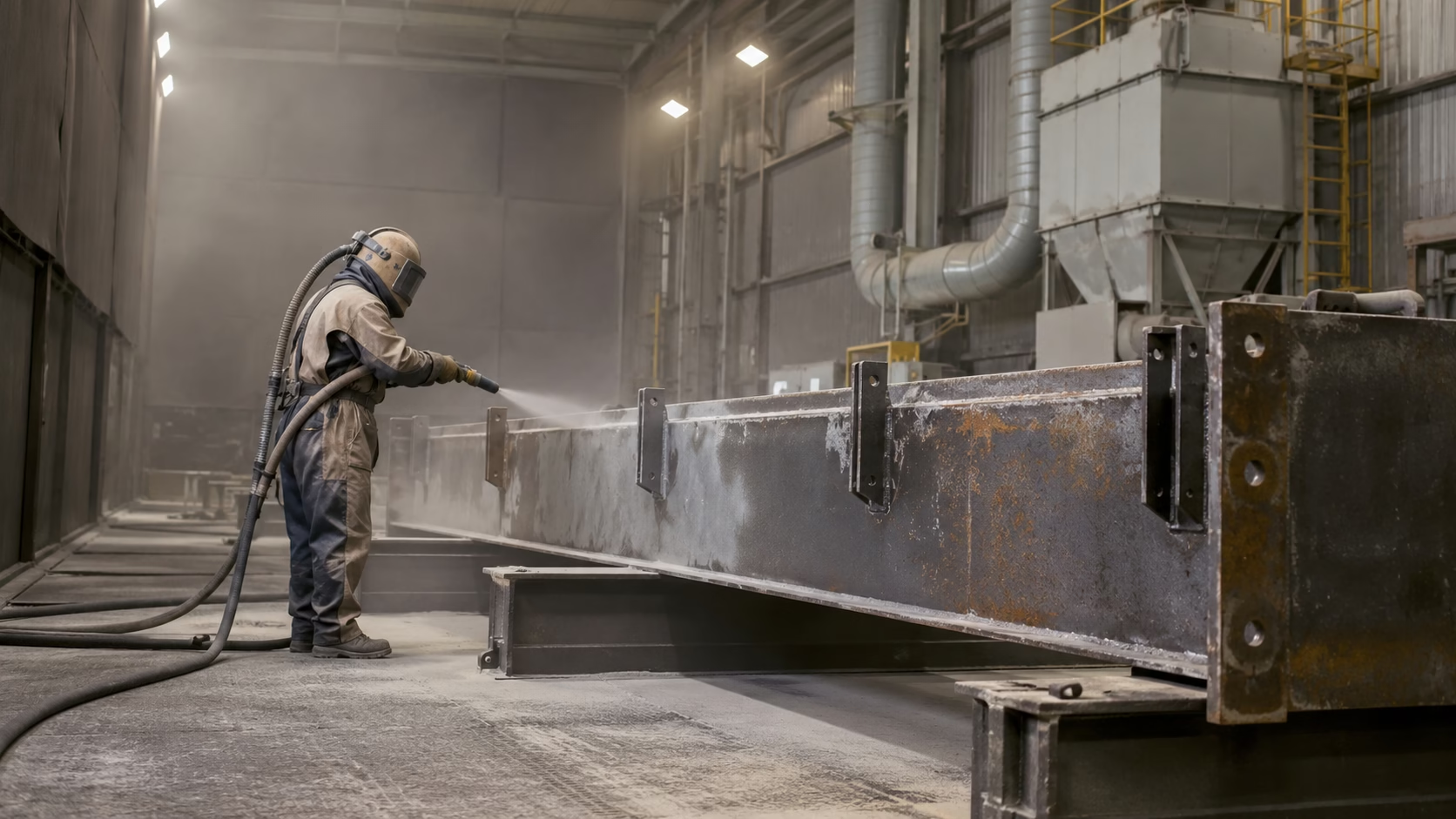
Different materials respond differently to abrasive impact. Carbon steel may require effective rust removal and a surface profile suitable for coating adhesion. Aluminum and other softer metals may need a less aggressive approach to avoid excessive material removal or surface damage. Glass and ceramics require particular care because their surface characteristics and fracture behavior differ from those of metals.
Contamination is another consideration. If the workpiece has strict cleanliness requirements, confirm whether the selected abrasive could introduce unwanted residues or other contaminants.
Define the Required Surface Profile
Ask what the blasting operation needs to accomplish. Is the goal to remove rust, strip an existing coating, clean a casting, prepare steel before painting, or create a specific surface profile?
Coarser or more angular particles can provide more aggressive mechanical action, while finer grades may be appropriate for more controlled finishing. 然而, abrasive size alone does not determine the result. 压力, nozzle distance, impact angle, exposure time, and substrate condition all play a role.
For steelwork before painting, the relevant specifications may include the cleanliness grade and required surface profile. These requirements should be established before choosing the abrasive.
Consider Equipment, Reuse, and Total Cost
The blasting system influences which abrasives are practical. Some operations use expendable media, while others rely on recovery and recycling systems. Reusable metallic media, 例如, require equipment designed to handle their characteristics and a process for separating broken particles and contaminants.
I also recommend comparing the total processing cost rather than the purchase price alone. Abrasive consumption, cleaning speed, waste disposal, labor, equipment wear, and the need for rework all affect the economics of a blasting operation.
A suitable abrasive is one that achieves the required result reliably at an acceptable overall cost.
How Abrasive Grain Size Affects Sandblasting Results
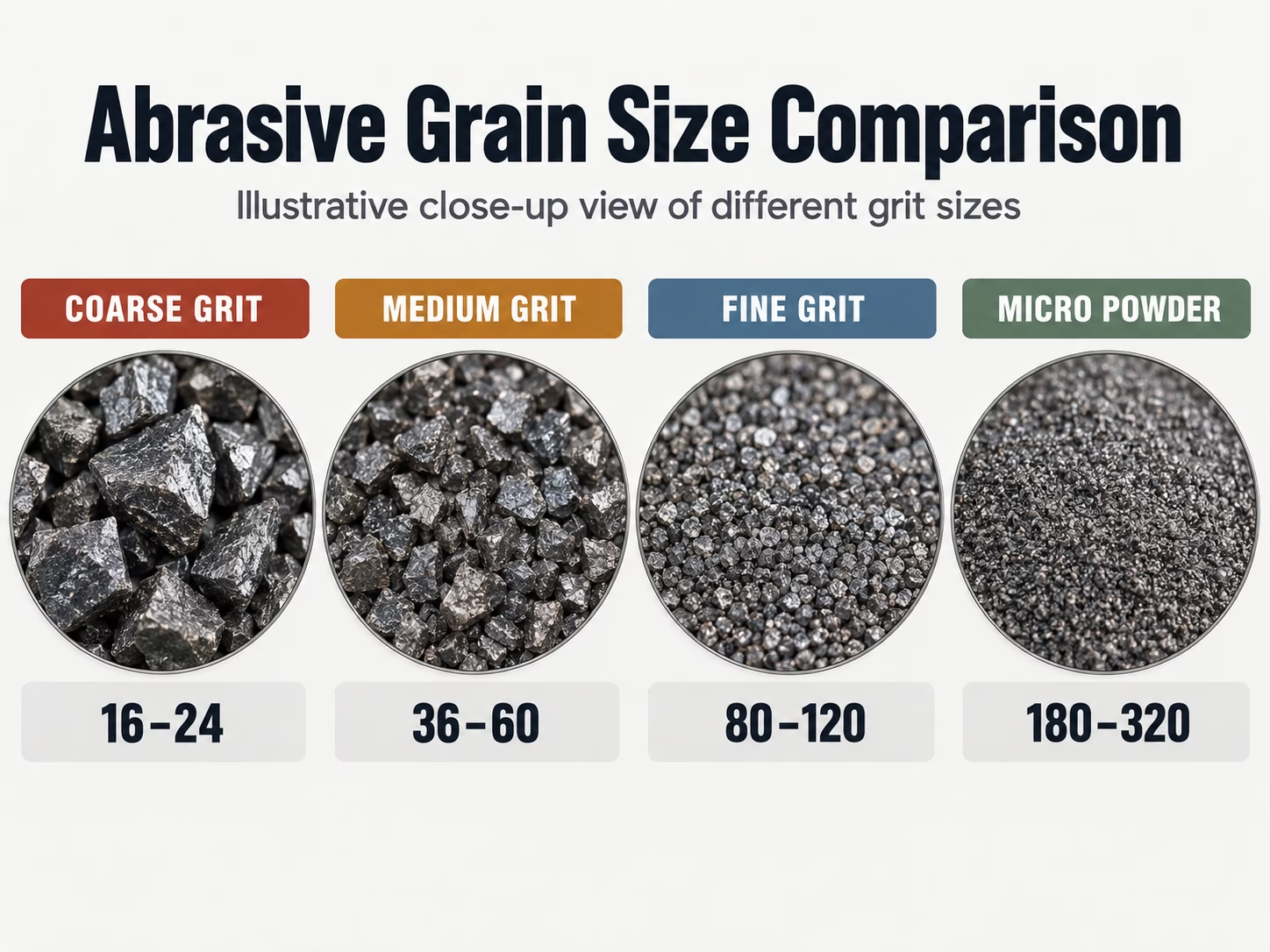
Abrasive grain size influences how particles interact with a surface. Coarser particles often produce more aggressive impact and may create a deeper surface profile, while finer particles may provide more controlled cleaning or finishing. The actual outcome depends on particle shape, 硬度, blasting conditions, and substrate properties.
Coarse vs. Fine Abrasive Grains
Coarse abrasives may be appropriate for heavy cleaning, removing firmly attached coatings, or preparing a surface that requires a pronounced profile. Finer grades can be useful when the process requires more controlled material removal or a less aggressive finish.
These are starting points rather than universal rules. A coarse abrasive used at an unsuitable pressure can damage a workpiece, while a fine abrasive may be inefficient for heavy rust removal.
Understanding Grit, Mesh, and Micron
Grit designations, mesh sizes, and micron measurements are not interchangeable without reference to the applicable grading method.
FEPA explains that abrasive size designations depend on the product category: F-grit sizes are used for bonded abrasives, while P-grit sizes are used for coated abrasives. Its grain standards define particle-size distributions rather than treating each grade as one exact particle diameter.
For blasting media, buyers should confirm the specification relevant to the actual material. 国际标准化组织 11126-1:2025 covers the classification and designation of non-metallic blast-cleaning abrasives used for preparing steel substrates before coating. It is a more directly relevant reference for many non-metallic blasting applications than assuming a grinding-abrasive grit designation defines every blasting medium.
For a broader explanation of particle-size systems, see YUMO’s guide to abrasive grain sizes explained: 喂养, 美国国家标准学会, and JIS.
Sandblasting Safety and Common Buying Mistakes
Choosing the right abrasive involves safety as well as performance. One important mistake is assuming that any material sold as blasting sand is safe to use in an industrial environment.
The US Occupational Safety and Health Administration (OSHA) identifies abrasive blasting with silica-containing materials as a potential source of respirable crystalline silica exposure. Inhaling this fine dust can cause serious diseases, including silicosis. OSHA’s crystalline silica guidance explains the associated hazards and worker-protection requirements.
I recommend assessing the hazards of both the abrasive and the material being blasted. Dust extraction, suitable ventilation, containment, exposure controls, and appropriate respiratory and other protective equipment should be selected according to the task and applicable regulations. Alternative blasting media should also be assessed for their own hazards rather than assumed to be risk-free.
Other common mistakes include:
Choosing abrasive solely by price without considering consumption and disposal costs.
Selecting grain size without defining the desired surface profile.
Assuming the same grit number means the same particle-size distribution across different standards.
Reusing abrasive without checking contamination, particle breakdown, and equipment requirements.
Ignoring the workpiece’s risk of damage or contamination.
A clear specification and a controlled trial can help prevent costly mistakes before full-scale production begins.
结论: Find the Best Abrasive Grain for Your Sandblasting Needs
The best abrasive grain for sandblasting is the one that meets the cleaning or surface-preparation requirements without creating unnecessary cost, damage, or safety risks. Brown fused alumina is a practical option for many industrial applications, but white fused alumina, 碳化硅, garnet, steel grit, and glass-based media each have their own uses.
Before purchasing, confirm the workpiece material, 目标表面轮廓, grain size, applicable standard, equipment compatibility, and safety requirements. Where performance is uncertain, test a suitable sample under controlled conditions before committing to a bulk order.
Need Abrasive Grains for Sandblasting? YUMO Can Help
YUMO supplies brown fused alumina, 白刚玉, and silicon carbide in different abrasive grades for industrial applications. If you are sourcing abrasive grains for sandblasting or surface preparation, share your workpiece material, required grain size, 目标表面轮廓, 应用, and estimated quantity with our team.
We can discuss the available grades and technical specifications to help you identify a suitable material for your process. Whether you are preparing metal surfaces, evaluating abrasive media for a production line, or sourcing materials for distribution, our goal is to help you match the abrasive specification to your actual requirements.
Contact YUMO to discuss your sandblasting abrasive requirements and request product specifications or a quotation.
Frequently Asked Questions About Sandblasting Abrasives
What is the best abrasive grain for sandblasting?
There is no single best abrasive for every blasting task. Brown fused alumina is a versatile option for many industrial applications, while garnet, 白刚玉, 碳化硅, steel grit, and glass-based media may be better suited to specific workpieces and finishing requirements. The right choice depends on the required surface profile, 设备, safety controls, and total processing cost.
Is brown fused alumina good for sandblasting?
是的. Brown fused alumina can be suitable for industrial sandblasting and surface preparation because of its hardness, 韧性, and availability in different grain grades. Its effectiveness depends on particle size, blasting conditions, the workpiece material, and the surface profile required.
What abrasive grain size should I use for sandblasting?
Choose a size based on the cleaning objective, required surface profile, substrate, and equipment. Coarser particles may be suitable for aggressive cleaning, while finer grades can be used for more controlled finishing. Confirm the actual size distribution and applicable specification with the supplier before ordering.
What is the difference between aluminum oxide and silicon carbide for blasting?
Aluminum oxide abrasives are widely used for industrial surface preparation and grinding-related applications. Silicon carbide is harder and has sharp cutting characteristics that can be useful for specialized processing. Neither is automatically better for every job; compare the workpiece, required finish, abrasive consumption, and cost.
Can sandblasting abrasives be reused?
Some abrasives can be reused when the equipment and process support recovery, 打扫, and classification. Reuse depends on the media’s durability, particle breakdown, 污染, and the quality requirements of the job. There is no universal number of reuse cycles that applies to every abrasive.


