
白刚玉 uses range from precision grinding and abrasive blasting to refractory production, investment casting, polishing and wear-resistant coatings.
Also known as white aluminum oxide, white corundum or WFA, white fused alumina is an electrically fused synthetic mineral made primarily from high-purity aluminum oxide. Its combination of high hardness, controlled friability, angular grain shape, low iron content and thermal stability makes it suitable for processes that require clean and precise material removal.
然而, not every WFA grade is suitable for every application. Coarse grains, FEPA macrogrits, microgrits and fine powders perform differently. Selecting the correct particle size, grain shape and purity level is therefore just as important as selecting the material itself.
This guide explains the main industrial uses of white fused alumina, why manufacturers choose it and how buyers can select an appropriate grade.
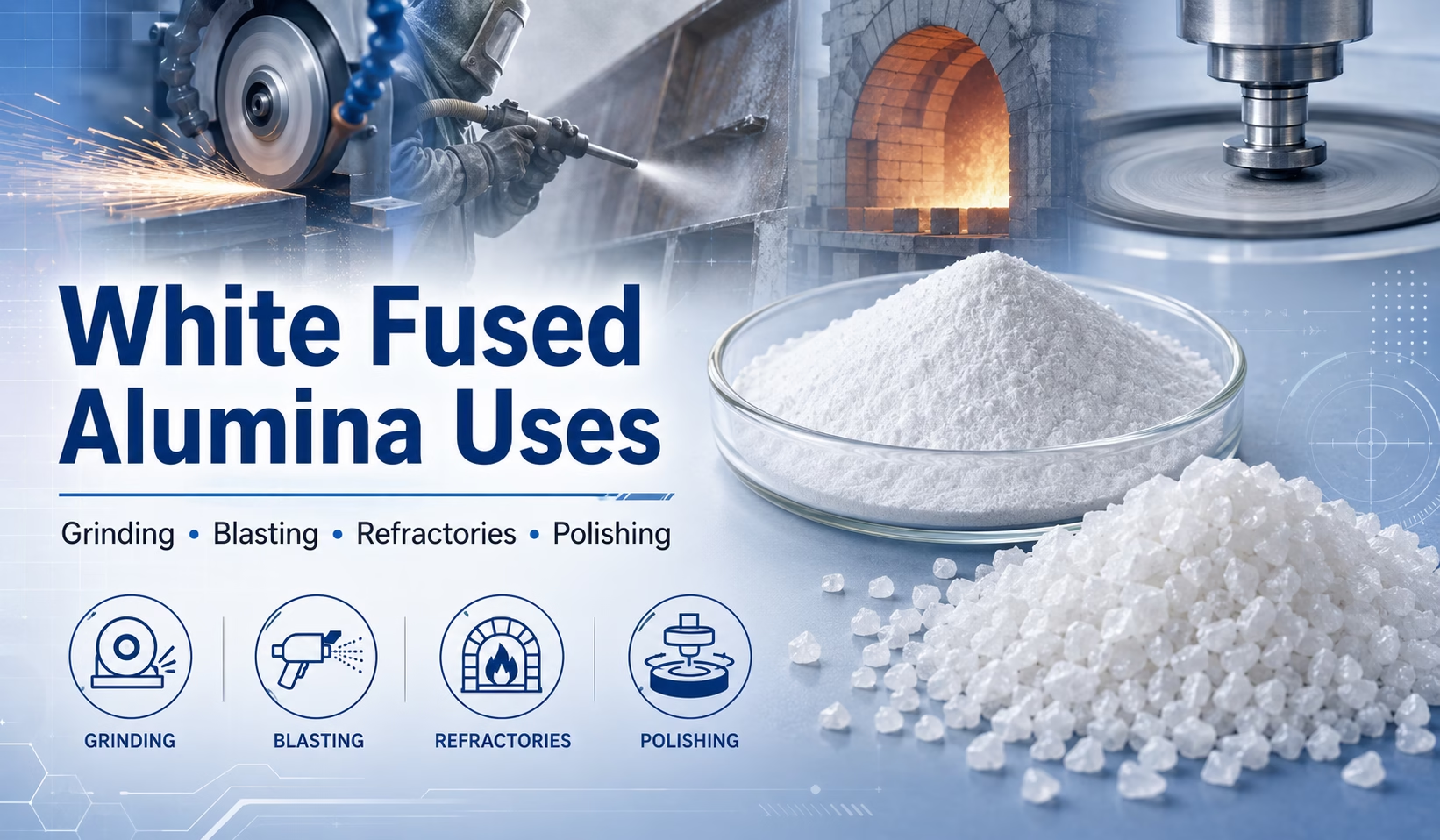
快速解答: What Is White Fused Alumina Used For?
White fused alumina is mainly used for:
- Bonded grinding wheels
- Coated abrasives and sandpaper
- Abrasive blasting and surface preparation
- Lapping and precision polishing
- Refractory castables and refractory shapes
- Investment casting shell coatings
- Technical ceramics
- Wear-resistant coatings
- Heat-treatment setting sands
- Industrial fillers, laminates and anti-slip surfaces
FEPA identifies fused aluminum oxide as one of the principal materials used in abrasive grains. These grains are incorporated into bonded and coated abrasives and are also used for blasting, 耐火材料, 地板, 研磨和抛光.
White fused alumina is normally selected when high purity, 低铁污染, controlled cutting and a clean surface finish are more important than maximum impact toughness.
White Fused Alumina Uses at a Glance
| 应用 | Common Product Form | Why WFA Is Used |
| 精密磨削 | F-grits and macrogrits | Hard, sharp and self-renewing cutting edges |
| Grinding wheels | Macrogrits and microgrits | Controlled friability and relatively cool cutting |
| Sandpaper | P-grits | Clean cutting and consistent scratch pattern |
| Abrasive blasting | Angular grains | Surface cleaning, profiling and coating preparation |
| Lapping | Fine grains and microgrits | Controlled material removal and surface flatness |
| 抛光 | Fine powder and micro powder | Fine finish with controlled oversized particles |
| 耐火材料 | Coarse grain, aggregate and fine powder | High-temperature and abrasion resistance |
| Investment casting | Flour and stucco grain | High-purity refractory shell material |
| Wear-resistant coatings | Fine powder or graded grain | Hardness and resistance to surface wear |
| Heat treatment | Setting sand | Thermal stability and separation of components |
| 陶瓷 | Powder and graded grain | High alumina content and wear resistance |
| Anti-slip surfaces | Graded abrasive grain | Hard, angular texture and long wear life |
The exact grade depends on the production process, required finish, particle-size standard and acceptable impurity levels.
Why Is White Fused Alumina Used in Industrial Manufacturing?
White fused alumina is used because it combines several useful properties in one material:
- Mohs hardness of approximately 9
- High Al₂O₃ content
- Sharp or blocky angular particles
- Controlled friability
- Low iron and coloring impurities
- High melting point
- Good chemical stability
- Strong wear resistance
- Availability from coarse grains to fine microgrits
Washington Mills lists white fused alumina as a raw material for refractories, ceramic shapes, 砂轮, 砂纸, blasting media, metal preparation, 层压板, 涂料, 研磨, polishing and grinding.
The most important advantage is not simply that WFA is hard. It is the balance between hardness, purity and fracture behavior.
As a white fused alumina grain becomes dull during grinding, parts of the grain may fracture and expose new cutting edges. This self-sharpening behavior can support consistent cutting and reduce excessive rubbing in suitable grinding systems.
1. Bonded Abrasives and Grinding Wheels
One of the most common white fused alumina uses is the manufacture of bonded abrasives.
Bonded abrasive products combine abrasive grains with a vitrified, 树脂, rubber or other bonding system. Common products include:
- Vitrified grinding wheels
- Resin-bonded grinding wheels
- Mounted points
- Grinding segments
- Sharpening stones
- Cut-off wheels
- Internal grinding wheels
- Surface grinding wheels
FEPA describes bonded abrasives as mixtures of abrasive grain, filler and bonding material designed for particular cutting speeds, finishes and stock-removal requirements.
WFA is particularly suitable for applications requiring a sharp and relatively cool cutting action. It is commonly considered for:
- Hardened steel
- Tool steel
- Stainless steel
- High-alloy steel
- Precision tools
- Bearings
- Cutting tools
- Heat-sensitive components
The controlled friability of WFA allows worn grain edges to break away and expose new cutting surfaces. This can reduce glazing and help maintain cutting efficiency.
然而, WFA is not always the best option for heavy-impact grinding. Brown fused alumina is generally tougher and may provide better grain life in aggressive, high-pressure applications.
Important Selection Factors
When choosing WFA for bonded abrasives, evaluate:
- FEPA F-grit designation
- Grain shape
- Friability
- 堆积密度
- Bond compatibility
- 磁性材料含量
- Surface treatment
- Oversized and undersized particle limits
FEPA lists fused aluminum oxide grains for bonded abrasive macrogrits from F4 to F220 and microgrits from F230 to F2000.
2. Coated Abrasives and Sandpaper
White fused alumina is also used in coated abrasive products, including:
- Abrasive paper
- Abrasive cloth
- Sanding belts
- Sanding discs
- Flap discs
- Abrasive film
- Specialty finishing products
In a coated abrasive, grains are fixed to a backing such as paper, woven cloth, polyester film or vulcanized fibre.
The angular particle shape of WFA helps the grain penetrate the workpiece instead of only rubbing against the surface. Its white color and low level of dark impurities are also useful when processing light-colored or contamination-sensitive materials.
Typical coated abrasive applications include:
- Stainless steel finishing
- Tool sharpening
- Precision metal sanding
- Surface preparation
- Deburring
- Fine finishing
- Wood coating preparation
- Selected ceramic finishing
Saint-Gobain notes that the fracture properties of premium abrasive grains continuously create new microscopic cutting surfaces in coated abrasive applications.
For coated abrasives, buyers should specify a P-grit designation rather than assuming that an F-grit of the same number is equivalent. FEPA lists fused aluminum oxide macrogrits for coated abrasives from P12 to P220.
3. Abrasive Blasting and Surface Preparation
White fused alumina is widely used as a blasting medium for cleaning, etching, profiling and preparing industrial surfaces.
Typical blasting tasks include:
- Removing oxide layers
- Removing light rust and scale
- Stripping old coatings
- Preparing surfaces before painting
- Preparing surfaces before bonding
- Creating a controlled surface profile
- Producing a matte finish
- Etching glass or ceramics
- Cleaning precision components
- Light deburring
Washington Mills identifies white aluminum oxide among the abrasive grains used for cleaning, etching, finishing, profiling, stripping, polishing and surface preparation of metal parts.
Its angular particles cut into the surface and can create a more defined profile than spherical blasting media.
When Is WFA Preferred for Blasting?
WFA is often selected when:
- Iron contamination must be minimized
- A clean, light-colored abrasive is required
- The workpiece is stainless steel or a non-ferrous alloy
- The blasting process requires a controlled finish
- The surface will receive a sensitive coating
- The component belongs to an aerospace, electronics or medical supply chain
Washington Mills notes that white fused alumina may be used in chemically sensitive environments such as medical and aerospace manufacturing because of its high purity.
The healthcare industry also uses abrasive grains and powders to prepare surfaces on selected medical devices, orthopedic implants and dental appliances. The exact media grade and process must be validated for the component and applicable quality requirements.
Wet and Dry Blasting
White fused alumina can be used in both wet and dry pressure-blasting systems. Blasting media are commonly used to clean a surface before coating or to produce a specified surface profile.
Wet blasting can help control dust and may create a softer finish. Dry blasting is usually more aggressive and easier to integrate into conventional blasting equipment.
4. Lapping and Precision Polishing
Fine WFA grains and micro powders are used in lapping and polishing processes that require controlled material removal.
Common applications include:
- Mechanical seals
- Piston rings
- Valve components
- Steel rings
- Cast-iron parts
- Bronze parts
- Optical components
- Precision instruments
- Ceramic components
- Semiconductor-related materials
- Flat metal surfaces
Saint-Gobain offers white fused alumina for performance-enhanced lapping and polishing applications. Its micrograded fused aluminum oxide products are engineered for controlled machining and close attention is given to coarse-particle control to reduce unwanted scratching.
Why Particle Distribution Matters
In polishing applications, the average particle size is not the only important value.
An oversized particle can create a deep scratch even when most particles are within the correct range. Buyers should therefore review:
- D10, D50 and D90 values
- Maximum particle size
- Oversized-particle control
- Agglomeration
- Suspension stability
- 水分
- Cleanliness
- 颗粒形状
A narrow particle-size distribution usually provides a more predictable cutting rate and surface finish.
Loose Abrasive Applications
WFA can be supplied as a loose abrasive powder and mixed with water, oil or another suitable vehicle to create a lapping or polishing slurry.
The correct carrier depends on the workpiece, 机器, required finish and cleaning process. The slurry formulation should be tested because settling behavior and abrasive concentration can affect both removal rate and surface quality.
5. Refractory Castables and Refractory Shapes
Refractory production is another major white fused alumina use.
WFA can be incorporated into:
- High-alumina castables
- Refractory bricks
- Precast refractory shapes
- Ramming mixes
- Gunning mixes
- Furnace linings
- Kiln furniture
- Burner components
- Refractory coatings
- High-temperature wear linings
Fused mineral grains are used in refractories because they can resist combinations of heat, corrosion, abrasion and impact.
White fused alumina is especially relevant when a refractory formulation requires:
- High alumina purity
- Low iron content
- High refractoriness
- Resistance to abrasion
- 化学稳定性
- Dimensional stability
- A light-colored raw material
- Reliable performance at elevated temperatures
Washington Mills describes refractory-grade white fused alumina as a raw material for dense refractory products requiring purity at elevated temperatures. White fused alumina bubbles can also be used in lightweight insulating refractories requiring lower thermal conductivity.
Aggregate and Matrix Functions
Coarse WFA grains may function as refractory aggregate, while fine powder fills spaces between larger particles and contributes to the matrix.
The final refractory performance depends on the entire formulation, including:
- Aggregate grading
- Fine-powder content
- Binder system
- Cement content
- Additives
- Installation method
- Firing temperature
- Open porosity
- Furnace atmosphere
- Slag chemistry
A high-purity raw material alone does not guarantee successful refractory performance.
6. Investment Casting Shells
White fused alumina is used in selected investment casting shell systems as refractory flour, coating material or stucco grain.
Common functions include:
- Primary or backup shell coating
- Refractory stucco
- Shell reinforcement
- Creating a heat-resistant mold surface
- Supporting dimensional stability during metal casting
Washington Mills lists refractory coatings for investment casting shells among the applications of special white fused alumina.
The high purity and thermal stability of WFA can be useful when casting systems require a clean refractory material and controlled interaction with molten metal.
Imerys also identifies white fused alumina grades for investment casting applications where high density and low porosity are important.
Selection Considerations
Investment casting buyers should consider:
- Flour particle-size distribution
- Stucco-grain size
- Slurry stability
- Shell permeability
- Thermal expansion
- Chemical compatibility with the alloy
- Surface-finish requirements
- Shell-removal behavior
The primary coat and backup coats may require different particle sizes or different refractory materials.
7. Technical Ceramics and Ceramic Shapes
White fused alumina may be used as a raw material in selected ceramic products and high-temperature ceramic shapes.
Potential applications include:
- Wear-resistant ceramic components
- Ceramic grinding media formulations
- Furnace components
- Electrical or thermal ceramic systems
- High-temperature structural parts
- Ceramic filters
- Ceramic tiles and shapes
Washington Mills lists ceramic shapes among the established applications of white fused aluminum oxide.
The suitability of WFA depends on the required ceramic microstructure. Fused alumina is not automatically interchangeable with calcined alumina, reactive alumina or tabular alumina.
Manufacturers must evaluate:
- Sintering behavior
- Particle morphology
- Green density
- Final porosity
- Shrinkage
- Binder compatibility
- Mechanical strength
- Electrical requirements
- 导热系数
For high-performance electrical or electronic ceramics, a specialized ceramic-grade alumina powder may be more appropriate than a conventional abrasive-grade WFA.
8. Wear-Resistant Coatings and Surface Systems
Fine white fused alumina can be incorporated into coatings that require a hard and wear-resistant surface.
Possible applications include:
- Industrial equipment coatings
- Wear-resistant metal coatings
- Floor coatings
- Protective laminates
- Abrasion-resistant panels
- Machinery surfaces
- Selected thermal spray systems
- Polymer or resin composite systems
Saint-Gobain lists wear-resistant coatings among the applications for its white fused aluminum oxide macrogrits and microgrits.
WFA contributes hardness and abrasion resistance, but coating performance also depends on:
- Resin or binder selection
- Grain concentration
- Particle size
- Particle distribution
- Adhesion
- Coating thickness
- Substrate preparation
- Curing conditions
Using particles that are too coarse can create an excessively rough surface, while particles that are too fine may not provide the required wear texture.
9. Heat-Treatment Setting Sands
White fused alumina can be used as a setting sand or support material during selected heat-treatment operations.
Saint-Gobain includes heat-treatment setting sands among the applications for its white fused aluminum oxide grains.
In this application, WFA may help:
- Support components during heating
- Separate parts
- Reduce unwanted sticking
- Provide a stable bed at elevated temperatures
- Maintain component positioning
- Reduce interaction with lower-purity support materials
The grain size should be selected according to the component geometry, furnace conditions and required surface quality.
Fine powder may pack too tightly, while coarse material may leave a more pronounced surface impression.
10. Laminates, Fillers and Anti-Slip Surfaces
WFA may also be used in laminates, fillers, flooring products and anti-slip systems.
Washington Mills includes laminates and coatings among the broad commercial applications of white fused alumina. It also lists decorative non-skid tile as an application for special white fused alumina.
In anti-slip applications, the hard and angular grain creates a durable textured surface.
Potential uses include:
- 工业地坪
- Stair treads
- Loading areas
- Walkways
- Decorative non-slip tiles
- Abrasion-resistant laminates
- Resin-bonded floor coatings
The correct particle size depends on the balance between slip resistance, cleanability and visual appearance.
Very coarse grains may create more traction but can make a surface harder to clean. Fine grains provide a smoother appearance but may offer less aggressive texture.
How WFA Grade Affects Its Uses
White fused alumina is available in several forms.
Macrogrits
Macrogrits are typically used for:
- Grinding wheels
- 涂附磨具
- 爆破
- Refractory aggregates
- Surface preparation
- Anti-slip coatings
Microgrits
Microgrits are commonly used for:
- 精密磨削
- Lapping
- 抛光
- Fine bonded abrasives
- Microblasting
- Wear-resistant coatings
Saint-Gobain reports WFA product ranges extending from standard macrogrits to specialized microgrits as fine as approximately three microns.
Refractory Aggregate
Coarse refractory grades are used for:
- Castables
- Ramming mixes
- Precast shapes
- Bricks
- Furnace linings
- High-temperature wear areas
细粉
Fine powder may be used for:
- Refractory matrices
- Ceramic formulations
- Coatings
- 抛光
- Investment casting slurry
- Fillers
The name “white fused alumina powder” is not a complete specification. Buyers should include the particle-size range, standard and test method in the purchase order.
White Fused Alumina Uses by Industry
| Industry | Typical Use |
| Automotive | Grinding gears, shafts, tools and precision components |
| Aerospace | Precision grinding and controlled surface preparation |
| Metalworking | 磨削, 去毛刺, blasting and coating preparation |
| Stainless steel | Clean blasting, grinding and finishing |
| Refractory | Castables, bricks, linings and precast shapes |
| Foundry | Investment casting shell systems |
| 陶瓷 | Ceramic shapes, wear parts and high-temperature components |
| 电子产品 | Selected fine grinding, polishing and ceramic applications |
| Construction | 防滑地板, coatings and wear-resistant surfaces |
| Tool manufacturing | Sharpening and grinding hardened tool steel |
| Medical and dental | Validated surface preparation of selected devices |
| Glass processing | Etching, blasting and surface finishing |
The specific application must be matched to the correct purity, grain size and particle morphology.
White Fused Alumina vs Brown Fused Alumina Uses
| Selection Factor | 白刚玉 | 棕刚玉 |
| 纯度 | Higher | Lower |
| Iron content | 一般较低 | 一般较高 |
| 韧性 | Relatively lower | 一般较高 |
| Friability | Higher | Lower |
| Cutting behavior | Sharp and controlled | Durable and aggressive |
| 典型用途 | Precision grinding and clean blasting | Heavy grinding and general blasting |
| Refractory positioning | High-purity formulations | General high-temperature formulations |
| 相对成本 | 通常较高 | Usually lower |
Choose white fused alumina when the application prioritizes:
- 纯度
- Low iron contamination
- Precision
- Controlled friability
- A clean finish
- White color
- High-purity refractory performance
Choose brown fused alumina when the application prioritizes:
- Grain toughness
- Heavy stock removal
- Repeated blasting cycles
- Resistance to mechanical impact
- Lower raw-material cost
Neither material is universally better. The correct choice depends on operating pressure, required finish, contamination limits and total process cost.
How to Choose White Fused Alumina for Your Application
Step 1: Define the Process
Identify whether the material will be used for:
- 磨削
- 爆破
- 抛光
- Lapping
- Refractory production
- Investment casting
- Ceramic manufacturing
- Coating formulation
Step 2: Define the Required Result
Specify the target:
- Material-removal rate
- Surface roughness
- Scratch depth
- Blasting profile
- Refractory density
- Wear resistance
- Operating temperature
- Visual appearance
Step 3: Choose the Particle-Size Standard
Common systems include:
- FEPA F-grit
- FEPA P-grit
- 他
- ANSI
- GB
- Mesh size
- Micron distribution
Do not rely on a rough grit-conversion table for precision applications. Two grading systems may use similar numbers but different particle-size limits.
Step 4: Set Chemical Limits
取决于应用, specify limits for:
- 铝2O₃
- Na₂O
- 铁氧体
- 二氧化硅
- TiO₂
- Magnetic material
- 水分
- Loss on ignition
Step 5: Test a Representative Sample
A technical data sheet helps compare products, but an application trial provides more useful evidence.
Measure results such as:
- Grinding ratio
- 切削率
- Tool life
- Surface finish
- Scratch defects
- Dust generation
- Blasting profile
- Refractory density
- Coating adhesion
- Material consumption
White Fused Alumina Purchasing Checklist
Before ordering, provide the white fused alumina supplier with:
- 应用
- Workpiece material
- Required grit or micron range
- Applicable grading standard
- Target chemical composition
- Bulk-density requirement
- Grain-shape requirement
- Magnetic-content limit
- Required annual volume
- Packaging preference
- Sample requirement
- Certificate and test-report requirements
For polishing and fine grinding, also request information about oversized-particle control.
For refractory applications, include the complete aggregate grading rather than ordering only one particle size.
Conclusion
White fused alumina uses cover a wide range of industrial processes, from precision grinding and sandblasting to refractory production, investment casting and wear-resistant coatings.
Its main applications include:
- 固结磨具
- 涂附磨具
- Blasting media
- 研磨和抛光
- 耐火材料
- Investment casting shells
- Technical ceramics
- Heat-treatment setting sands
- Wear-resistant coatings
- Anti-slip surfaces
The best results depend on selecting the correct particle size, 颗粒形状, purity level and grading standard.
Industrial buyers should avoid choosing WFA based only on price or Al₂O₃ content. A complete evaluation should include particle-size distribution, 脆碎度, 堆积密度, magnetic content, grain shape and real application testing.
A technically suitable WFA grade can improve cutting consistency, surface quality, contamination control and high-temperature performance. An unsuitable grade may increase scratches, 灰尘, abrasive consumption or production variability.
Always confirm the supplier’s current technical data sheet, certificate of analysis and particle-size report before approving a material for production.
常见问题解答
What is the main use of white fused alumina?
The main use of white fused alumina is as an abrasive grain in grinding wheels, 涂附磨具, blasting media, lapping compounds and polishing products. It is also widely used in refractories and investment casting.
Can white fused alumina be used for sandblasting?
是的. White fused alumina is used for cleaning, etching, profiling, coating preparation and producing matte finishes. It is particularly useful when low iron contamination and a clean surface are required.
Is white fused alumina used for stainless steel?
是的. WFA is used for grinding, polishing and blasting stainless steel because it combines high hardness with relatively low iron contamination. The magnetic-content specification should still be verified.
Is white fused alumina suitable for polishing?
是的. Fine WFA powder and microgrits are used for lapping and polishing metal, ceramic and selected semiconductor-related materials. A narrow particle distribution is important for reducing scratches.
Why is white fused alumina used in grinding wheels?
Its hardness and controlled friability allow worn grains to expose new cutting edges. This supports sharp cutting and can reduce excessive rubbing in suitable grinding systems.
Can WFA be used for investment casting?
是的. Selected WFA grades are used as refractory flour, coating material and stucco grain in investment casting shell systems.
What grit is best for blasting?
The correct grit depends on the required surface profile and workpiece. Coarser grains usually create a deeper profile, while finer grains create a smoother finish. Trial blasting is recommended.
What grit is best for polishing?
Fine microgrits are generally used for polishing, but the correct size depends on the starting surface and required finish. Oversized-particle control can be more important than the average particle size.
Is white fused alumina better than silicon carbide?
Neither material is better for every application. WFA is often selected for precision steel grinding and clean surface treatment, while silicon carbide is frequently selected for hard, brittle and non-metallic materials.


