
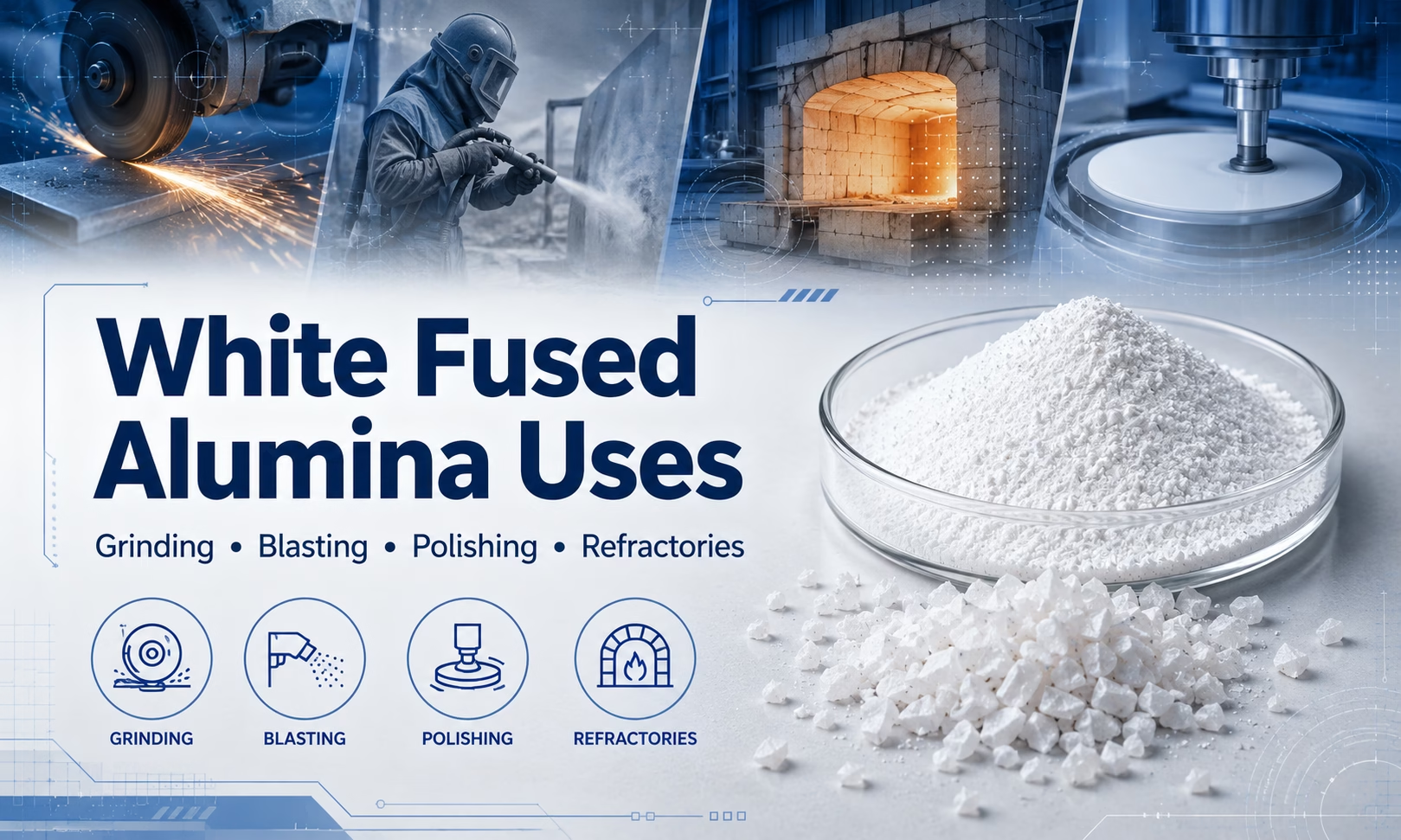
白刚玉 is mainly used in grinding wheels, 涂附磨具, 喷砂, 研磨和抛光, 耐火制品, 熔模铸造和选定的技术陶瓷应用.
Also known as white aluminum oxide, white corundum or WFA, it is a high-purity fused abrasive available as coarse grains, standard abrasive grits and precisely classified micro powders.
Manufacturers typically choose WFA when they need:
- Clean and controlled cutting
- Relatively low iron contamination
- Sharp abrasive grains
- Controlled grain breakdown
- Consistent surface finishing
- 高温稳定性
- A white or light-colored mineral
White fused alumina is commercially supplied in a wide range of standard and customized sizes. Industry product ranges cover grinding, 砂纸, 爆破, 耐火材料, 研磨, 抛光, coatings and ceramic shapes.
然而, the correct grade depends on more than the application name. Particle size, 颗粒形状, 化学成分, friability and oversized-particle control all influence the final result.
What Is White Fused Alumina Used For?
The following table summarizes the most important white fused alumina uses.
| 应用 | Common WFA Form | Main Reason for Using WFA |
|---|---|---|
| 砂轮 | F-grits and microgrits | Sharp cutting with controlled grain breakdown |
| 涂附磨具 | P-grits and shaped grains | Consistent cutting and surface finish |
| Abrasive blasting | Angular macrogrits | Cleaning and controlled surface profiling |
| 研磨和抛光 | Fine grains and micro powders | Precise material removal and scratch control |
| Refractory products | Aggregate and fine powder | Heat, chemical and abrasion resistance |
| Investment casting | Refractory flour and stucco grain | Shell stability at high temperatures |
| Technical ceramics | Fine powder and graded grain | 纯度, hardness and wear resistance |
| Wear-resistant coatings | Fine powder or graded grain | Increased surface durability |
| Heat-treatment support | Setting sand | Stable support and component separation |
| Non-slip surfaces | Coarse abrasive grain | Durable surface texture |
Washington Mills identifies refractories, ceramic shapes, 砂轮, 砂纸, blasting media, metal preparation, 层压板, 涂料, lapping and polishing as established WFA applications.
1. Grinding Wheels and Abrasive Tools
One of the most important white fused alumina uses is the production of bonded abrasive tools.
Common products include:
- Vitrified grinding wheels
- Resin-bonded grinding wheels
- Mounted points
- Grinding segments
- Sharpening stones
- Internal grinding wheels
- Surface grinding wheels
- Fine finishing tools
WFA is a high-purity and relatively friable abrasive. Friability means that worn sections of the grain can fracture during grinding and expose new cutting edges.
This behavior can help the wheel continue cutting instead of allowing dull grains to rub continuously against the workpiece. It is especially valuable in precision grinding and lower-force applications where excessive heat or metallurgical damage must be controlled. Washington Mills lists grinding wheels and precision grinding among the principal applications of its friable white fused alumina grades.
Typical Workpiece Materials
White fused alumina grinding tools are commonly considered for:
- Hardened steel
- Tool steel
- Stainless steel
- High-alloy steel
- Bearings
- Cutting tools
- Precision shafts
- Dies and molds
The actual performance depends on the wheel bond, grain size, grain concentration, wheel hardness, grinding speed and workpiece condition.
涂附磨具
WFA is also used in:
- 砂纸
- Sanding belts
- Sanding discs
- 砂布
- Abrasive film
- Flap discs
- Fine finishing sheets
Its angular cutting edges can provide a controlled scratch pattern and a clean finish. Special WFA grades are commercially produced specifically for coated abrasives.
F-Grit vs P-Grit
The abrasive standard must match the finished product.
- F-grits are used for bonded abrasives.
- P-grits are used for coated abrasives.
FEPA explains that abrasive grit designations vary according to the product type and that macrogrit numbers represent particle-size distributions rather than one exact particle diameter.
An F120 grain should therefore not automatically be treated as equivalent to a P120 grain.
2. Abrasive Blasting and Surface Preparation
White fused alumina can be used as a sharp, angular blasting medium for cleaning, etching, finishing and profiling surfaces.
Typical blasting applications include:
- Removing light rust and oxide
- Removing scale
- Stripping coatings
- Cleaning metal parts
- Preparing surfaces before painting
- Preparing surfaces before bonding
- Producing a matte finish
- Creating a controlled anchor profile
- Etching glass and ceramics
- Light deburring
Abrasive blasting removes contamination and creates a cleaner surface that can improve the adhesion of a later coating. WFA can be used in wet or dry pressure-blasting systems and on materials including metals, 玻璃, 陶瓷和石材.
When Should Buyers Choose WFA for Blasting?
WFA is particularly useful when:
- Iron contamination must be minimized
- Stainless steel or non-ferrous materials are being processed
- A light-colored abrasive is preferred
- A defined surface profile is required
- The finished surface must remain visually clean
- A sharp cutting action is needed
White fused alumina products for pressure blasting are commercially available in standard and customized grit sizes.
Is White Fused Alumina Reusable?
WFA may be reused in some blasting systems, but its practical recycling rate depends on:
- Blasting pressure
- Nozzle type
- Workpiece hardness
- Grain size
- Dust separation
- Contamination limits
- Acceptable surface profile
Because WFA is relatively friable, it may break down more quickly than tougher abrasive materials under severe impact.
为此原因, buyers should compare total blasting cost rather than only the price per ton. Blasting speed, media consumption, dust generation and recycling efficiency all affect the real operating cost.
3. 研磨和抛光
White fused alumina powder is widely used for controlled lapping, polishing and precision finishing.
Typical applications include:
- Mechanical seals
- Piston rings
- Valve components
- Steel rings
- Bronze rings
- Cast-iron parts
- Stainless steel surfaces
- Precision cylinders
- Ceramic components
- Selected semiconductor materials
Saint-Gobain supplies fused aluminum oxide powders for lapping cast-iron seals, piston rings, steel rings and bronze rings to specified flatness. Its micrograded products are sized with particular attention to coarse-particle control because oversized grains can create unwanted scratches.
Why Is WFA Used for Lapping?
WFA can provide:
- Controlled material removal
- Sharp cutting action
- Good flatness control
- Predictable surface finishing
- Availability in fine and micrograded sizes
- Compatibility with loose abrasive compounds
It may be used as a dry abrasive or mixed into a water-based, oil-based or application-specific slurry.
Important Micro Powder Requirements
For precision polishing, buyers should not evaluate only the nominal grit number.
The most important parameters may include:
- Median particle size
- D10, D50 和 D90
- 最大粒径
- 超大颗粒含量
- 分布宽度
- 集聚
- 颗粒形状
- Suspension behavior
- Batch-to-batch consistency
Commercial WFA ranges extend from standard macrogrits to specialized microgrits as fine as approximately three microns. These products are used in lapping compounds, microblasting and wear-resistant coatings as well as conventional abrasive processes.
Finer Is Not Always Better
Selecting the finest available powder does not automatically improve the process.
A powder that is too fine may:
- Reduce the material-removal rate
- Increase polishing time
- Increase material cost
- Settle differently in the slurry
- Provide no meaningful improvement in finish
The correct grade should balance removal rate, scratch control and the required surface roughness.
4. 耐火材料
White fused alumina is used as both aggregate and fine powder in high-alumina refractory formulations.
Common refractory applications include:
- Refractory castables
- High-alumina bricks
- Precast refractory shapes
- Furnace linings
- Ramming mixes
- Gunning mixes
- Kiln furniture
- Burner components
- Wear-resistant furnace areas
- Refractory coatings
Commercial WFA grades are available specifically for refractory applications, including split sizes, single grits and fine powders.
Why Is WFA Used in Refractories?
White fused alumina may be selected when the formulation requires:
- High alumina purity
- Low iron contamination
- Resistance to abrasion
- Stability at high temperatures
- 化学稳定性
- A white or light-colored raw material
Coarse WFA particles form part of the refractory aggregate structure. Fine powder fills spaces between larger grains and contributes to the surrounding matrix.
A well-designed particle-size distribution can help improve packing and reduce large voids within the refractory body.
WFA Alone Does Not Determine Performance
The performance of a refractory product also depends on:
- Aggregate grading
- Binder system
- Cement content
- Fine-powder ratio
- Water demand
- Installation quality
- Firing conditions
- Operating atmosphere
- Contact with slag or molten metal
- Thermal cycling
A high-purity WFA raw material cannot compensate for an unsuitable refractory formulation or poor installation.
5. Investment Casting and Technical Ceramics
Investment Casting
Selected 白刚玉 grades are used in investment casting shell systems as:
- Refractory flour
- Shell coating material
- Stucco grain
- Backup shell material
- Shell reinforcement material
High-purity, friable WFA products are commercially specified for refractory coatings used in investment casting shells.
The required grade depends on whether the material is being used in the primary slurry, backup coats or stucco layer.
Important selection factors include:
- Particle-size distribution
- Slurry stability
- Shell permeability
- Shell strength
- Thermal expansion
- Compatibility with the casting alloy
- Required casting surface finish
- Shell-removal behavior
The primary coat and backup coats may require different particle sizes or different refractory minerals.
Technical Ceramics
WFA can also be used in selected ceramic formulations, 包括:
- Wear-resistant ceramic shapes
- Furnace components
- High-temperature ceramic parts
- Ceramic fillers
- Abrasion-resistant bodies
- Selected insulating systems
White fused alumina is commercially supplied for ceramic shapes and other industrial ceramic applications.
然而, conventional abrasive-grade WFA should not automatically replace calcined alumina, reactive alumina or tabular alumina.
Ceramic manufacturers must evaluate:
- Sintering behavior
- Green density
- Final porosity
- Shrinkage
- 颗粒形状
- Binder compatibility
- Electrical requirements
- Thermal requirements
Other Industrial Uses of White Fused Alumina
WFA is also used in several specialized applications.
| 应用 | Function of WFA |
| Wear-resistant coatings | Adds hardness and abrasion resistance |
| Heat-treatment setting sands | Supports and separates components during heating |
| Microblasting | Provides controlled treatment of small or delicate parts |
| 防滑地板 | Creates a hard and textured surface |
| Decorative non-skid tiles | Provides durable traction and a light appearance |
| Laminates and fillers | Improves wear resistance in selected systems |
| Buffing compounds | Supports controlled surface finishing |
Saint-Gobain lists heat-treatment setting sands, microblasting and wear-resistant coatings among the applications of white fused aluminum oxide microgrits. Washington Mills also identifies non-skid tile, 层压板, coatings and buffing powders as commercial WFA applications.
Recommended White Fused Alumina Sizes by Application
The following ranges are practical starting points rather than universal specifications. Final selection should be confirmed through production trials and the applicable FEPA, 美国国家标准学会, 他, ISO or customer-specific standard.
| 应用 | Common Starting Range | Main Quality Requirement |
| Coarse blasting | F16–F46 | Angularity and cutting rate |
| General blasting | F54–F100 | Profile consistency and breakdown rate |
| Fine blasting | F120–F220 | Controlled surface finish |
| 砂轮 | F24–F220 | Friability, grain shape and bulk density |
| Fine bonded abrasives | F230–F600 | Stable particle distribution |
| 研磨 | F320–F1200 | Tight distribution and coarse-particle control |
| Fine polishing | F800–F2000 or micron powder | Maximum particle size and scratch control |
| 涂附磨具 | Appropriate P-grit | Backing and coating-process compatibility |
| Refractory aggregate | 0–1 mm to 5–8 mm | 化学, density and aggregate grading |
| Refractory matrix | 200 网, 325 mesh or finer | Packing and chemical composition |
| Investment casting | Application-specific flour and stucco | Slurry and shell performance |
FEPA requires different designations for bonded and coated abrasive products and defines grit sizes as controlled particle distributions. Supplier product ranges also show that WFA is available from coarse grains to very fine powders.
白刚玉与棕刚玉
WFA and brown fused alumina are both widely used industrial abrasives, but they are not identical.
| Selection Factor | 白刚玉 | 棕刚玉 |
| 纯度 | 一般较高 | 一般较低 |
| Grain behavior | More friable | Tougher |
| Typical cutting style | Sharp and self-renewing | Durable and aggressive |
| Contamination control | Better suited to sensitive work | Suitable for general industrial work |
| 精密磨削 | Often preferred | Used when greater toughness is needed |
| Heavy blasting | Suitable but may break down faster | Often preferred for durability |
| Refractory use | High-purity formulations | General high-alumina formulations |
| Relative price | 通常较高 | Usually lower |
Washington Mills describes its white fused alumina as a high-purity, friable abrasive, while its brown fused alumina is described as a tough, hard material with high strength and wear resistance.
Choose WFA when the priority is:
- 纯度
- 受控脆碎度
- Precision
- Low iron contamination
- Clean surface finishing
- High-purity refractory performance
Choose brown fused alumina when the priority is:
- 韧性
- Grain life
- Heavy stock removal
- Aggressive blasting
- Resistance to mechanical impact
- Lower material cost
Neither material is better for every process.
How to Choose the Right WFA Grade
1. Define the Application
First identify whether the WFA will be used for grinding, 爆破, 抛光, refractory manufacturing, investment casting or ceramics.
The same grit number may behave differently in different machines and formulations.
2. Define the Required Result
Specify the target outcome, 例如:
- Material-removal rate
- Surface roughness
- Blasting profile
- Scratch limit
- Refractory density
- Operating temperature
- Finished product color
3. Set the Technical Specification
A complete specification may include:
- Grit or micron size
- Applicable grading standard
- Al2O₃含量
- Na₂O limit
- Fe₂O₃ limit
- Magnetic-content limit
- 颗粒形状
- 堆积密度
- 水分
- Oversized-particle limit
4. Test a Representative Sample
A technical data sheet confirms basic product information, but it cannot fully predict real production performance.
A trial should evaluate measurements such as:
- Grinding ratio
- 切削率
- Surface roughness
- Scratch defects
- Blasting profile
- Abrasive consumption
- Refractory density
- Slurry stability
- Finished product rejection rate
常见的选择错误
Comparing Only Al₂O₃ Content
Two products with similar alumina purity can perform differently because of grain shape, sodium content, magnetic impurities and particle distribution.
Treating Every Grit System as Equivalent
F-grit, P-grit, mesh and micron classifications are not automatically interchangeable.
Selecting Only by Price
A cheaper product may create higher costs through slower cutting, greater consumption, inconsistent finishes or increased rejection rates.
Ignoring Oversized Particles
In precision lapping and polishing, a small number of oversized grains can create deep scratches.
Choosing WFA for Severe Impact Without Testing
WFA is hard but relatively friable. A tougher abrasive may offer better service life under heavy pressure or repeated impact.
结论
White fused alumina uses cover five main industrial areas:
- Grinding and abrasive tools
- Abrasive blasting
- 研磨和抛光
- 耐火材料
- Investment casting and technical ceramics
WFA is particularly valuable when manufacturers need high purity, controlled cutting, relatively low iron contamination and access to a wide range of particle sizes.
The correct product should be selected according to the application, particle-size standard, 颗粒形状, chemical limits and required surface or thermal performance.
Before approving a bulk order, request a current technical data sheet, certificate of analysis and particle-size report, and test a representative sample under real production conditions.


