
白色電融アルミナ (WFA) 工業用途で広く使用されている高純度の合成酸化アルミニウムです。, 砥石を含む, コーティングされた研磨材, サンドブラスト, 精密研磨, 耐火物, investment casting, and technical ceramics. Manufacturers value this material for its high hardness, relatively friable grain structure, 化学的安定性, and availability in different particle sizes, ranging from coarse abrasive grains to fine micro powders.
When I look at white fused alumina from an industrial perspective, I see more than just an abrasive material. Its characteristics make it useful in several manufacturing processes where particle size, material purity, cutting behavior, and temperature resistance all matter. しかし, different applications require different product specifications. A grain suitable for grinding wheel production may not meet the particle-size requirements of precision polishing or the chemical requirements of refractory manufacturing.
このガイドでは, I will explain how manufacturers use white fused alumina across different industries, why they choose it over alternative materials, and how buyers can select the right grade for their production requirements. I will also discuss the differences between WFA abrasive grains and micro powders, with particular attention to particle-size distribution and quality consistency.
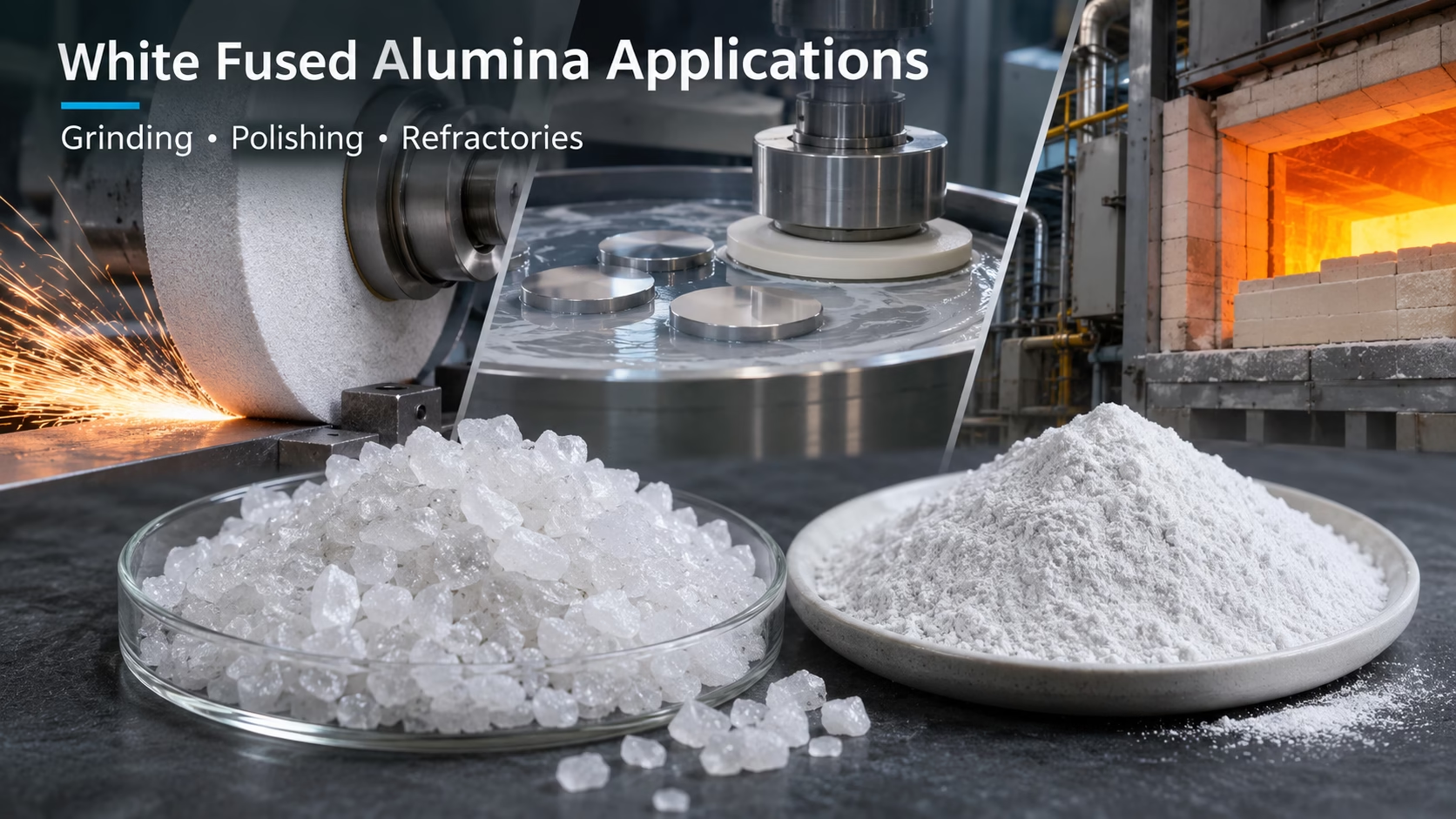
1. What Makes White Fused Alumina Suitable for Industrial Applications?
White fused alumina is a synthetic abrasive material produced by melting high-purity alumina in an electric arc furnace. After cooling, manufacturers crush, clean, and classify the fused material into different grain sizes and powder specifications.
The production process gives WFA a crystalline structure with a combination of hardness, 純度, and controlled fracture characteristics. These properties explain why manufacturers use it in both abrasive products and selected high-temperature industrial materials.
For a closer look at how manufacturers produce and classify this material, see our guide to the 白色電融アルミナの製造工程.
High Purity and Chemical Stability
One of the main reasons manufacturers choose white fused alumina is its high aluminum oxide content. Depending on the grade and production specification, WFA can offer relatively low levels of iron and other impurities.
This characteristic matters in applications where material contamination, surface appearance, or chemical composition affects the final product. 例えば, manufacturers may select suitable high-purity WFA grades for precision abrasive products, selected ceramic formulations, and refractory materials.
しかし, buyers should not assume that every WFA product has identical chemical properties. They should confirm the actual Al₂O₃, Na₂O, Fe₂O₃, and SiO₂ content through the supplier’s technical specifications and batch test reports.
Hardness and Controlled Friability
White fused alumina combines high hardness with relatively friable grain characteristics. Its cutting edges can fracture under suitable mechanical conditions and expose fresh abrasive surfaces.
This behavior makes WFA useful in grinding and finishing processes where manufacturers need consistent cutting action. The exact fracture behavior depends on grain quality, 粒子の形状, processing conditions, and the design of the finished abrasive product.
Different Particle Forms for Different Industries
Manufacturers supply WFA in several product forms, and each form serves different industrial requirements:
- Coarse abrasive grains: Suitable for grinding wheels, ブラストメディア, and refractory aggregates.
- Standard abrasive grits: Commonly used in bonded abrasives and coated abrasive products.
- Fine abrasive powders: Suitable for selected ceramic, 耐火性, and industrial finishing applications.
- Micro powders: Used in precision lapping, 研磨, and other applications that require controlled fine-particle distributions.
The correct product form depends on the manufacturing process rather than the material name alone.
2. Main Industrial Applications of White Fused Alumina
White fused alumina serves a wide range of manufacturing industries. Its applications extend beyond conventional grinding because manufacturers can process the material into different particle sizes and incorporate it into various product formulations.
Bonded Abrasives and Grinding Wheels
One of the most established white fused alumina applications is the production of bonded abrasive tools.

Manufacturers incorporate WFA grains into:
- ビトリファイド砥石
- レジンボンド砥石
- 研削セグメント
- 搭載ポイント
- 砥石
- Internal grinding tools
- Precision grinding products
The abrasive grain performs the cutting action, while the bonding system holds the particles together and controls their release during grinding.
White fused alumina is particularly useful in selected applications where manufacturers require high-purity abrasive grains and controlled cutting behavior. Its relatively friable structure can help expose fresh cutting edges as the wheel wears.
The choice of grain size and wheel formulation depends on the workpiece material, grinding pressure, required surface finish, and machine conditions. Buyers should therefore evaluate the complete wheel specification rather than selecting WFA based only on its hardness.
Coated Abrasives and Surface Preparation
Manufacturers also use white fused alumina in coated abrasive products, 含む:
- Abrasive sandpaper
- サンディングベルト
- Abrasive discs
- フラップディスク
- 研磨布
In these products, manufacturers attach abrasive grains to a flexible or semi-rigid backing using suitable bonding systems.
粒形状, 粒度分布, and coating consistency all influence cutting performance. Angular grains can provide effective material removal, while controlled particle sizes help manufacturers achieve more consistent finishing results.
WFA can also serve surface preparation operations where buyers need a clean abrasive medium and want to control unwanted iron contamination. Typical applications include cleaning metal components, removing surface residues, and preparing selected surfaces for subsequent treatments.
For contamination-sensitive applications, buyers should confirm the abrasive’s chemical specifications and validate the finished surface through testing.
Precision Lapping and Polishing
Precision lapping and polishing represent particularly important applications for white fused alumina micro powder.
Manufacturers use fine WFA particles to remove small amounts of material and improve surface conditions on selected metal, セラミック, and other industrial components.

Common applications include:
- Precision metal lapping
- Surface finishing of metal components
- Polishing compounds
- Fine grinding of selected ceramic materials
- Precision abrasive formulations
- Specialized lapping processes
The particle-size distribution becomes especially important in these applications. A small number of oversized particles can produce unwanted scratches, even when the average particle size meets the nominal specification.
このため, I recommend evaluating more than the mesh number or grit designation. Buyers should also consider D10, D50, D90, maximum particle size, distribution width, and the presence of agglomerates.
Saint-Gobain describes its white fused aluminum oxide microgrits as materials for applications including lapping compounds, microblasting, and wear-resistant coatings. Its precision abrasive materials also serve specialized lapping operations where coarse-particle control matters.
For manufacturers looking for finer particle specifications, YUMO offers 白い融合アルミナマイクロパウダー in different mesh and customized size options.
Refractory Materials and High-Temperature Applications
White fused alumina also plays an important role in selected refractory applications.
Manufacturers incorporate WFA into refractory castables, shaped refractory products, 炉内張り, and other high-temperature formulations. Its high alumina content, 硬度, and thermal characteristics make it a useful raw material for products that operate under demanding conditions.
Depending on the formulation, manufacturers may use coarse WFA grains as aggregates and finer powders as matrix components.
The particle-size distribution helps manufacturers design the packing structure of refractory mixtures. Coarse and fine fractions can fill different spaces within the formulation, while the binder system provides the required cohesion and strength.
Common applications include:
- High-alumina refractory castables
- Refractory bricks and shaped products
- 炉内ライニング
- Refractory repair materials
- Selected refractory coatings
- High-temperature industrial components
しかし, WFA alone does not determine the final refractory performance. Manufacturers must also consider binder chemistry, aggregate grading, installation methods, thermal cycling, and the actual operating environment.
Washington Mills lists white fused alumina among its raw materials for industrial refractory applications, including refractory products and ceramic shapes.
インベストメント鋳造とテクニカルセラミックス
Investment casting manufacturers use refractory materials to create ceramic shells around wax patterns. White fused alumina can serve as a refractory flour or stucco grain in selected shell-building formulations.
The material contributes refractory characteristics and can support the shell’s ability to withstand the temperatures involved in metal casting. しかし, manufacturers must match the abrasive grain, 粒径, and chemical specification to their slurry and shell system.
White fused alumina also appears in selected technical ceramic and wear-resistant material formulations. Manufacturers may use suitable WFA grades where hardness, 純度, and wear resistance matter.
These applications require more than a standard abrasive specification. Buyers should discuss the intended formulation and operating conditions with their material supplier before selecting a grade.
Wear-Resistant Coatings and Specialized Industrial Uses
Fine white fused alumina powders can also serve as raw materials in selected coating applications.
例えば, thermal spray manufacturers may use alumina powders to produce coatings that protect components against abrasive wear, erosion, and oxidation.
Other specialized applications include microblasting, heat-treatment setting sands, non-slip surface products, and selected laminate formulations.
The required grain morphology and particle-size distribution vary considerably between these applications. A powder designed for thermal spraying, 例えば, may require different physical characteristics from a powder used in polishing compounds.
3. White Fused Alumina Grains vs Micro Powders: Sizes and Selection
Choosing the correct particle size is essential when purchasing white fused alumina. Coarse grains and fine powders may share the same basic chemical composition, but they perform very different functions in industrial production.

Coarse Grains and Standard Abrasive Grits
Coarse and medium WFA grains commonly support abrasive manufacturing, 爆破, and refractory applications.
Manufacturers use these grades when they need sufficient particle size for mechanical cutting, 表面の準備, or aggregate formulation.
For bonded abrasives, buyers commonly specify FEPA F-grit grades. For coated abrasives, they generally use the appropriate FEPA P-grit specifications.
Fine Powders and Microgrits
Fine powders and microgrits serve applications that require more controlled material removal and smaller particle sizes.
Typical applications include lapping, 研磨, 細かい研削, selected ceramic formulations, and specialized industrial coatings.
YUMO supplies 白い融合アルミナ微粉末 in different particle-size specifications for industrial requirements.
When purchasing fine powders, I recommend confirming the particle-size measurement method and asking for a distribution report rather than relying on a general mesh designation.
How to Choose the Right WFA Size
The following table provides a general starting point for industrial buyers. It does not replace application-specific technical specifications.
| Industrial application | Common product form | Key specification |
|---|---|---|
| 砥石 | Fグリット | Grain shape and grading |
| コーティング研磨材 | P-グリット | Particle distribution and coating compatibility |
| サンドブラスト | Angular macrograins | Cutting rate and surface profile |
| ラッピングと研磨 | 微粒子およびマイクロパウダー | Oversize control and particle distribution |
| 耐火物 | 骨材と微粉末 | Chemical composition and particle grading |
| インベストメント鋳造 | Refractory flour and stucco | Slurry and shell compatibility |
| 耐摩耗性コーティング | Fine or engineered powder | Particle morphology and feedstock requirements |
For more detailed information, read our guide to White Aluminium Oxide Grit Sizes Explained.
One important point: Fグリット, P-グリット, mesh sizes, and micron measurements belong to different grading approaches. Buyers should not assume that the same numerical designation represents an identical particle-size distribution across all systems.
4. White Fused Alumina vs Other Industrial Abrasive Materials
White fused alumina is not the only material available to industrial manufacturers. 茶色の融合アルミナ, 炭化ケイ素, and other aluminum oxide products offer different characteristics and application advantages.
| Material | Main characteristics | Typical applications |
|---|---|---|
| 白色電融アルミナ | 高純度, 硬度, and relatively friable grains | Precision abrasives, 研磨, and selected refractories |
| 茶色の融合アルミナ | Tough and versatile | General metal grinding and blasting |
| 黒色炭化ケイ素 | Hard and sharp | Cast iron and non-ferrous materials |
| 緑色の炭化ケイ素 | High hardness and purity | Carbide and selected ceramic processing |
| Calcined alumina | Different production route and particle characteristics | Polishing and ceramic formulations |
| Tabular alumina | 密集, sintered alumina with high thermal stability | High-performance refractory applications |
When Should Manufacturers Choose White Fused Alumina?
I would consider WFA when an application requires a combination of high alumina content, controlled abrasive cutting, and suitable particle-size specifications.
Three situations deserve particular attention.
初め, manufacturers producing precision abrasive products may prefer suitable WFA grades when they need relatively clean cutting behavior and controlled grain characteristics.
2番, polishing and lapping operations may benefit from carefully classified WFA micro powders, especially when the process requires tight particle-size distribution and strict oversize control.
三番目, refractory manufacturers may consider refractory-grade WFA for formulations that require high-alumina raw materials and suitable thermal properties.
しかし, WFA does not automatically outperform other materials. Brown fused alumina may offer a more practical choice for certain general grinding operations, while silicon carbide can provide advantages when processing selected hard or non-ferrous materials.
The right material depends on the actual production objective.
5. How to Select a Reliable White Fused Alumina Supplier
Choosing a reliable supplier is just as important as choosing the right abrasive grade. In industrial purchasing, inconsistent raw materials can affect production quality, increase processing costs, and create unnecessary manufacturing problems.
Check Chemical Composition
Start by reviewing the chemical composition of the WFA grade.
アプリケーションに応じて, important parameters may include:
- Al₂O₃含有量
- Na₂O含有量
- Fe₂O₃ content
- SiO₂ content
- CaO content
- 磁気材料含有量
The required limits depend on the final application. A precision polishing powder may require different contamination controls from a refractory aggregate.
Always request a Certificate of Analysis (COA) and compare the reported values against your purchasing specification.
Check Particle Size and Quality Consistency
For coarse grains, examine grading accuracy, oversized particles, undersized particles, and grain shape.
For micro powders, pay particular attention to particle-size distribution, maximum particle size, agglomeration, バッチの一貫性.
A supplier should be able to explain its classification methods and provide relevant particle-size information.
Request Technical Documents and Samples
Before placing a large order, I recommend requesting:
- Technical Data Sheet (TDS)
- 分析証明書 (COA)
- Safety Data Sheet (SDS)
- Particle Size Distribution Report
- Representative Product Samples
Sample testing allows manufacturers to evaluate how the material performs in their actual production process. This is particularly important for precision polishing, specialized coatings, and refractory formulations.
最終的な考え: Understanding White Fused Alumina Applications
White fused alumina serves far more than traditional abrasive applications. Its combination of high purity, 硬度, controlled grain characteristics, and different particle-size options makes it useful in grinding wheels, コーティングされた研磨材, 爆破, 精密研磨, 耐火物, investment casting, and selected technical ceramic applications.
しかし, each industry has different requirements. Coarse abrasive grains support grinding and surface preparation, while fine powders and microgrits provide greater control in lapping and polishing. Refractory applications require particular attention to chemical composition, aggregate grading, and formulation compatibility.
産業用バイヤー向け, the most important step is to match the WFA specification to the actual manufacturing process. By checking particle-size distribution, 化学組成, バッチの一貫性, manufacturers can make more informed purchasing decisions and reduce the risk of unsuitable raw materials.
Need White Fused Alumina for Your Industrial Applications? YUMO Can Help
At YUMO, we supply white fused alumina in different abrasive grades, including coarse grains, standard grit sizes, 微粉末, and precisely classified micro powders. Our products support industrial requirements across abrasive manufacturing, 研削, 研磨, 表面の準備, and selected refractory applications.
We understand that different manufacturers need different specifications. A grinding wheel producer may focus on grain grading and physical characteristics, while a precision polishing manufacturer may pay closer attention to particle-size distribution and oversized-particle control.
If you are sourcing white fused alumina for industrial production, share your intended application, 必要な粒子径, 化学仕様, and estimated quantity with our team. We can help you review available grades and provide relevant technical information, particle-size reports, product samples, and customized packaging options.
Whether you need standard abrasive grains or fine white fused alumina micro powder, YUMO is ready to discuss your material requirements.
Contact YUMO today to request white fused alumina specifications, samples, or a quotation for your industrial application.


