
White aluminum oxide blast media, also known as white fused alumina (WFA), is a high-purity synthetic abrasive widely used for industrial surface preparation, クリーニング, deburring, and finishing. Its main advantages include high hardness, sharp angular grain characteristics, relatively low iron contamination, and availability in different particle sizes. These properties make it particularly useful for blasting stainless steel, aluminum, specialty alloys, and precision components where surface cleanliness and controlled material removal matter.
しかし, choosing a blasting abrasive involves more than comparing hardness or purchasing prices. 粒度, 粒子の形状, blasting pressure, recovery efficiency, and workpiece material all influence the final result. A blasting medium that works well for heavy steel cleaning may not be suitable for a precision stainless steel component.
このガイドでは, I will explain the main advantages of white aluminum oxide blast media, its industrial applications, and how it compares with other blasting abrasives. I will also discuss grit selection, reuse conditions, and the quality specifications buyers should check before purchasing.
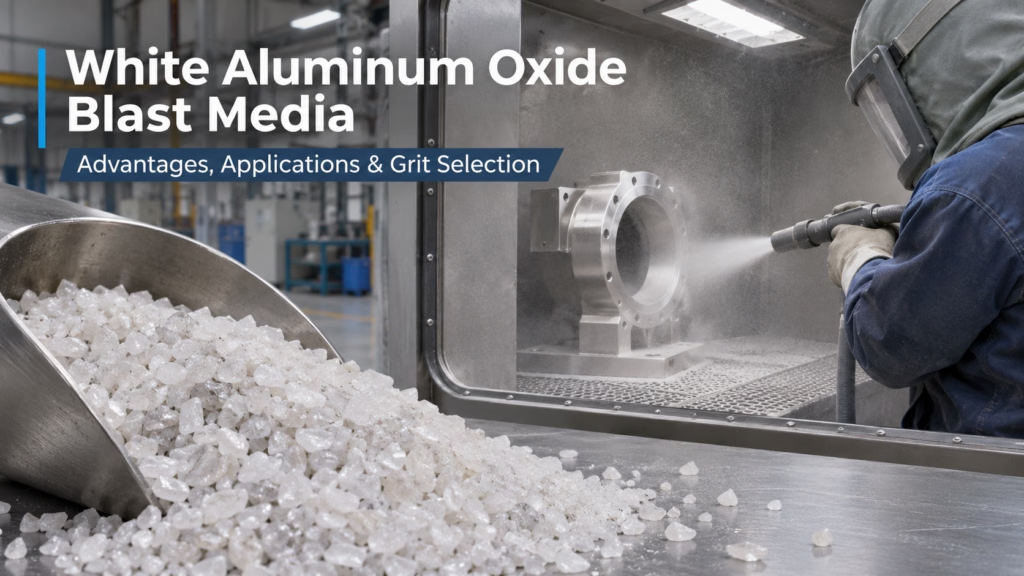
1. What Is White Aluminum Oxide Blast Media?
White aluminum oxide blast media is a synthetic abrasive produced by electrically fusing high-purity alumina in an electric arc furnace. After cooling, manufacturers crush the fused material, remove magnetic impurities, and classify the grains into different particle-size specifications.
The resulting material is commonly known as white fused alumina, 白いコランダム, or WFA. It has a white appearance, a sharp angular grain structure, and high hardness. Commercial products commonly have a Mohs hardness of approximately 9, although buyers should confirm the actual specification with the supplier.
Composition and Physical Characteristics
White fused alumina mainly consists of aluminum oxide (al₂o₃). Its chemical composition varies according to raw materials, manufacturing processes, and product grades. Commercial abrasive grades generally feature high alumina content and relatively low levels of iron-bearing impurities.
The following characteristics explain why manufacturers use WFA for industrial blasting:
- 高硬度: Helps abrasive particles penetrate and remove unwanted surface materials.
- Angular grain shape: Provides cutting edges for cleaning and surface profiling.
- アルミナ純度が高い: Makes suitable grades attractive for applications with contamination-control requirements.
- Controlled particle sizes: Allows manufacturers to select different grades for different surface finishes.
- Relatively friable structure: Individual grains can fracture under repeated impact, exposing fresh cutting edges but also generating finer particles.
One published commercial specification in Airblast’s 2025 Product Selection Guide reports 99.58% al₂o₃, 0.03% Fe₂O₃, and approximately 9.0 Mohs hardness for its listed white fused alumina product. These figures describe that particular commercial specification rather than a universal guarantee for every WFA grade.
Why Is It Used as Blasting Media?
During abrasive blasting, compressed air or mechanical equipment accelerates abrasive particles toward a workpiece. When angular WFA grains strike the surface, their sharp edges help remove oxidation, コーティング, residues, and other unwanted materials.
Unlike spherical media, which mainly produce a peening or impact-finishing effect, angular aluminum oxide can cut into the surface and create a measurable profile. This makes it useful when manufacturers need both cleaning and controlled surface preparation.
For technical specifications, buyers can refer to ISO 11126-7:2018 – Fused Aluminium Oxide, which covers particle-size ranges, density, Mohs hardness, 水分, conductivity of aqueous extract, and water-soluble chlorides for newly supplied fused aluminum oxide blasting abrasives.
2. What Are the Six Main Advantages of White Aluminum Oxide Blast Media?
When I evaluate white aluminum oxide for industrial blasting, I focus on six practical advantages. These characteristics explain why manufacturers consider WFA for applications where ordinary general-purpose blasting media may not meet their requirements.
1. High Purity and Relatively Low Iron Contamination
One of the most important advantages of white fused alumina is its relatively high purity and lower iron-related impurity profile compared with typical brown fused alumina grades.
This matters when blasting stainless steel, aluminum, titanium alloys, and other materials where unwanted iron contamination can affect surface quality or subsequent processing.
例えば, stainless steel manufacturers may need to prepare components without introducing additional iron-bearing residues from the abrasive or previously used blasting equipment. A suitable low-iron WFA grade can help reduce this risk.
しかし, I would never assume that white color automatically means iron-free material. Buyers should specify acceptable Fe₂O₃ and magnetic-material limits, request batch chemical analysis, and ensure that the blast pot, hoses, recovery equipment, and work area remain free from cross-contamination.
2. High Hardness and Sharp Cutting Performance
White aluminum oxide has a Mohs hardness of approximately 9, which allows it to process many hard industrial materials effectively. Its angular particles provide multiple cutting edges that help remove surface contaminants and create a controlled surface profile.
This characteristic is particularly useful when removing oxidation, preparing metal surfaces before coating, or cleaning components with firmly attached residues.
Compared with rounded glass beads, angular WFA generally provides a more aggressive cutting action. The operator can adjust the abrasive grade and blasting conditions to achieve the required balance between cleaning efficiency and surface roughness.
3. Suitable for Precision and Contamination-Sensitive Applications
Manufacturers often choose white aluminum oxide when surface cleanliness matters as much as material removal.
Its high alumina purity and relatively low iron content make suitable grades attractive for selected applications involving stainless steel, aluminum, titanium alloys, and precision-engineered components.
Examples include aerospace parts, specialized machinery components, and metal products that require controlled surface preparation before coating or further processing.
The important distinction is that the abrasive itself does not automatically guarantee a contamination-free result. The operator must also control equipment cleanliness, media handling, and the condition of recycled abrasive.
4. Reusable in Suitable Blasting Systems
White fused alumina can be recovered and reused in properly designed closed-loop blasting systems, including blast cabinets and blast rooms.
This offers potential economic advantages because manufacturers do not need to replace the entire abrasive charge after every operation. しかし, WFA has a relatively friable grain structure, and repeated impacts gradually change its particle-size distribution.
As the abrasive circulates, some particles fracture into smaller grains and dust. Recovery systems must remove excessive fines and contaminants while maintaining an acceptable working mixture.
I recommend monitoring the operating abrasive rather than relying on a fixed number of reuse cycles. 噴射圧力, workpiece hardness, impact energy, dust extraction, and recovery efficiency all influence media life.
The real purchasing question is not simply how many times the abrasive can be reused, but how much it costs to process each square meter of surface to the required quality.
5. Available in Different Grit Sizes
Another advantage of white aluminum oxide is its availability in a wide range of grain sizes.
Coarser grades generally support more aggressive cleaning and surface profiling, while finer grades provide more controlled finishing and lighter material removal.
This flexibility allows manufacturers to select different specifications according to the workpiece and blasting objective.
例えば, a company removing heavy surface contamination from robust metal components may require a coarser grade, while a precision parts manufacturer may prefer a finer abrasive to reduce the risk of excessive surface roughness.
6. Versatile Across Multiple Industrial Processes
White aluminum oxide is not limited to one type of blasting operation. Depending on the grade and process, manufacturers can use it for surface cleaning, deburring, oxide removal, controlled etching, and preparation before coating or bonding.
It also serves other abrasive manufacturing applications, including grinding wheels and coated abrasives.
This versatility gives industrial buyers more flexibility when sourcing different abrasive grades from the same material family.
3. Common Industrial Applications of White Aluminum Oxide Blast Media
The combination of high hardness, angular grain characteristics, and relatively low iron contamination makes white fused alumina useful in several industrial surface-treatment processes.
Stainless Steel and Non-Ferrous Metal Blasting
Stainless steel is one of the most relevant applications for white aluminum oxide blasting media. Manufacturers use suitable WFA grades to clean weld areas, remove surface residues, and prepare components for subsequent finishing processes.
Aluminum and titanium alloy components may also benefit from suitable low-contamination abrasive media. In these applications, buyers should pay particular attention to iron-bearing impurities and the cleanliness of the blasting system.
Aerospace and Precision Component Finishing
Aerospace and precision manufacturing involve components with demanding surface-quality requirements. White fused alumina may be used for selected cleaning, deburring, and surface-preparation operations.
しかし, aerospace applications often require specific customer approvals, process qualification, and documented material specifications. Standard commercial WFA should never be assumed to meet aerospace requirements without the necessary verification.
表面の洗浄, バリ取り, and Etching
Manufacturers also use white aluminum oxide to remove oxidation, clean cast or machined components, and eliminate small burrs from selected metal parts.
Its angular particles provide cutting action that can help create a uniform matte finish or a controlled surface texture. Fine grades may be useful when the process requires more precise treatment, while coarser particles support heavier cleaning.
Surface Preparation Before Coating
Before applying protective coatings, manufacturers often need to remove contaminants and create a suitable surface profile.
White aluminum oxide can support this preparation process by removing surface residues and creating mechanical roughness for subsequent coating or bonding.
The required profile depends on the coating system and applicable process specifications. Operators should measure the resulting surface rather than assume that a particular abrasive grade will always produce the same roughness.
4. White Aluminum Oxide vs Other Blasting Media
White aluminum oxide is a specialized abrasive rather than a universal replacement for every blasting material. To understand where it offers the greatest value, I recommend comparing it with other commonly used media.
| Blasting media | Main characteristics | Typical applications |
|---|---|---|
| 白色電融アルミナ | 高純度, angular, relatively low iron | Precision and contamination-sensitive blasting |
| 茶色の融合アルミナ | 厳しい, angular, versatile | General industrial steel blasting |
| ガラスビーズ | Rounded particles, less aggressive cutting | Cleaning and satin finishing |
| ガーネット | Angular natural mineral abrasive | General surface preparation |
| 炭化ケイ素 | Very hard, sharp, relatively brittle | Specialized hard-material processing |
| スチールグリット | Dense metallic abrasive | Heavy-duty steel cleaning and profiling |
White Aluminum Oxide vs Brown Aluminum Oxide
Both materials belong to the aluminum oxide abrasive family, but they have different production characteristics and impurity profiles.
White fused alumina generally offers higher purity and relatively lower iron-related contamination. Its more friable grain structure can expose fresh cutting edges during use.
Brown fused alumina generally offers greater toughness and is often a more economical choice for heavy-duty general blasting.
If I were helping a buyer select between the two, I would first identify the main production requirement. For contamination-sensitive stainless steel or non-ferrous components, suitable WFA may be worth the additional cost. For general carbon steel cleaning, BFA may offer a better balance of toughness and operating economics.
You can read our detailed comparison of 白色電融アルミナ vs 褐色電融アルミナ for a closer look at their differences.
White Aluminum Oxide vs Glass Beads
The main difference is particle shape and the resulting surface effect.
White aluminum oxide has angular grains that cut into the workpiece and create a surface profile. Glass beads have spherical particles that produce a more peened appearance and are often used for cleaning or satin finishing without the same aggressive cutting action.
Xometry’s guide to bead blasting and abrasive media explains how spherical glass beads create small surface indentations, while angular aluminum oxide supports more aggressive cutting and etching.
このため, I would choose WFA when the process requires material removal or surface profiling, and consider glass beads when a softer, more uniform cosmetic finish is the main objective.
When Should Buyers Choose White Aluminum Oxide?
White aluminum oxide is particularly worth considering when the application requires:
- 鉄汚染が比較的少ない.
- High-purity abrasive material.
- 鋭い刃先.
- Controlled surface preparation.
- Different grain-size options.
- Recovery and reuse in a suitable blasting system.
しかし, it may not be the most economical option for every large-scale steel cleaning operation. Buyers should compare the actual processing results and total operating costs before making a final decision.
5. How to Choose the Right White Aluminum Oxide Blast Media
Selecting the right white aluminum oxide grade requires a clear understanding of the workpiece, surface condition, and blasting equipment. I recommend checking three main areas before requesting a quotation.
Select the Correct Grit Size
Particle size affects cleaning speed, surface roughness, and material removal. Coarser particles generally provide stronger individual impacts, while finer grades support more controlled surface treatment.
The following table offers a general starting point:
| Grain category | General blasting purpose |
|---|---|
| Coarse | Heavy cleaning and stronger surface profiling |
| Medium | General surface preparation |
| 大丈夫 | Controlled finishing and lighter cleaning |
| Microgrit | Precision microblasting and specialized finishing |
These descriptions are general guidelines, not a substitute for a recognized particle-size specification.
For industrial purchasing, I recommend identifying the exact grade and grading standard rather than requesting only a general mesh number. You can refer to our guide to White Aluminum Oxide Grit Sizes for more information.
Check Chemical Composition and Particle Distribution
A reliable abrasive specification should include the parameters relevant to the application.
Important items may include:
- Al₂O₃含有量
- Fe₂O₃ content
- Na₂O含有量
- SiO₂ content
- 磁気材料含有量
- 粒度分布
- Apparent and bulk density
- Moisture content
- Water-soluble chlorides
- Conductivity of aqueous extract
For newly supplied fused aluminum oxide blasting abrasives, ISO 11126-7:2018 provides a useful technical reference. It specifies particle-size ranges and relevant physical and chemical requirements. The standard applies to new abrasive material, not media that has already undergone repeated blasting cycles.
I also recommend requesting a Technical Data Sheet (TDS), 分析証明書 (COA), and Safety Data Sheet (SDS) before placing a bulk order.
Match the Abrasive to the Blasting Equipment
The same abrasive grade can produce different results under different operating conditions.
Before finalizing a specification, consider whether the process uses pressure blasting or suction blasting, along with air pressure, nozzle size, blasting distance, impact angle, and media feed rate.
For recycling systems, the recovery equipment and dust separator must also maintain a suitable operating mixture. Excessive fines can reduce consistency, while contamination from previous media may affect surface cleanliness.
A practical approach is to test two or three suitable grades on representative workpieces. Compare cleaning time, surface profile, abrasive consumption, dust generation, and finished-part quality before approving a production specification.
最終的な考え: Is White Aluminum Oxide Blast Media the Right Choice?
White aluminum oxide blast media offers several practical advantages for industrial surface preparation, especially when purity, contamination control, 切断性能, and particle-size consistency matter.
Its high hardness and angular grain structure support effective cleaning and surface profiling, while its different grit sizes allow manufacturers to adapt the abrasive to different workpieces and finishing requirements. In suitable recovery systems, WFA can also be reused, although its relatively friable structure means operators must monitor particle breakdown and operating costs.
購入者向け, the most important step is to match the abrasive specification to the actual process. A suitable grade should deliver the required surface condition without introducing unnecessary contamination, material damage, or operating expenses.


