
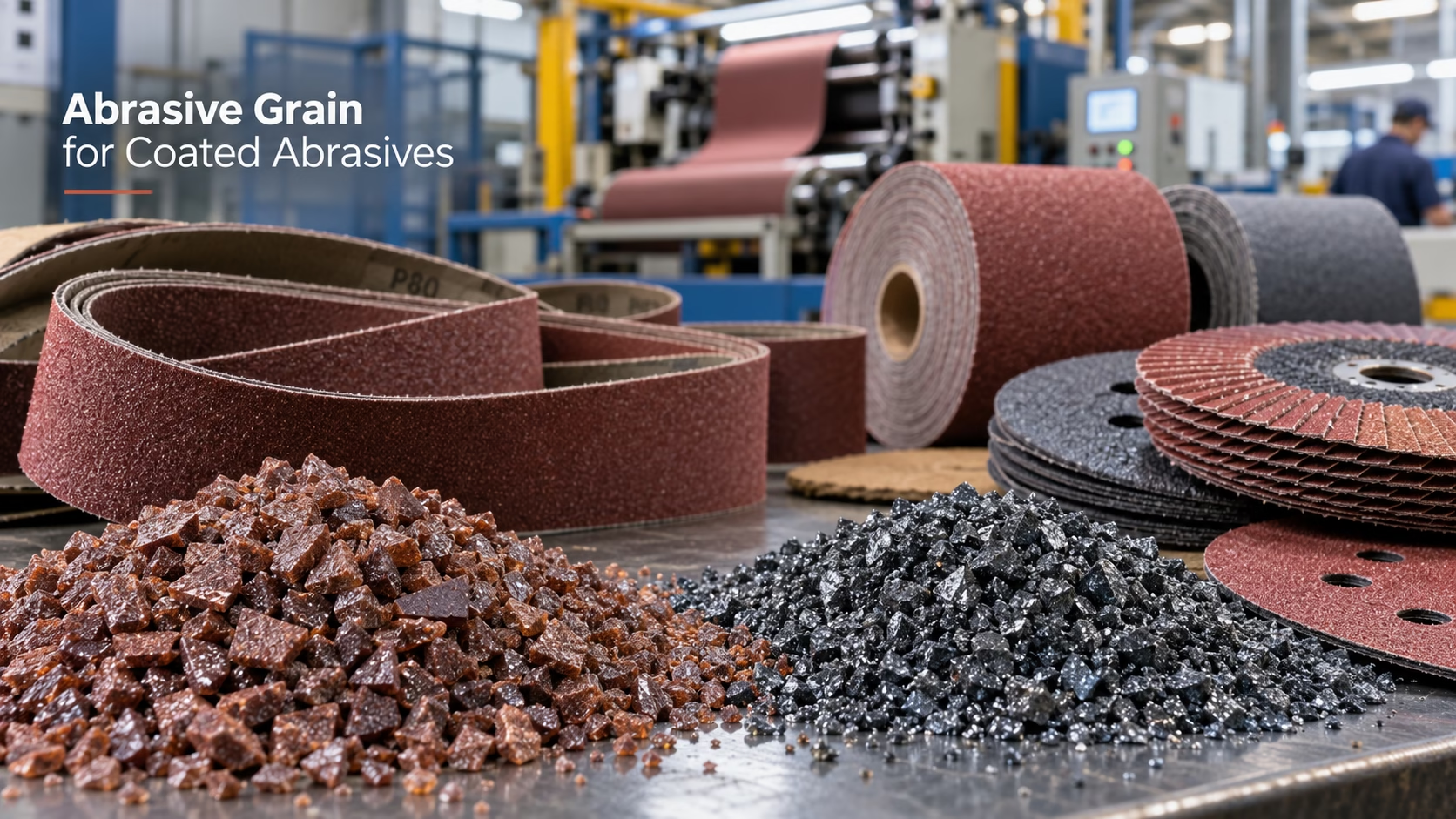
Abrasive grain is the cutting component of coated abrasives such as sandpaper, sanding belts, abrasive discs, and abrasive rolls. The grain material, 입자 크기, 모양, and fracture characteristics influence how the finished product removes material, develops a surface finish, and performs during use. Choosing the right abrasive grain is therefore essential for coated abrasive manufacturers and industrial buyers who need consistent cutting performance and reliable product quality.
When I evaluate abrasive grain specifications, I look beyond the material name or grit number. Aluminum oxide and silicon carbide, for example, have different properties and are suited to different applications. Even when two products use the same nominal grit size, their performance can vary because of differences in particle distribution, 입자 모양, 뒷면 소재, 본딩 시스템, and manufacturing conditions.
이 가이드에서는, I will explain the main abrasive grain types used in coated abrasives, how P-grit sizes are classified, and how manufacturers can select suitable abrasive materials for sanding, 금속 가공, woodworking, and other industrial applications. I will also cover the technical specifications buyers should confirm before placing an order.
1. What Is Abrasive Grain for Coated Abrasives?
Coated abrasives are tools made by attaching abrasive grains to a flexible or semi-flexible backing material using a bonding system. Common products include sandpaper sheets, sanding belts, abrasive discs, 롤, and abrasive cloth. Depending on the design, the backing may consist of paper, woven fabric, nonwoven material, film, or another suitable substrate.
The abrasive grains provide the cutting action, while the backing and bonding system support the particles during use. Manufacturers must therefore consider the complete product structure rather than treating abrasive grain as the only factor affecting performance.
How Abrasive Grains Work
When a coated abrasive contacts a workpiece, individual grain edges remove small amounts of material. The resulting cutting action depends on grain hardness, 모양, orientation, 입자 크기, and the pressure applied during sanding.
Grain fracture also matters. Some abrasive materials maintain their cutting edges through controlled fracture, while others rely more heavily on wear resistance and durability. The appropriate behavior depends on the workpiece and the intended application.
예를 들어, sanding wood requires a different balance of cutting action and surface finish from grinding stainless steel. A product designed for rapid stock removal may not be suitable for a finishing operation that requires a consistent appearance and minimal scratching.
For a broader introduction to abrasive materials and their applications, see our guide to abrasive grain sizes explained: 밥을 먹이다, 안시, and JIS.
2. Common Types of Abrasive Grains for Coated Abrasives
Different abrasive materials provide different combinations of hardness, 강인함, cutting characteristics, and cost. The best choice depends on the workpiece, production conditions, and finish required.
| Abrasive grain | Main characteristics | Common applications |
|---|---|---|
| 산화알루미늄 | Versatile, tough, and widely used | 목재 샌딩, 금속 가공, and general-purpose sanding |
| 실리콘 카바이드 | 딱딱한, 날카로운, and relatively brittle | 유리, 결석, 도예, and selected fine-finishing applications |
| Zirconia alumina | Tough grain structure suited to demanding removal tasks | Heavy-duty metal sanding and grinding |
| Ceramic alumina | Engineered grain designed for controlled cutting and fracture | High-performance grinding and demanding metalworking |
| 석류석 | Natural mineral abrasive | Selected woodworking and finishing applications |
These are general application guidelines rather than universal rules. The final result depends on grain grade, coating construction, 장비, and operating conditions.
Aluminum Oxide Abrasive Grain
Aluminum oxide is one of the most widely used abrasive materials in coated abrasives. Its combination of toughness, cutting performance, and versatility makes it suitable for many sanding and metalworking applications.
Industrial aluminum oxide abrasives include brown fused alumina and white fused alumina. These materials differ in composition and properties, so manufacturers should select the appropriate grade for the intended application rather than treating all aluminum oxide products as interchangeable.
Brown fused alumina is commonly considered for general industrial abrasion, while white fused alumina may be appropriate when higher-purity alumina or particular cutting characteristics are required.
YUMO supplies brown fused alumina abrasive grades 산업용 애플리케이션용. When sourcing grain for coated abrasive production, buyers should confirm the required particle-size distribution and whether the supplied grade meets their manufacturing specification.
Silicon Carbide Abrasive Grain
Silicon carbide is a hard synthetic abrasive with sharp cutting characteristics. It is commonly used in applications involving glass, 결석, 도예, and other hard or brittle materials. Depending on the product design, it can also be used in coated abrasives for selected finishing and surface-treatment tasks.
Black and green silicon carbide differ in their typical material specifications and application requirements. The correct choice depends on the workpiece, required purity, grain size, and manufacturing process.
YUMO supplies silicon carbide abrasive materials, including black and green silicon carbide. For coated abrasive manufacturers, the important step is to confirm that the specific grade is suitable for the intended product and coating process.
Zirconia Alumina and Ceramic Alumina
Zirconia alumina and ceramic alumina are engineered abrasive materials used in demanding grinding and sanding applications. Their grain structures and fracture behavior can support cutting performance under particular operating conditions.
하지만, these materials should not automatically be considered superior for every coated abrasive product. Their suitability depends on the workpiece, required removal rate, operating pressure, product construction, and overall manufacturing cost.
3. How Abrasive Grain Properties Affect Coated Abrasive Performance
Selecting abrasive grain requires more than choosing a mineral and a grit number. Grain properties influence cutting behavior, product durability, 표면 마무리, and the consistency of the finished abrasive tool.
Hardness and Toughness
Hardness describes a material’s resistance to localized deformation or scratching, while toughness concerns its ability to withstand mechanical loading without fracturing excessively. These properties influence how abrasive grains behave during use.
A grain that maintains its cutting edges for a long time may be suitable for one process, while another application may benefit from controlled fracture that exposes fresh cutting edges. Neither maximum toughness nor maximum hardness guarantees the best performance in every situation.
I recommend evaluating these properties alongside the workpiece material and the expected operating conditions.
Grain Shape and Fracture Behavior
Grain shape affects how particles contact the workpiece and form cutting edges. More angular particles may produce a different cutting action from blockier grains, while fracture behavior influences how those edges change during use.
For coated abrasives, grain orientation and distribution on the backing also matter. Manufacturers may use different coating methods to achieve the desired grain arrangement and product performance.
Grain Distribution and Coating Quality
Two abrasive batches carrying the same nominal grade may not perform identically if their particle-size distributions differ. Excessively coarse particles can produce unwanted scratches, while an unsuitable distribution may affect cutting consistency and the finished surface.
The final product also depends on the backing material, 본딩 시스템, grain coverage, and manufacturing process. A high-quality abrasive grain cannot compensate for an unsuitable backing or poorly controlled coating process.
이러한 이유로, I would assess the abrasive specification together with the complete coated abrasive design rather than judge quality by grain type alone.
4. Understanding P-Grit Sizes and Coated Abrasive Standards
Particle-size classification is particularly important when manufacturing sandpaper, sanding belts, and abrasive discs. For coated abrasives, FEPA P-grit designations and the ISO 6344 series provide important references for grain-size classification.
What Does P-Grit Mean?
P-grit is a grain-size designation used for coated abrasives under the FEPA system. It should not automatically be treated as equivalent to an F-grit designation used for bonded abrasives.
예를 들어, P80 is a coated-abrasive grade, while F80 belongs to a different grading system. Although the numbers look similar, buyers should not assume that their particle-size distributions or technical requirements are identical.
그만큼 FEPA abrasive standards provide an official reference for understanding these distinctions.
Understanding ISO 6344
The ISO 6344 series addresses the determination and designation of grain-size distributions for coated abrasives.
- ISO 6344-2:2021 specifies methods for determining and testing the grain-size distribution of electro-fused aluminum oxide and silicon carbide macrogrits from P12 to P220.
- ISO 6344-3:2021 addresses the grain-size distribution of coated-abrasive microgrits from P240 to P5000.
These standards help manufacturers and buyers establish a consistent basis for specifying and checking abrasive grain sizes. The relevant standard should be confirmed when preparing a purchasing specification.
Why Grit Numbers Are Not Exact Particle Diameters
A grit designation represents a classified grade rather than one exact particle diameter. An abrasive batch contains a distribution of particle sizes, controlled according to the applicable grading requirements.
This matters because oversized particles may cause scratches, particularly in finer finishing applications. Buyers may therefore need information about particle-size distribution, coarse-particle limits, and the applicable test method.
When a specification is important to product performance, I recommend identifying the exact standard instead of relying on a generic grit-to-micron conversion chart.
5. How to Choose Abrasive Grain for Different Coated Abrasive Applications
The right abrasive grain depends on the workpiece, the intended sanding or grinding operation, and the quality requirements of the finished surface.
Woodworking and Furniture Manufacturing
Wood sanding requires a balance between material removal, surface smoothness, and preparation for subsequent finishing. Aluminum oxide is commonly used in coated abrasives for woodworking because of its versatility.
Manufacturers should also consider backing flexibility, grain distribution, and resistance to loading. 침엽수, 견목, painted surfaces, and engineered wood products can behave differently during sanding, so the abrasive product should match the application.
Metalworking and Stainless Steel Finishing
Metalworking applications may require rapid stock removal, 디버링, weld finishing, or surface preparation before coating. Aluminum oxide is widely used, while zirconia alumina and ceramic alumina may be considered for more demanding applications.
For stainless steel, buyers should also consider contamination control, heat generation, and the required surface appearance. The abrasive grain is only one component of the solution; the backing, 본딩 시스템, machine settings, and operator technique also influence the result.
유리, 결석, and Fine Finishing
Silicon carbide is often considered for coated abrasives used on glass, 결석, 도예, and other hard or brittle materials. Its suitability depends on the specific workpiece, grain grade, and desired finish.
For fine finishing, the particle-size distribution and the risk of deep scratches become especially important. Manufacturers should validate the abrasive in representative production conditions rather than assume that a particular material or grit number guarantees the desired result.
Choose the Complete Abrasive Product, Not Just the Grain
When comparing coated abrasive products, I recommend considering the entire construction. Two products made with the same abrasive grain may perform differently because of their backing, 본딩 시스템, grain orientation, 코팅 밀도, and intended operating conditions.
The right grain is the starting point, but consistent finished-product quality requires control over the complete manufacturing process.
6. What Buyers Should Check When Sourcing Abrasive Grain
For coated abrasive manufacturers, a clear purchasing specification helps reduce quality problems and makes it easier to compare suppliers.
주문하기 전에, I recommend confirming the following information:
| Specification | What to confirm |
|---|---|
| Abrasive material | 산화알루미늄, 실리콘 카바이드, or another specified material |
| Grain grade | Required P-grit or other applicable size designation |
| 기준 | 밥을 먹이다, ISO, or a clearly defined customer specification |
| 입자 크기 분포 | Required distribution and oversized-particle limits, where applicable |
| Chemical requirements | Purity and impurity limits relevant to the product |
| Intended application | 사포, sanding belts, 디스크, or another coated abrasive |
| Quality documentation | Technical data sheet, test results, or certificate of analysis where available |
| Packaging and quantity | 가방 크기, packaging requirements, and expected order volume |
Common Purchasing Mistakes
One common mistake is comparing suppliers only by price per kilogram. The lowest-priced grain may not be the most economical choice if it fails to meet the required particle distribution or creates quality problems during production.
Another mistake is treating P-grit and F-grit as interchangeable. Buyers should specify the grading system clearly, particularly when sourcing from international suppliers.
A third mistake is assuming that the abrasive grain alone determines finished-product performance. Backing quality, bonding, coating construction, and manufacturing controls all contribute to the final result.
For precision or demanding production applications, I recommend reviewing technical documentation and testing a sample before approving a material for regular supply.
최종 생각: Selecting the Right Abrasive Grain
Abrasive grain selection is an important part of coated abrasive manufacturing, but the best results come from matching the grain to the complete product design. 산화알루미늄, 실리콘 카바이드, zirconia alumina, and ceramic alumina each have different properties and application strengths.
산업용 구매자를 위한, I recommend specifying the abrasive material, grading standard, 입자 크기 분포, intended application, and quality requirements before placing an order. This makes supplier comparisons more meaningful and helps reduce the risk of inconsistent production results.
Need Abrasive Grain for Coated Abrasives? YUMO Can Help
YUMO supplies white fused alumina, 갈색 용융 알루미나, and silicon carbide in different abrasive grades for industrial applications. If you manufacture coated abrasives or source abrasive grain for sanding products, share your required material, P-grit specification, particle-size requirements, 애플리케이션, and estimated quantity with our team.
We can help you review available specifications and identify a suitable abrasive material for your production requirements. Whether you need aluminum oxide grain for general abrasive manufacturing or silicon carbide for specialized applications, the selection should be based on your actual technical requirements.
Contact YUMO to discuss your coated abrasive grain requirements and request product specifications or a quotation.
Frequently Asked Questions About Abrasive Grain for Coated Abrasives
What is abrasive grain for coated abrasives?
Abrasive grain is the cutting material attached to a backing in products such as sandpaper, sanding belts, and abrasive discs. The grain removes material through mechanical abrasion, while the backing and bonding system support the particles during use.
Which abrasive grain is best for sandpaper?
There is no single best abrasive for every sandpaper application. Aluminum oxide is widely used for general woodworking and metalworking, while silicon carbide is suitable for selected applications involving glass, 결석, 도예, 그리고 깔끔한 마무리. The choice depends on the workpiece and required result.
What is the difference between P-grit and F-grit?
P-grit is used for coated abrasives, such as sandpaper and sanding belts. F-grit is associated with bonded abrasives, 그라인딩 휠과 같은. The two systems should not be treated as interchangeable simply because their numbers look similar.
Is aluminum oxide or silicon carbide better for coated abrasives?
Aluminum oxide is a versatile option for many sanding and metalworking applications. Silicon carbide is often selected for hard or brittle materials and particular finishing tasks. The best choice depends on the workpiece, 필요한 표면 마감, abrasive grade, and product construction.
What should manufacturers check when buying abrasive grain?
Manufacturers should confirm the abrasive material, P-grit or other required grade, applicable standard, 입자 크기 분포, chemical requirements, and intended application. Technical documentation and sample testing can help verify suitability before a bulk order.


