
If you are sourcing black fused alumina in 2026, one of the first questions you probably have is simple:
How much does black fused alumina cost per ton?
The short answer is that there is no single market price.
Based on publicly available supplier listings in 2026, black fused alumina prices from Chinese suppliers commonly appear between about US$320 and US$860 per metric ton, depending on grade, 입자 크기, chemical composition, quantity, 포장, and commercial terms.
But if you are actually preparing a purchase order, that broad number is only a starting point.
Two suppliers may both quote “black fused alumina F60,” yet one offer may be significantly higher because of tighter particle-size control, higher Al₂O₃ content, better magnetic separation, lower impurities, palletized packaging, or different Incoterms.
이 가이드에서는, I will explain what really determines the black fused alumina price per ton, how to compare quotations, and what information you should send a manufacturer before asking for a firm price.
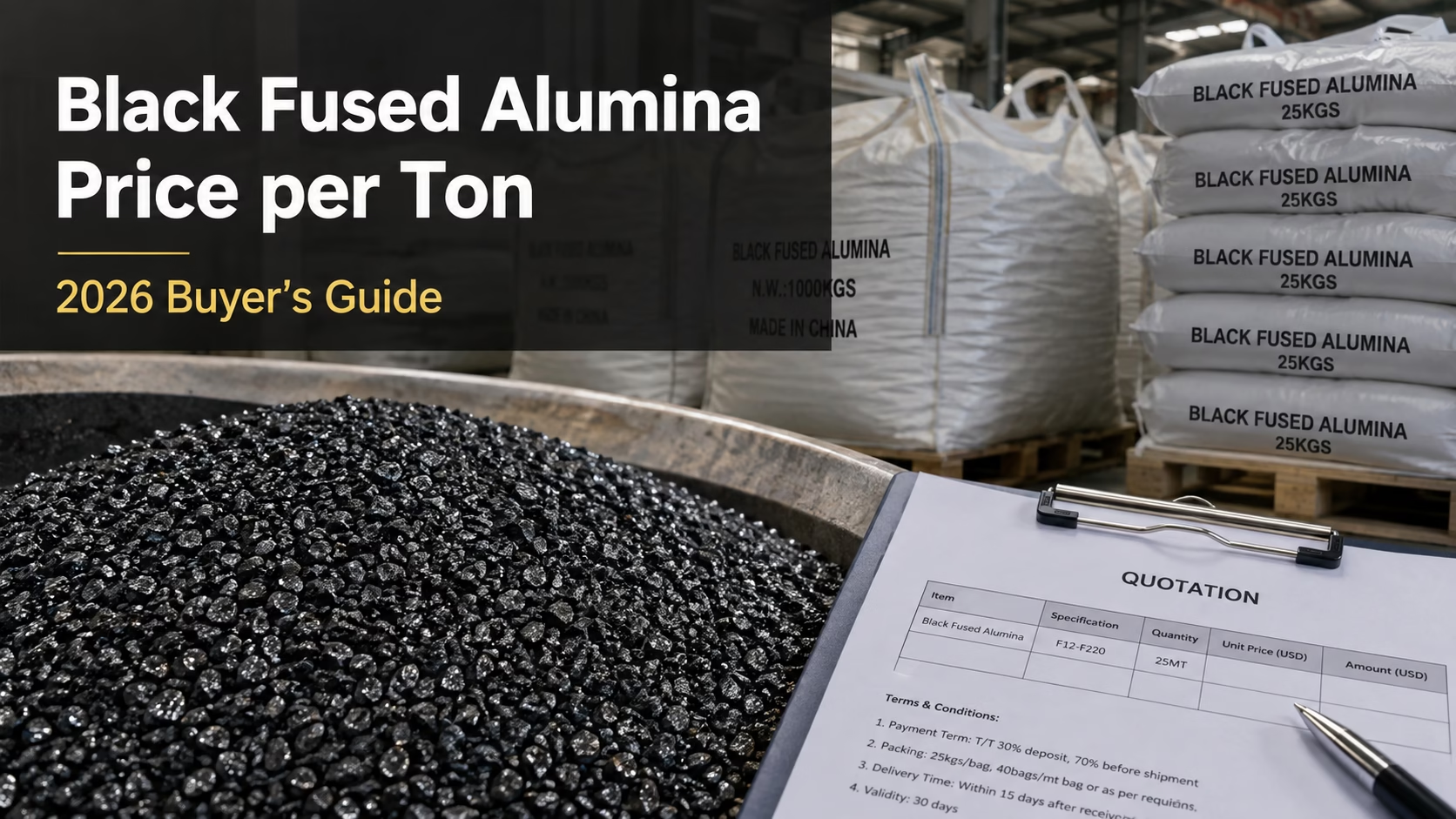
What Is the Black Fused Alumina Price per Ton in 2026?
For buyers looking for a quick benchmark, current online quotations from China show a fairly wide range.
| Black Fused Alumina Type | Indicative 2026 Price Range | Typical Use |
|---|---|---|
| General industrial grade | US$320–450/ton | 폭파, cleaning, general grinding |
| Standard abrasive grit | US$400–600/ton | 샌드 블라스팅, 표면 준비, abrasive products |
| Controlled FEPA grit | US$500–700/ton | 그라인딩 휠, 연마 도구, precision applications |
| Selected or higher-spec grades | US$650–850+/ton | Special polishing, tighter specifications, customized supply |
These figures should be treated as reference prices rather than guaranteed quotations.
예를 들어, current listings include products around US$330–400/ton, while other black fused alumina products are listed around US$420–690/ton, US$650–720/ton, and in some cases up to roughly US$860/ton.
So when someone asks me:
“What is the black fused alumina price today?”
My first response is usually:
What grade, 입자 크기, quantity, and delivery term do you need?
Without those details, comparing prices is not very meaningful.
Why Does Black Fused Alumina Price Vary So Much?
흑색 용융 알루미나 is not a single standardized commodity where every ton is identical.
The final price is normally influenced by several factors.
1. Al₂O₃ Content and Chemical Composition
Chemical composition is one of the biggest reasons for price differences.
Many commonly supplied black fused alumina grades contain approximately 70–85% Al₂O₃, although specifications vary significantly between manufacturers and product grades. Some suppliers separate products into different quality levels depending on alumina, 규토, iron oxide, and titanium oxide content.
A typical specification may include:
- Al₂O₃
- SiO2
- Fe₂O₃
- TiO₂
- Magnetic material
- 수분
- 부피 밀도
A buyer purchasing material for general blasting may not need the same chemical control as a manufacturer producing abrasive wheels or polishing products.
That is why comparing only the price per ton can be misleading.
A US$400/ton product and a US$600/ton product may not actually be equivalent materials.
2. Grit Size Has a Direct Effect on Price
Particle size matters a lot.
Black fused alumina is available in coarse grains, standard abrasive grits, fine powders, and micro powders.
Common FEPA sizes can include:
F12, F16, F24, F30, F36, F46, F54, F60, F80, F100, F120, F150, F180, F220 and finer grades.
Some manufacturers offer an even wider range extending into very fine powders.
일반적으로, producing a precisely controlled fine grit requires more:
- 눌러 터뜨리는
- Screening
- 분류
- Dust removal
- Magnetic separation
- Quality inspection
As particle size becomes finer or the required distribution becomes tighter, production costs can increase.
이러한 이유로, you should never request only:
“Please quote black fused alumina.”
Instead, write something like:
Black Fused Alumina F60, FEPA 표준, 20 MT.
That immediately makes the quotation more useful.
3. 밥을 먹이다, JIS and Customized Particle Sizes
Another common pricing difference comes from the particle-size standard.
International buyers may request:
- FEPA F grit
- FEPA P 그릿
- JIS grit
- Mesh size
- Customized particle distribution
For basic blasting applications, a standard commercial particle range may be enough.
For coated abrasives, 접착 연마재, polishing compounds or specialized manufacturing, buyers often require much stricter grain distribution.
The stricter the specification, the more processing and inspection may be required.
And that normally means a higher price.
4. Order Quantity Changes the Price per Ton
Quantity is another major factor.
A supplier quoting one ton usually cannot offer the same unit price as a buyer purchasing a full container.
Common purchasing quantities may include:
- 1 MT trial order
- 5 MT
- 10 MT
- 20 MT
- 25 MT
- Full container load
- Regular monthly or quarterly supply
Several current supplier listings show a minimum order of one ton, while others require five or ten tons for certain grades.
For a small test order, fixed costs such as packaging, documentation, inland transport, and handling are spread across fewer tons.
For regular container orders, the supplier may have more room to negotiate.
So if you are comparing two quotations, make sure the quantities are the same.
5. Packaging Can Change Your Final Cost
Black fused alumina is commonly supplied in several packaging formats.
Typical options include:
- 25 kg PP bags
- 25 kg paper bags
- 25 kg 가방 + 짚자리
- 1 MT jumbo bags
- 25 kg × 40 bags inside one jumbo bag
- Customized export packaging
One product data sheet, for example, lists 1-ton big bags and 25 kg 가방 as available options, while other manufacturers also offer palletized packaging.
A simple jumbo bag is normally cheaper than:
25 kg 가방 + shrink wrapping + fumigation-free pallet + customized printing.
But price is not the only consideration.
If your warehouse workers need to handle material manually, paying slightly more for 25 kg bags may save significant handling time later.
FOB Price vs CIF Price: Do Not Compare Them Directly
This is one of the most common mistakes I see when buyers compare abrasive suppliers.
Supplier A offers:
US$480/ton FOB China
Supplier B offers:
US$570/ton CIF Hamburg
At first glance, Supplier A looks cheaper.
But these are not the same quotation terms.
FOB Price
FOB normally covers the product and costs up to loading at the agreed Chinese port.
You still need to consider:
- Ocean freight
- Insurance if required
- Destination charges
- Customs clearance
- Import duties
- Inland delivery
CIF Price
CIF normally includes:
- 제품
- Export handling
- Ocean freight
- Marine insurance to the named destination port
That is why buyers should compare quotations based on the same Incoterm and destination.
For serious sourcing, I recommend comparing either:
FOB vs FOB
또는
CIF vs CIF
rather than comparing the headline price alone.
What Is Black Fused Alumina?
흑색 용융 알루미나, 라고도 black aluminum oxide 또는 검은 커런덤, is a synthetic abrasive produced by high-temperature fusion of alumina-containing raw materials with additional components in an electric arc furnace.
Compared with higher-purity fused alumina materials, black fused alumina is generally valued for its combination of:
- 인성
- Moderate hardness
- Cutting ability
- Self-sharpening characteristics
- Grinding efficiency
- Cost efficiency
Typical products can have a Mohs hardness around 8–9, with a specific gravity of approximately 3.5 g/cm³ or above, 등급에 따라.
Because it generates relatively low grinding heat and provides good finishing performance, it is often used where aggressive cutting needs to be balanced with surface quality.
What Is Black Fused Alumina Used For?
The application is important because it helps determine which grade you should buy.
샌드블라스팅 및 표면 준비
Black fused alumina can be used for:
- 녹 제거
- 표면 청소
- 디버링
- 표면 준비
- Metal treatment
For general blasting, buyers usually focus on:
- Grit size
- 인성
- Reusability
- Dust level
- Price per ton
Stainless Steel Polishing
One of the better-known applications for black fused alumina is the grinding and polishing of stainless steel.
Its moderate hardness and grinding behavior can help reduce excessive heat generation during polishing.
Manufacturers also list black fused alumina for polishing:
- Stainless steel parts
- Metal hardware
- Tableware
- 유리
- 결석
- Various industrial components
If you are buying material for stainless steel polishing, do not choose based on price alone.
Test the surface finish first.
Bonded Abrasives
Black fused alumina can also be used in the production of:
- Resin grinding wheels
- Cutting discs
- Grinding stones
- Fiber wheels
In some formulations, it can also be blended with other fused alumina materials to adjust cutting performance and cost.
이 애플리케이션의 경우, particle distribution and bonding performance are normally more important than saving US$20–30 per ton.
코팅된 연마재
Black fused alumina may also be used for:
- 사포
- 연마포
- 연마 벨트
- Flap wheels
Here, consistent grain size becomes especially important.
An unstable grain distribution can affect both manufacturing consistency and abrasive performance.
Black Fused Alumina vs Brown Fused Alumina Price
Buyers sometimes compare black fused alumina directly with brown fused alumina.
They are related abrasive materials, but they should not be treated as interchangeable simply because both are fused alumina products.
Black fused alumina generally has a lower alumina content than standard brown fused alumina.
One technical comparison lists typical black fused alumina around 75–85% Al₂O₃, while brown fused alumina is commonly 95%+ Al₂O₃.
This difference affects:
- 경도
- 인성
- Cutting characteristics
- 표면 마무리
- 애플리케이션
- Cost
Black fused alumina can therefore be an economical choice for certain polishing, grinding and blasting applications.
But the “cheaper” material is not automatically the better material.
The right question is:
Which abrasive gives me the required performance at the lowest total processing cost?
Is the Cheapest Black Fused Alumina Worth Buying?
Not always.
산업용 구매자를 위한, purchasing decisions should be based on cost per usable ton, not simply invoice price per ton.
Imagine two offers:
Supplier A
US$390/ton
Supplier B
US$470/ton
Supplier A looks cheaper.
But after delivery you discover:
- Particle-size distribution is inconsistent
- Dust content is high
- Oversized particles are present
- Magnetic impurities are higher than expected
- Batch-to-batch color and chemistry vary
Your operators may then need to:
- Screen the material again
- Use more abrasive
- Reduce production speed
- Reject more finished parts
The US$80/ton you saved during purchasing may disappear very quickly.
That is why experienced buyers normally ask for technical data before negotiating the last few dollars.
What Should You Check Before Buying?
대량 주문을 하기 전에, I recommend checking at least the following information.
1. Chemical Analysis
Ask for a COA showing:
- Al₂O₃
- SiO2
- Fe₂O₃
- TiO₂
If your process has additional limits, tell the supplier before quotation.
2. 입자 크기 분포
Do not accept only a product label such as:
F60
Ask whether the material is produced according to the particle standard you require.
For demanding applications, request a particle-size analysis.
3. 샘플 테스트
If you are changing suppliers, testing a sample is often much cheaper than dealing with a rejected container.
Current suppliers commonly advertise sample availability for black fused alumina, although freight conditions vary.
Test the material in your actual process whenever possible.
4. Batch Consistency
A sample can be perfect.
The bigger question is whether the supplier can deliver similar quality every month.
For long-term purchasing, ask about:
- Raw material control
- 눌러 터뜨리는
- Screening
- 분류
- Magnetic separation
- Laboratory inspection
- Batch records
Consistency is often more valuable than obtaining the lowest first-order price.
How to Get an Accurate Black Fused Alumina Quote
If you want a supplier to give you a useful quotation quickly, provide enough purchasing information in the first message.
A good inquiry can look like this:
- 제품: 흑색 용융 알루미나
Grit Size: F60
기준: 밥을 먹이다
수량: 20 MT
애플리케이션: Stainless steel polishing
포장: 25 kg bags on pallets
목적지: 함부르크, 독일
Price Required: FOB Qingdao and CIF Hamburg
Documents: COA + TDS
견본: 대량 주문 전 필수
With this information, the supplier can calculate a much more realistic price.
Compare that with:
“Hello, black fused alumina price?”
The second message almost always creates several rounds of unnecessary communication.
How Much Black Fused Alumina Fits in a Container?
Container loading depends on:
- 포장
- Bag dimensions
- Pallets
- Local road limits
- Shipping-line restrictions
이러한 이유로, buyers should confirm the actual loading quantity with the supplier before calculating the landed cost per ton.
Palletized 25 kg bags usually use more container space than non-palletized jumbo bags.
If maximizing loading quantity is your priority, tell the supplier at the quotation stage.
How Can You Reduce Black Fused Alumina Purchasing Costs?
There are several practical ways.
Consolidate Your Order
Buying one full shipment instead of several very small shipments can reduce:
- Handling cost
- Documentation cost
- Inland freight per ton
- Packaging cost per ton
Standardize Your Grit Sizes
If your production process can use standard FEPA sizes, avoid unnecessarily customized particle distributions.
Customized grading normally means additional production steps.
Use the Right Grade for the Application
Higher purity is not automatically better.
If your process does not require a premium grade, you may be paying for specifications that provide no practical benefit.
Build a Long-Term Supplier Relationship
Regular purchasing makes production planning easier for both sides.
For repeated orders, suppliers can often plan:
- Raw materials
- Production
- 포장
- Container loading
more efficiently.
That can help stabilize both price and delivery.
Frequently Asked Questions About Black Fused Alumina Price
What is the black fused alumina price per ton in 2026?
Current public Chinese supplier listings generally show black fused alumina at approximately US$320–860 per metric ton, with many standard offers falling somewhere in the middle of that range. Final pricing depends on grit, composition, quantity, packaging and Incoterm.
Why is one supplier’s black fused alumina much cheaper?
The cheaper quotation may use a different alumina content, particle standard, packaging method or commercial term.
Always compare the technical specification before comparing prices.
Does finer black fused alumina cost more?
Often, yes.
Fine powder and tightly controlled particle distributions require additional crushing, classification and inspection.
하지만, the exact price depends on the size and supplier.
Can I buy one ton of black fused alumina?
예. Several current Chinese supplier listings show 1 metric ton MOQ, although other products may require 5 또는 10 톤.
What packaging is available?
Common packaging includes:
- 25 kg 가방
- 25 kg bags on pallets
- 1 MT jumbo bags
- Customized export packaging
Always confirm packaging before comparing quotations.
Can black fused alumina be used for sandblasting?
예.
Black fused alumina is used for sandblasting, 표면 청소, rust removal and other surface-treatment applications.
Is black fused alumina suitable for stainless steel polishing?
예.
It is widely supplied for polishing and grinding stainless steel and other metal products, particularly where good cutting performance and surface finish are required.
Can suppliers provide customized grit sizes?
Many manufacturers offer standard FEPA or JIS sizes as well as customized particle-size requirements.
For customized specifications, send the target particle distribution rather than only a mesh number.
Can I request a COA before ordering?
You should.
산업용 구매용, a Certificate of Analysis is one of the easiest ways to confirm that the material being quoted matches your requirements.
For repeat orders, keep the COAs and compare batch-to-batch consistency.
최종 생각: Do Not Buy Black Fused Alumina by Price Alone
If you searched for “Black Fused Alumina Price per Ton,” you probably hoped to find one number.
Unfortunately, that number does not really exist.
In 2026, publicly advertised prices from Chinese suppliers range from roughly US$320 to more than US$800 per ton, but the actual price you should pay depends on what you are buying.
The most important factors are:
- 화학 성분
- Al₂O₃ 함량
- Grit size
- Particle-size standard
- 애플리케이션
- 수량
- 포장
- Shipping term
- Quality consistency
산업 구매자의 경우, the best quotation is not necessarily the lowest quotation.
It is the offer that gives you the required 표면 마무리, cutting efficiency, consistency and delivered cost.


