
When selecting abrasive materials for industrial production, one question appears frequently: What is the difference between natural and synthetic abrasive grains?
Abrasive grains are the cutting components used in grinding, 폭파, 세련, and surface preparation processes. They remove material through controlled abrasion, but the source and manufacturing method of the abrasive can significantly affect performance.
The main difference is simple:
Natural abrasive grains come from minerals found in nature, while synthetic abrasive grains are manufactured through controlled industrial processes to achieve specific properties.
하지만, choosing the right abrasive is not only about whether the material is natural or synthetic. In real industrial applications, factors such as grain size, 경도, 강인함, 청정, particle distribution, and processing requirements are usually more important.
From my experience working with abrasive materials, I find that many buyers initially focus on the abrasive name, but the better approach is to understand how the grain behaves during the actual production process.
이 기사에서는, I will explain the differences between natural and synthetic abrasive grains, compare their advantages and limitations, and share how I evaluate abrasive materials for industrial applications.
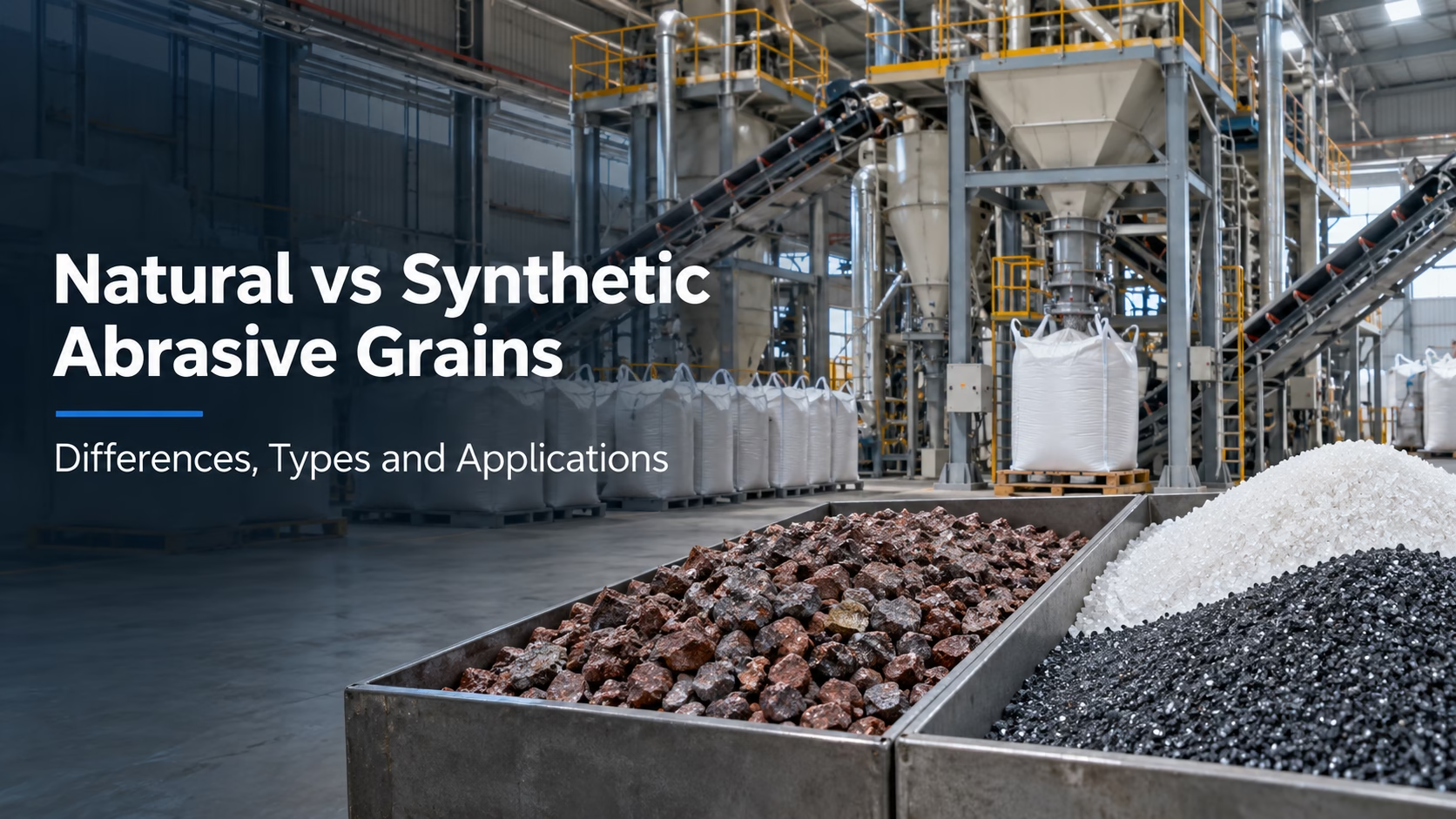
What Are Natural Abrasive Grains?
Natural abrasive grains are materials obtained directly from naturally occurring minerals. These materials are mined, processed, crushed, cleaned, and classified before being used as abrasives.
Historically, natural abrasives were the foundation of many grinding and polishing applications because they already possessed the hardness required for material removal.
Common natural abrasive materials include:
- Natural diamond
- 석류석
- Emery
- Natural corundum
- Quartz
Types of Natural Abrasive Grains
Natural Diamond
Diamond is one of the hardest naturally occurring materials and has excellent cutting ability.
Natural diamond has been used in specialized cutting and polishing applications where extreme hardness is required. 하지만, many industrial applications today use synthetic diamond because it allows better control over size, 모양, and availability.
석류석
Garnet is a natural mineral abrasive known for its durability and sharp cutting characteristics.
It is commonly used in abrasive blasting and waterjet cutting applications. Garnet remains valuable in industries where its natural properties provide advantages.
Emery and Natural Corundum
Emery is a natural abrasive material mainly composed of aluminum oxide minerals and other compounds.
Natural corundum also has abrasive properties due to its hardness. 하지만, their performance can vary depending on mineral origin and composition.
This variation is one reason why modern industries increasingly rely on synthetic abrasive materials.
Limitations of Natural Abrasive Grains
Although natural abrasives have historical importance, they also have several limitations in modern manufacturing.
The biggest challenge is consistency.
Because natural abrasives come from geological sources, their:
- chemical composition,
- 경도,
- impurity levels,
- crystal structure,
may vary between different deposits.
For some applications, this variation is acceptable. 하지만, industries such as precision grinding, 전자 제품, 도예, and advanced manufacturing require highly predictable abrasive performance.
Another limitation is particle-size control.
Modern abrasive industries often require specific grading systems such as FEPA, 안시, or JIS. Maintaining very precise particle-size distributions can be more challenging with naturally sourced materials.
This is where synthetic abrasive grains provide significant advantages.
What Are Synthetic Abrasive Grains?
Synthetic abrasive grains are engineered abrasive materials produced through controlled manufacturing processes.
Instead of depending on natural mineral deposits, manufacturers can control the raw materials, production conditions, chemical composition, and grain classification.
Common synthetic abrasive materials include:
- 브라운 융합 알루미나
- 백색 용융 알루미나
- 실리콘 카바이드
- Zirconia alumina
- Ceramic alumina
These materials are widely used in modern grinding, 폭파, 세련, 내화 물질, and ceramic industries.
예를 들어, 흰색 융합 알루미나 is produced from high-purity alumina and is commonly selected for applications requiring clean cutting performance and controlled abrasive properties.
Why Synthetic Abrasive Grains Are Widely Used
When I evaluate abrasive materials for industrial customers, consistency is usually one of the first factors I consider.
Manufacturers do not only need an abrasive that works once. They need a material that performs consistently throughout thousands of production cycles.
Synthetic abrasive grains provide several advantages.
Better Quality Control
Synthetic abrasives allow manufacturers to control:
- grain size,
- chemical composition,
- 경도,
- 강인함,
- fracture behavior.
This makes performance more predictable.
예를 들어, a grinding wheel manufacturer may need abrasive grains with specific fracture characteristics, while a polishing manufacturer may require very fine particles with controlled distribution.
More Flexible Applications
Different synthetic abrasives are designed for different industrial purposes.
브라운 용융 알루미나
Brown fused alumina is known for its toughness and durability.
그것은 일반적으로 사용됩니다:
- 그라인딩 휠,
- 폭파,
- 표면 준비,
- 코팅된 연마재.
YUMO provides brown fused alumina abrasive grain sizes for different industrial applications.
흰색 융합 알루미나
White fused alumina offers high purity and sharp cutting characteristics.
Typical applications include:
- 정밀 연삭,
- 세련,
- abrasive blasting,
- 도예.
실리콘 카바이드
Silicon carbide is a hard and sharp synthetic abrasive.
It is widely used for:
- 유리 처리,
- ceramic grinding,
- stone finishing,
- hard materials.
YUMO supplies silicon carbide abrasive materials including black silicon carbide and green silicon carbide.
Natural vs Synthetic Abrasive Grains: 주요 차이점
| 특징 | Natural Abrasive Grains | Synthetic Abrasive Grains |
|---|---|---|
| Source | Natural minerals | Manufactured materials |
| Quality consistency | Depends on mineral source | Controlled production |
| Particle size control | More difficult | Precise classification |
| Customization | Limited | Multiple grades available |
| Industrial usage | Specialized applications | Wide industrial applications |
Synthetic abrasive grains are not always universally better, but they are usually more suitable for modern industrial manufacturing because their properties can be controlled more precisely.
Abrasive Grain Size and Standards
Another important difference between natural and synthetic abrasive grains is particle-size control.
Industrial buyers often specify abrasive sizes using standards such as FEPA, 안시, or JIS.
According to the FEPA abrasive standards, abrasive grains are classified according to controlled particle-size distributions. FEPA also distinguishes between F-grit for bonded abrasives and P-grit for coated abrasives.
This is important because a specification such as F80 and P80 should not automatically be considered identical.
For international purchasing, I recommend confirming:
- abrasive material,
- grit standard,
- particle size,
- application,
- quality requirements.
Our guide on 연마 입자 크기 설명: 밥을 먹이다, ANSI와 JIS explains how different abrasive grading systems work.
How I Choose Between Natural and Synthetic Abrasive Grains
When selecting abrasive materials, I usually follow a simple process.
첫 번째, I look at the workpiece material.
강철, 유리, 도예, 결석, and carbide materials all require different abrasive characteristics.
두번째, I define the production goal.
Is the customer trying to:
- remove material quickly?
- prepare a surface?
- achieve a polished finish?
- improve dimensional accuracy?
Third, I evaluate abrasive properties:
- 경도,
- 강인함,
- 입자 모양,
- particle size,
- 청정.
Finally, I confirm the required abrasive standard.
A common mistake is selecting an abrasive only because it has a lower price or higher hardness. The best abrasive is the one that provides the correct balance between performance, consistency, and production cost.
최종 생각: Choosing the Right Abrasive Grain
The difference between natural and synthetic abrasive grains is not only about origin. It is about performance, consistency, and suitability for the application.
Natural abrasives remain valuable because of their unique mineral characteristics. 하지만, synthetic abrasive grains have become the preferred choice for many industries because they offer better control over particle size, 청정, grain structure, and manufacturing consistency.
When selecting an abrasive, I recommend focusing on the complete application rather than simply comparing materials.
The right abrasive should match the workpiece, production process, 필요한 표면 마감, and quality expectations.
Need Synthetic Abrasive Grains? YUMO Can Support Your Requirements
If you are looking for reliable synthetic abrasive grains for grinding, 폭파, 세련, 도예, or refractory applications, YUMO can help you select a suitable abrasive solution.
YUMO supplies:
- 백색 용융 알루미나
- 브라운 융합 알루미나
- 검은 실리콘 카바이드
- 녹색 실리콘 카바이드
Available products include abrasive grains, abrasive grit, fine powders, and customized particle sizes.
Whether you need coarse abrasive grains for aggressive surface treatment or fine abrasive powders for precision applications, our team can help evaluate your:
- abrasive material,
- 입자 크기,
- grading standard,
- application,
- packaging requirements.
At YUMO, we focus on providing stable abrasive materials that match real industrial requirements rather than simply supplying standard products.
Contact YUMO with your abrasive requirements, and we can help you find the right abrasive grain solution for your manufacturing process.


