
When comparing abrasive materials for grinding, 폭파, 랩핑, or polishing, buyers often come across two familiar terms: abrasive grain and abrasive powder. Although they may be made from exactly the same mineral, they are not always intended for the same processing conditions. Understanding the difference can help you choose an appropriate abrasive, avoid specification mistakes, and achieve more consistent manufacturing results.
The main difference between abrasive grain and abrasive powder is generally particle size and intended application. Abrasive grain usually refers to relatively coarse, classified particles used in grinding wheels, abrasive blasting, 절단, 표면 준비. Abrasive powder typically describes finer particles used for precision grinding, 랩핑, 세련, and certain ceramic manufacturing processes.
하지만, I want to make one distinction clear from the beginning: there is no universal particle-size boundary at which abrasive grain officially becomes abrasive powder. Manufacturers, industries, and grading systems do not always use these terms in exactly the same way.
In practice, 입자 크기 분포, abrasive composition, grading standards, and the intended application tell us much more about a material than its commercial name.
이 가이드에서는, I will explain the differences between abrasive grain and abrasive powder, how their particle sizes influence performance, where each material is commonly used, and what I recommend checking before purchasing abrasive materials for industrial production.
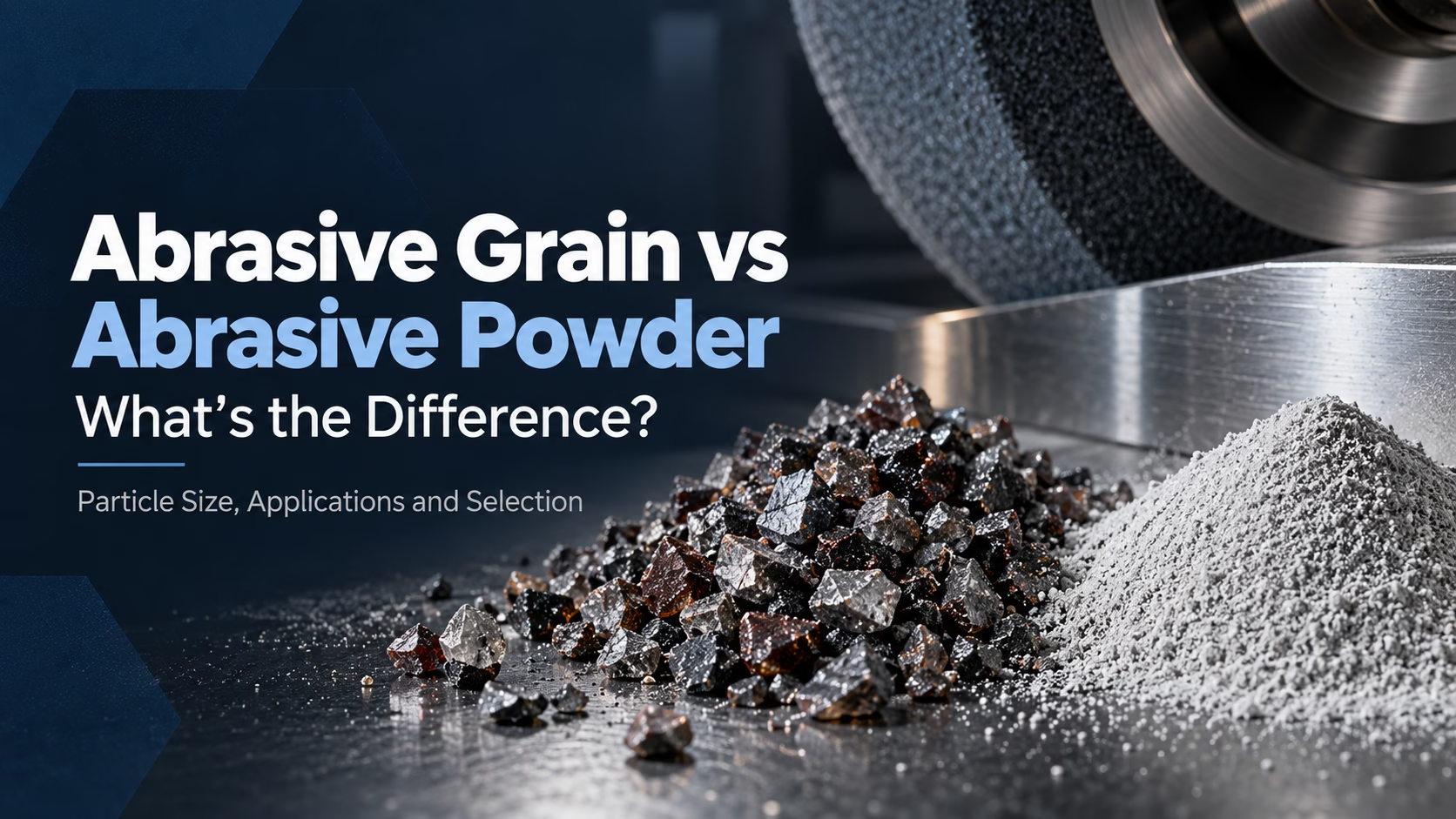
What Is the Difference Between Abrasive Grain and Abrasive Powder?
The easiest way to understand abrasive grain vs abrasive powder is to think about how much material needs to be removed and what surface condition the process must achieve.
Both products are made from hard materials capable of removing material through mechanical abrasion. Common examples include fused aluminum oxide and silicon carbide. The same base mineral can be manufactured into coarse particles, standard abrasive grits, fine powders, and precisely classified micro powders.
Their primary differences usually involve particle size, classification requirements, processing methods, and the type of finish they are expected to produce.
연마 입자 란 무엇입니까??
Abrasive grain consists of hard particles that act as cutting points when they contact a workpiece. Depending on the application, the grains may be bonded together in grinding wheels, attached to abrasive belts, or propelled against a surface during blasting.
Compared with products sold as fine abrasive powders, standard abrasive grains are often larger and are selected for applications requiring noticeable cutting action, mechanical durability, or relatively high material removal rates.
예를 들어, brown fused alumina grain is commonly used in grinding and blasting because of its combination of hardness and toughness. White fused alumina grain is another popular choice, particularly where sharp cutting action and material purity are important.
Grain shape also influences performance. Angular grains can penetrate a surface aggressively, while blockier particles may behave differently under pressure or repeated impact.
For a broader explanation of the materials themselves, our article on what abrasive grain is and how it works covers common abrasive types, 속성, sizes, and industrial applications.
What Is Abrasive Powder?
Abrasive powder is generally a finer form of abrasive material produced through crushing, milling, classification, 그리고, where necessary, additional purification or processing.
It is frequently used when manufacturers need controlled material removal, improved surface flatness, reduced scratch depth, or a specified surface finish.
Unlike abrasive grains used in a blasting cabinet or conventional grinding wheel, fine abrasive powders are often used as loose abrasives or mixed into liquids to form lapping and polishing slurries. They may also be incorporated into ceramic formulations and other industrial products.
I would not describe abrasive powder as simply a smaller version of blasting grit. In demanding applications, powder performance depends heavily on its particle-size distribution, oversized-particle content, 청정, and behavior within the processing system.
A nominally fine powder that contains unexpected coarse particles can create surface defects, even when most of its particles fall within the desired size range.
Abrasive Grain vs Abrasive Powder: 주요 차이점
| 특징 | Abrasive Grain | Abrasive Powder |
|---|---|---|
| Typical particle size | Generally coarser | Generally finer |
| Common appearance | Distinct individual particles | Fine granular or powder-like material |
| Main purpose | 연마, 폭파, cutting and surface preparation | 랩핑, 세련, fine grinding and precision processing |
| Material removal | Often selected for heavier stock removal | Often selected for controlled, fine removal |
| 표면 마무리 | Can produce deeper cutting marks | Can support finer surface finishes |
| Common specifications | F-grit, P-grit, mesh and aggregate sizes | Microgrit, micron sizes and fine-powder grades |
| Typical materials | 브라운 융합 알루미나, 흰색 융합 알루미나, 실리콘 카바이드 | 백색 용융 알루미나, silicon carbide and other abrasive powders |
| Important quality factors | Size distribution, 강인함, shape and durability | Size distribution, oversized particles, purity and consistency |
This table describes general industrial practice rather than an absolute technical classification. A fine abrasive grain and a coarse abrasive powder may overlap in particle size, and both terms can refer to the same material in different markets.
Abrasive Grain and Powder Sizes: 모래, Mesh and Micron
Particle size is one of the most important factors when comparing abrasive grain and abrasive powder. It affects cutting behavior, material removal, surface roughness, classification requirements, and purchasing specifications.
일반적으로, larger abrasive particles can penetrate a workpiece more deeply and remove material aggressively. Smaller particles tend to create shallower individual scratches, making them useful for controlled finishing operations.
하지만, particle size should never be considered independently of abrasive material, 입자 모양, processing pressure, or equipment.
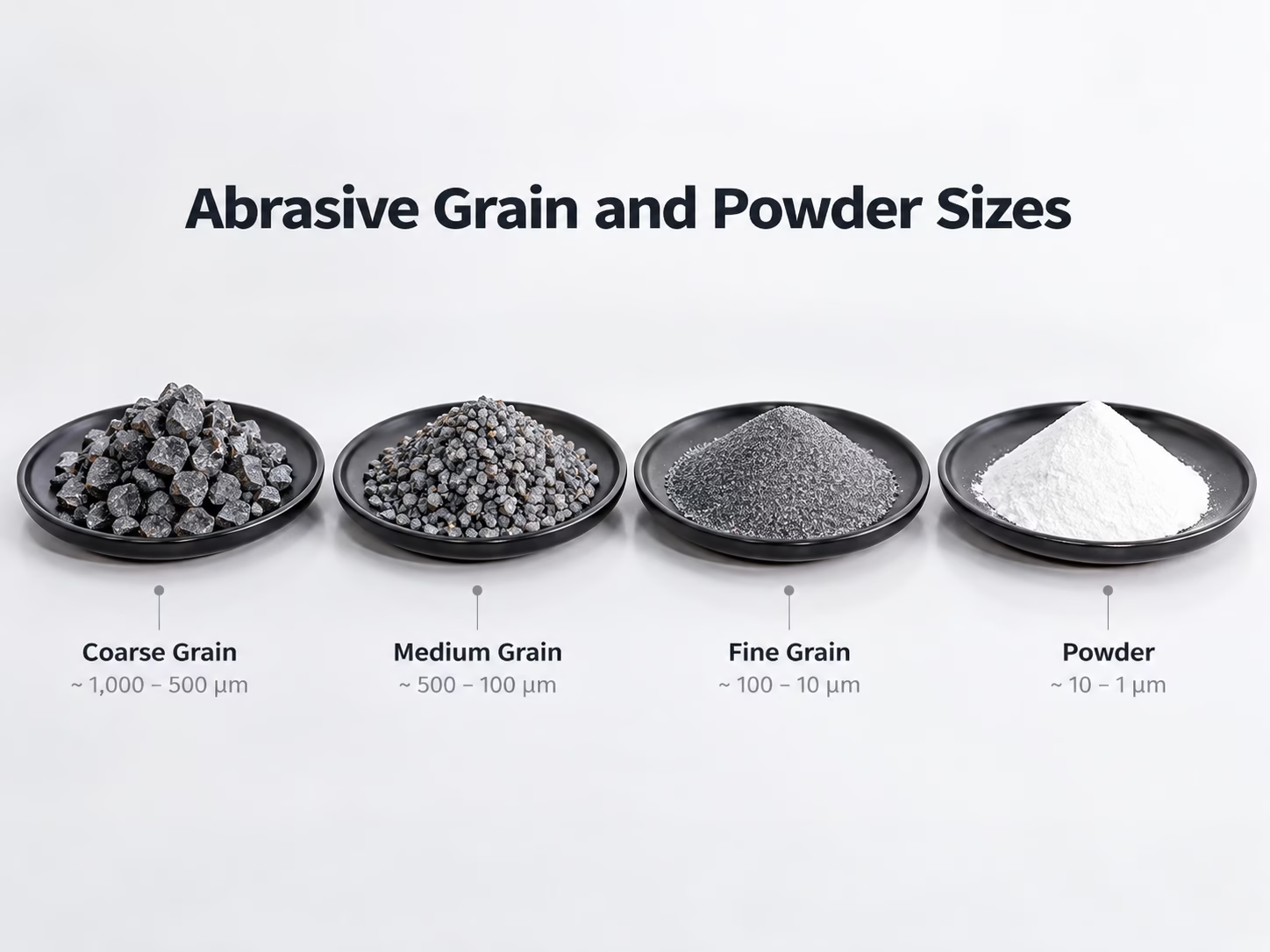
Macrogrit vs Microgrit
In technical abrasive specifications, the distinction between macrogrit and microgrit is often more useful than the commercial distinction between grain and powder.
Macrogrits are relatively coarse classified abrasive particles. They are commonly associated with grinding wheels, 연마 벨트, 폭파, and other applications requiring larger cutting grains.
Microgrits are finer abrasive particles that require more precise particle-size classification and testing. They are widely used in fine grinding, 랩핑, 세련, and related applications.
According to the Federation of European Producers of Abrasives (밥을 먹이다), particle-size designations depend on the abrasive product category. FEPA identifies F-grit sizes for bonded abrasives and P-grit sizes for coated abrasives. Its standards also describe particle size as a distribution rather than one exact diameter.
For conventional bonded abrasive grains, ISO 8486-2:2007 마이크로그릿 F230 ~ F2000을 포괄합니다. in fused aluminum oxide and silicon carbide. The standard specifies methods for determining and checking the particle-size distributions of these materials.
These details help explain why terms such as “미세 분말,” “미세분말,” 그리고 “microgrit” may overlap without being completely interchangeable.
Why Grit, Mesh and Micron Are Not Interchangeable
One mistake I often try to avoid in abrasive specifications is treating grit, 망사, and micron as though they were three different names for the same measurement.
Grit designations refer to particle-size grades defined by particular standards. Mesh traditionally refers to the number of openings per linear inch in a sieve, although the actual opening size also depends on the sieve specification. 미크론, or micrometer, is a direct unit of length.
A micron-based specification may describe a median particle size, an upper particle-size limit, or a defined distribution. Simply stating “10 microns” does not necessarily tell a supplier which of those measurements matters.
Different grit standards can also define different particle distributions. As a result, I do not recommend converting FEPA, 안시, 그, 망사, and micron specifications using a general conversion chart without confirming the intended standard.
For a more detailed explanation, see our guide to abrasive grain sizes and FEPA, ANSI and JIS standards.
Why Particle Size Distribution Matters
Abrasive products do not consist of perfectly identical particles. Even a carefully classified material contains a distribution of particle sizes.
미세분말용, manufacturers may describe that distribution using values such as D10, D50, and D90. These are percentile-based measurements, although their interpretation depends on the measurement method and whether the distribution is reported by volume, number, or another basis.
In precision processing, I would pay particular attention to the upper end of the distribution. A small quantity of oversized abrasive particles can create deeper scratches than expected, especially during lapping or fine polishing.
Powder agglomeration can also matter. Very fine particles may cluster together, which can affect suspension stability, feeding, dispersion, and the finished surface.
This is why selecting the finest available powder does not automatically guarantee the best polishing result.
Common Applications of Abrasive Grain and Powder
The practical difference between abrasive grain and abrasive powder becomes clearer when we look at how manufacturers use them.
Both materials remove or modify surfaces, but their processing conditions and performance priorities can be quite different.
Abrasive Grain Applications
Grinding wheels and bonded abrasives are among the most familiar applications for abrasive grains. Individual particles provide cutting edges while the bonding system holds them in place. The grain’s hardness, 강인함, 부서지기 쉬움, and size influence how the wheel removes material.
Abrasive blasting is another major application. During blasting, abrasive particles strike a surface to remove rust, scale, 코팅, or other unwanted materials. Coarse or medium grains are frequently selected when the goal is efficient cleaning or surface profiling.
Grain size affects both removal behavior and the resulting surface texture. Larger grains generally create more aggressive cutting action, although blasting pressure, impact angle, 입자 모양, and workpiece properties also influence the result.
코팅된 연마재, including sanding belts and discs, use graded abrasive grains attached to a backing material. Depending on the workpiece and manufacturing process, these products may contain aluminum oxide, 실리콘 카바이드, or other abrasive materials.
For these applications, I generally focus on cutting efficiency, 내구성, 입자 모양, and the balance between material removal and surface finish.
Abrasive Powder Applications
Abrasive powders are particularly useful in processes where surface quality and dimensional control are more important than aggressive stock removal.
랩핑 is a good example. Fine abrasive particles are commonly used between a lap and the workpiece to remove small amounts of material and improve flatness. The abrasive may be carried in a liquid or another suitable medium.
In polishing, the objective is often to reduce surface roughness, remove fine scratches, or prepare a surface for a subsequent finishing operation. A tightly controlled abrasive powder can help produce a consistent result, although the final finish depends on the complete polishing system.
Fine powders are also used in processing glass, technical ceramics, precision components, and selected electronic or optical materials.
Their usefulness extends beyond conventional abrasion. Fine fused alumina and silicon carbide powders may be incorporated into ceramic bodies, refractory matrices, wear-resistant products, and industrial coatings.
This highlights an important point: abrasive powder is not always used to polish something. In some applications, particle size is selected primarily for packing behavior, composition, or compatibility with the final product.
White Fused Alumina and Silicon Carbide: Grain vs Powder
When comparing abrasive grain and powder, I find it helpful to examine two widely used abrasive families: white fused alumina and silicon carbide.
Both are available in different particle sizes and forms. Their applications overlap, but their material properties are not identical.
White Fused Alumina Grain vs Powder
백색 용융 알루미나, commonly abbreviated as WFA, is a synthetic aluminum oxide abrasive manufactured from high-purity alumina.
It is known for its hardness, sharp cutting characteristics, and relatively high friability compared with conventional brown fused alumina.
Coarse and standard-size WFA grains are commonly used for grinding wheels, abrasive blasting, 코팅된 연마재, and surface treatment. These applications benefit from the material’s cutting characteristics and the availability of different graded particle sizes.
Fine white fused alumina powders are more commonly associated with lapping, fine grinding, 세련, and selected ceramic or refractory applications.
Although the base mineral may be the same, the requirements for grain and powder can differ considerably.
예를 들어, a grinding-wheel manufacturer may emphasize grain shape, 부서지기 쉬움, and compatibility with the bonding system. A precision lapping operation may place greater importance on particle-size distribution, coarse-particle limits, and surface cleanliness.
YUMO supplies different white fused alumina grades for abrasive and industrial applications. Buyers looking for finer material specifications can also review our white fused alumina fine powder range.
I would always recommend checking the actual grade and intended application instead of assuming that every WFA powder is suitable for precision polishing.
Silicon Carbide Grain vs Powder
Silicon carbide is another important industrial abrasive. It is harder and generally more brittle than conventional fused aluminum oxide, giving it a sharp cutting action that is useful for many hard or brittle workpieces.
Black silicon carbide is commonly used in grinding, 폭파, 석재 가공, 내화물, and other industrial applications. Green silicon carbide is often selected where higher purity or particular precision-processing characteristics are required.
In grain form, silicon carbide may be used in bonded or coated abrasive products, 표면 준비, and grinding applications.
As a fine powder, it is used in lapping, fine grinding, 세련, 세라믹 가공, and selected hard-material finishing operations.
For instance, a silicon carbide grain intended for surface preparation will usually have different performance priorities from a fine SiC powder intended for lapping a precision component.
While both products contain silicon carbide, the particle-size distribution, 청정, 모양, and processing method may need to be specified differently.
YUMO offers silicon carbide abrasive materials, including black and green silicon carbide products for different industrial requirements.
The important lesson is that particle size and material type must be considered together. Choosing powder instead of grain does not automatically make an abrasive more suitable for every precision application.
How to Choose the Right Abrasive Grain or Powder
When evaluating abrasive materials, I prefer to begin with the manufacturing process rather than the product name.
The first question is what material needs to be processed. 강철, 스테인레스 스틸, 유리, technical ceramics, 결석, and carbide materials do not respond identically to abrasive cutting. Selecting the abrasive mineral is therefore just as important as selecting its size.
The next consideration is the desired result. If the objective is rapid rust removal or aggressive surface preparation, relatively coarse abrasive grain may be an appropriate starting point. If the process requires controlled flatness or fine finishing, a classified abrasive powder may be more suitable.
I would then look at the required material-removal rate, machine type, 압력, processing time, and acceptable surface roughness. Choosing an unnecessarily fine powder can increase processing time without producing a meaningful improvement in quality.
The final step is confirming the actual specification. Even when a supplier describes a product as fine powder or micro powder, I would still request the grading standard or particle-size distribution needed for the application.
What Should Buyers Include in an Abrasive RFQ?
A clear request for quotation helps avoid misunderstandings, particularly when purchasing abrasive materials internationally.
| Specification | Example |
|---|---|
| Abrasive material | 흰색 융합 알루미나 |
| Product form | Abrasive Grain / 마이크로 파우더 |
| Grain size | F80 or specified micron grade |
| Grading standard | 밥을 먹이다, 안시, JIS or customer specification |
| 애플리케이션 | 연마, 폭파, lapping or polishing |
| Chemical requirements | Customer-defined purity or impurity limits |
| Particle-size requirements | Distribution or maximum size, if necessary |
| 포장 | 25 kg bags or other required packaging |
| 수량 | Required order volume |
| Quality documents | Technical data sheet or certificate of analysis |
예를 들어, white fused alumina F80, FEPA F, for bonded abrasive manufacturing is more informative than simply requesting “white abrasive grain.”
For a precision powder, I would go further and provide the required particle-size distribution, measurement method, maximum coarse-particle limit, and end application whenever those details are available.
I would also ask about batch consistency and sample availability before approving a material for a demanding production process.
A common purchasing mistake is focusing entirely on the price per kilogram. The actual processing cost includes abrasive consumption, machine time, labor, surface defects, and possible rework.
A slightly more expensive abrasive may be economical if it produces more consistent results, but that conclusion should come from production testing rather than an unsupported performance claim.
Ultimately, the right decision depends on whether the abrasive delivers the required result within an acceptable manufacturing cost.
Conclusion: Choosing the Right Abrasive for Your Application
The difference between abrasive grain and abrasive powder is primarily a matter of particle size, classification, and intended application rather than two completely different categories of material.
Abrasive grain is generally associated with grinding, 폭파, 절단, 표면 준비, where controlled cutting action and material removal are important. Abrasive powder is more commonly associated with lapping, 세련, fine grinding, and applications requiring smaller particles or more tightly controlled distributions.
하지만, the terms are not governed by one universal size boundary. A product described as abrasive powder by one supplier may overlap with a fine abrasive grain specification used elsewhere.
산업용 구매자를 위한, my recommendation is to focus on abrasive material, particle size, grading standard, distribution, 청정, and application rather than relying on the terms grain and powder alone.
Need Abrasive Grain or Abrasive Powder? YUMO Can Help
If you are looking for a supplier of abrasive grains, fine powders, or micro powders, 허난 유모 신소재 유한회사, 주식회사 can help you identify suitable materials and specifications for your industrial application.
We supply white fused alumina, 갈색 용융 알루미나, 검은색 실리콘 카바이드, 녹색 실리콘 카바이드, and other abrasive materials for grinding, 폭파, 랩핑, 세련, refractory manufacturing, 도예, and surface treatment.
At YUMO, we understand that industrial buyers need more than a product name. Stable particle size, consistent chemistry, appropriate grading, and reliable supply all contribute to predictable processing results.
Whether you require coarse abrasive grains for aggressive surface preparation, standard grits for abrasive manufacturing, or fine powders for precision finishing, we can discuss your required material, particle size, grading standard, application, 포장, and purchasing volume.
Contact YUMO with your abrasive material requirements, target grit or micron size, application, and expected quantity. Our team can help you evaluate available grades and select an appropriate abrasive grain or powder for your manufacturing process.


