
Choosing the right abrasive material is essential for achieving consistent grinding performance, surface quality, 생산 효율성. Among the commonly used industrial abrasives, brown aluminum oxide is widely recognized for its hardness, 강인함, 내구성, and versatility. 하지만, it is not necessarily the best choice for every application.
When we compare brown aluminum oxide with other abrasives, such as white fused alumina, 검은색 실리콘 카바이드, 녹색 실리콘 카바이드, zirconia alumina, ceramic alumina, and garnet, we need to consider more than hardness alone. 입자 인성, 부서지기 쉬움, chemical composition, 입자 모양, and operating conditions all influence the final result.
이 가이드에서는, we explain the main differences between these abrasive materials, discuss their typical industrial applications, and help buyers understand when brown fused alumina is a practical choice and when another abrasive may be more suitable.
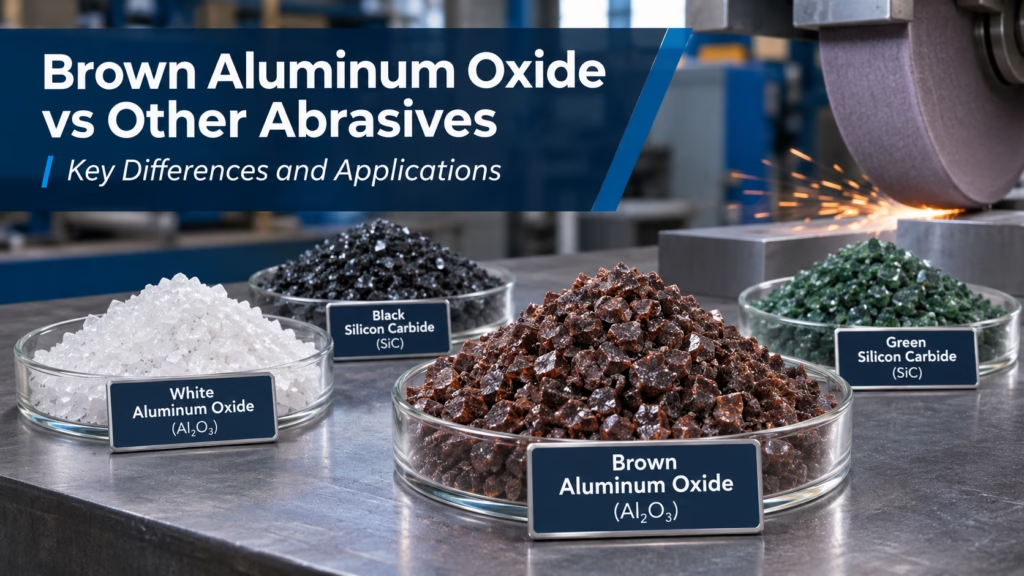
1. What Is Brown Aluminum Oxide?
Brown aluminum oxide, commonly known as Brown Fused Alumina (격아), is a synthetic abrasive material produced by electrically fusing bauxite-based raw materials in an electric arc furnace. 식힌 후, the fused material is crushed, processed, magnetically separated, and classified into different particle sizes.
Its main chemical component is aluminum oxide (Al₂O₃), while titanium dioxide (TiO2) and other minor oxides are also present in commercial grades. A typical commercial specification may contain approximately 95–97.5% Al₂O₃, although the actual composition depends on the raw materials, manufacturing process, and product grade.
Brown fused alumina is generally characterized by:
- 높은 경도: Common commercial grades are around 9 모스 경도 척도.
- Good toughness: Its grains can withstand considerable mechanical impact during grinding and blasting.
- 내마모성: Its relatively durable grain structure makes it useful in demanding industrial applications.
- Angular grain shape: Crushed particles provide cutting edges for material removal.
- Versatility: It is used in bonded abrasives, 코팅된 연마재, 폭파 미디어, and refractory products.
We consider brown fused alumina a practical general-purpose abrasive when buyers need a balance between cutting performance, grain durability, and material cost.
하지만, different BFA grades can have different chemical compositions, grain shapes, and particle-size distributions. Buyers should always check the actual technical specification rather than assuming every brown fused alumina product has identical properties.
2. Brown Aluminum Oxide vs Other Abrasives: 빠른 비교
The following table summarizes the main differences between commonly used industrial abrasive materials.
| Abrasive Material | Main Characteristics | 일반적인 애플리케이션 |
|---|---|---|
| 브라운 용융 알루미나 | 딱딱한, tough, durable | Steel grinding, 폭파, 접착 연마재 |
| 흰색 융합 알루미나 | 고순도, relatively friable | 정밀연삭, 세련, clean surface preparation |
| 블랙 실리콘 카바이드 | Very hard, 날카로운, relatively brittle | 주철, 결석, 유리, 도예 |
| 녹색 실리콘 카바이드 | 고순도, sharp cutting characteristics | Carbide, 기술 도자기, 정밀 연삭 |
| Zirconia Alumina | 높은 인성, controlled grain breakdown | Heavy-duty metal grinding |
| Ceramic Alumina | Engineered microstructure, micro-fracturing | High-performance grinding |
| 석류석 | Natural mineral, angular grain | Abrasive blasting, 워터젯 절단 |
These are general material characteristics rather than universal performance rankings. Actual results depend on abrasive grade, 입자 크기, 입자 모양, 장비, and operating conditions.
3. Brown Aluminum Oxide vs White Aluminum Oxide
Brown fused alumina and white fused alumina (WFA) are both synthetic aluminum oxide abrasives. 하지만, their raw materials, chemical composition, and grain behavior are different.
Chemical Composition and Purity
Brown fused alumina is generally produced from bauxite-based raw materials, while white fused alumina is manufactured by fusing high-purity alumina.
As a result, WFA typically has a higher Al₂O₃ content, commonly above 99%, while standard BFA grades generally contain around 95% or more.
The difference in chemical composition can influence their suitability for applications where purity and contamination control are important.
인성과 취약성
One of the most important differences is grain behavior.
Brown fused alumina is generally tougher and more resistant to mechanical breakdown. This makes it suitable for applications involving repeated impact, general-purpose grinding, and abrasive blasting.
White fused alumina is relatively more friable. Under suitable grinding conditions, its grains can fracture and expose new cutting edges. This characteristic can be useful when a relatively clean and controlled cutting action is required.
하지만, neither material has an absolute performance advantage in every grinding process. Bond type, grinding pressure, and grain structure also influence the result.
Which One Should You Choose?
We generally recommend considering brown fused alumina when toughness, 내구성, and general industrial performance are priorities.
White fused alumina is worth considering when higher purity, lower impurity levels, or controlled grain breakdown are more important.
For buyers comparing these two materials, we recommend reviewing our White Fused Alumina products 그리고 Brown Fused Alumina abrasive grades before making a final decision.
4. Brown Aluminum Oxide vs Black Silicon Carbide
검은 실리콘 카바이드 (블랙 SiC) is another widely used synthetic abrasive. Unlike brown fused alumina, which is primarily aluminum oxide, silicon carbide is a compound of silicon and carbon.
Silicon carbide is generally harder and more brittle than conventional fused aluminum oxide. Its sharp grain edges make it particularly useful for cutting hard and brittle materials.
Main Differences in Properties
Brown fused alumina is valued for its toughness and durability, while black silicon carbide is known for its sharp cutting characteristics and high hardness.
This difference affects how the grains behave during grinding. BFA is often selected when resistance to mechanical impact and general-purpose grinding performance are important. Black SiC is frequently used when sharp cutting action is required.
일반적인 애플리케이션
Black silicon carbide is commonly used for:
- Cast iron grinding and finishing
- Stone and marble processing
- Glass grinding and polishing
- 세라믹 가공
- 비철금속 마감
- Abrasive blasting and refractory applications
Brown fused alumina is widely used for steel grinding, 그라인딩 휠, 코팅된 연마재, 및 산업용 표면 처리.
We would not recommend selecting between these two materials based on hardness alone. The workpiece material, 필요한 표면 마감, grinding pressure, and abrasive product design should all be considered.
5. Brown Aluminum Oxide vs Green Silicon Carbide
녹색 실리콘 카바이드 (녹색 SiC) belongs to the same abrasive family as black silicon carbide, but it is generally manufactured with higher purity and is commonly selected for more demanding precision applications.
Both black and green silicon carbide are very hard abrasive materials. Green SiC is particularly useful where sharp cutting edges, 고순도, and controlled material removal are important.
Where Is Green Silicon Carbide More Suitable?
일반적인 응용 분야는 다음과 같습니다.:
- 초경합금 연삭
- Technical ceramic processing
- 광학 유리 마감
- 정밀 랩핑
- 정밀 연마
- Hard alloy tool manufacturing
Compared with green silicon carbide, brown fused alumina is often a more economical option for general industrial grinding and blasting.
We recommend evaluating green SiC when processing hard and brittle materials or when a specific precision requirement cannot be adequately achieved with conventional alumina abrasives.
You can also explore our Green Silicon Carbide product range for additional information about available abrasive grains and powders.
6. Brown Aluminum Oxide vs Zirconia Alumina and Ceramic Alumina
Zirconia alumina and ceramic alumina are often used in high-performance abrasive products. Although they are related to the broader aluminum oxide abrasive family, their engineered grain structures give them different performance characteristics.
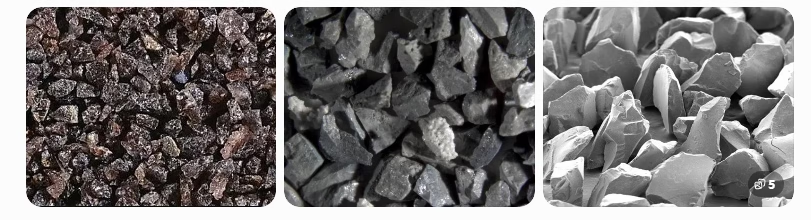
Brown Fused Alumina vs Zirconia Alumina
Zirconia alumina combines aluminum oxide and zirconium oxide to create an abrasive grain with high toughness and controlled fracture behavior.
It is commonly used in demanding grinding operations involving stainless steel, high-alloy steel, and heavy material removal.
Compared with standard BFA, zirconia alumina is generally designed for more aggressive grinding conditions and repeated exposure of fresh cutting surfaces.
For heavy-duty grinding, it may provide higher productivity or longer abrasive life. 하지만, its higher material cost needs to be justified by actual production performance.
Brown Fused Alumina vs Ceramic Alumina
Ceramic alumina abrasives are produced using engineered microstructures, often based on sol-gel technology.
Their microcrystalline structure allows controlled micro-fracturing during grinding, continuously exposing new microscopic cutting edges.
This makes ceramic alumina suitable for demanding applications where consistent cutting performance, productivity, and abrasive utilization are important.
Brown fused alumina remains a practical option for many conventional industrial applications, particularly when buyers need a reliable balance between performance and cost.
We recommend comparing these materials through actual grinding trials rather than assuming that a premium abrasive will always deliver a better economic result.
7. Brown Aluminum Oxide vs Garnet for Sandblasting
Garnet is a natural mineral abrasive commonly used for surface preparation and waterjet cutting. Unlike brown fused alumina, which is manufactured through electric arc fusion, garnet is mined, processed, cleaned, and classified.
Its angular grain structure makes it suitable for removing rust, 코팅, 표면 오염.
Differences in Hardness and Grain Behavior
Brown fused alumina commonly has a Mohs hardness of around 9, while commercial garnet abrasives are often rated approximately 7.5–8.
하지만, hardness alone does not determine blasting efficiency.
Other factors include grain shape, 입자 크기, air pressure, nozzle design, surface profile requirements, and abrasive consumption.
Reusability and Operating Cost
Both materials may be used in suitable abrasive recovery systems, but their actual service life depends on grain breakdown, 먼지 발생, contamination, and screening efficiency.
We do not recommend assuming a fixed number of reuse cycles for either material without testing under the intended blasting conditions.
Garnet may be attractive for certain blasting applications, while brown fused alumina can be considered when higher hardness and durable abrasive grains are required.
The most economical choice should be determined by total operating cost, not simply the purchase price per ton.
8. Main Industrial Applications of Brown Aluminum Oxide
Brown fused alumina is used across several industrial sectors because of its combination of hardness, 강인함, and relatively versatile grain behavior.
Grinding Wheels and Bonded Abrasives
BFA is widely used in resin-bonded and vitrified grinding wheels, 커팅 디스크, and other abrasive tools. Its mechanical durability makes it suitable for many general metalworking applications.
코팅된 연마재
Selected BFA grades are used in abrasive belts, sanding products, and abrasive papers for metal and other industrial surfaces. 입자 크기, 입자 모양, and coating consistency are important factors.
샌드블라스팅 및 표면 준비
Brown fused alumina can remove rust, 규모, and coatings while creating a defined surface profile. The appropriate grit size depends on the required surface roughness and blasting equipment.
내화물
BFA is also used in selected refractory applications because of its high alumina content, 경도, and high-temperature performance.
래핑 및 폴리싱
Fine and micro-sized BFA products can be considered for certain grinding, 랩핑, and polishing applications. 하지만, particle-size distribution and surface-finish requirements must be carefully evaluated.
9. How to Choose the Right Abrasive for Your Application
When helping industrial buyers evaluate abrasive materials, we recommend considering the following factors before placing an order.
| Selection Factor | Questions to Ask |
|---|---|
| Workpiece Material | Are you processing steel, 주철, 유리, 도예, or carbide? |
| Processing Method | Is the abrasive used for blasting, 연마, 랩핑, 또는 연마? |
| Required Surface Finish | Do you need aggressive material removal or a fine finish? |
| Grain Size | Which FEPA, 안시, 그, or micron specification is required? |
| Grain Toughness | Does the process require durable grains or controlled grain breakdown? |
| Chemical Purity | Are iron contamination or other impurities restricted? |
| Operating Cost | What are the abrasive consumption, recovery, and production costs? |
We also recommend confirming the particle-size standard before comparing quotations.
예를 들어, FEPA는 접착 연마재에 F-grit 명칭을 사용하고 코팅 연마재에 P-grit 명칭을 사용합니다.. These systems are not interchangeable simply because their grit numbers appear similar.
Furthermore, FEPA defines particle sizes through controlled distributions rather than treating every grit number as one exact particle diameter.
For more information, see our guide to Abrasive Grain Types, 크기, and Applications.
결론: Choosing the Right Abrasive Matters More Than Choosing the Hardest One
Brown aluminum oxide remains an important industrial abrasive because of its combination of hardness, 강인함, 내구성, and versatility. 하지만, 흰색 융합 알루미나, 실리콘 카바이드, zirconia alumina, ceramic alumina, and garnet each offer different advantages for particular processing requirements.
At YUMO, we believe that selecting the right abrasive should start with the workpiece material, processing method, required surface quality, and total operating cost—not simply the hardness or purchase price.
As an abrasive material supplier, we provide brown fused alumina, 흰색 융합 알루미나, 흑색 융합 알루미나, and black and green silicon carbide for different industrial applications. We can discuss customized particle sizes, 포장, and technical documentation, including COA and MSDS, to help buyers evaluate suitable materials.
If you are comparing abrasive materials for grinding, 폭파, 세련, or refractory production, contact YUMO to discuss your application and find an abrasive grade that matches your production requirements.
자주 묻는 질문
예. Brown aluminum oxide is a common commercial name for brown fused alumina (격아), a synthetic abrasive material primarily based on aluminum oxide.
Not necessarily. Both materials commonly have a Mohs hardness around 9. Their main differences are chemical purity, grain toughness, 부서지기 쉬움, and application requirements rather than a simple hardness ranking.
예, suitable BFA grades can be used in certain stainless steel grinding applications. 하지만, if low contamination or a specific surface-finish requirement is critical, buyers should evaluate high-purity alternatives and conduct application tests.
It can be reused in suitable recovery systems. Actual reuse performance depends on grain breakdown, 먼지 발생, contamination, and the efficiency of the abrasive recovery equipment.
예. BFA is a commonly used grain in resin-bonded and vitrified grinding wheels. The correct grade must be selected according to the wheel formulation, bond system, 공작물 재료, and grinding conditions.


