
사람들이 처음 연마재 산업에 입문했을 때, 제가 듣는 가장 일반적인 질문 중 하나는: 연마 입자 란 무엇입니까?, and why does the type or size matter so much? At first glance, abrasive grain may look like nothing more than crushed mineral particles. In practice, however, these small particles determine how quickly a grinding wheel cuts, how aggressively a blasting medium removes scale, how smooth a polished surface becomes, and how consistently an abrasive process performs.
An abrasive grain is a hard mineral or synthetic particle designed to remove, cut, grind, clean, 모양, or finish another material through mechanical action. Depending on the application, these grains may be bonded into grinding wheels, attached to coated abrasives such as sanding belts and discs, projected at high speed during abrasive blasting, or used as loose powders in lapping and polishing.
The most widely used industrial abrasive grains include aluminum oxide, 흰색 융합 알루미나, 갈색 용융 알루미나, 실리콘 카바이드, zirconia alumina, and ceramic alumina. Each behaves differently because hardness alone does not determine abrasive performance. 입자 모양, 강인함, 부서지기 쉬움, 청정, particle size distribution, operating pressure, and the material being processed all influence the final result.
이 가이드에서는, I will explain what abrasive grain is, how the main abrasive materials differ, how abrasive grit sizes work, where these materials are used, and what I normally consider when selecting an abrasive grain for industrial applications.
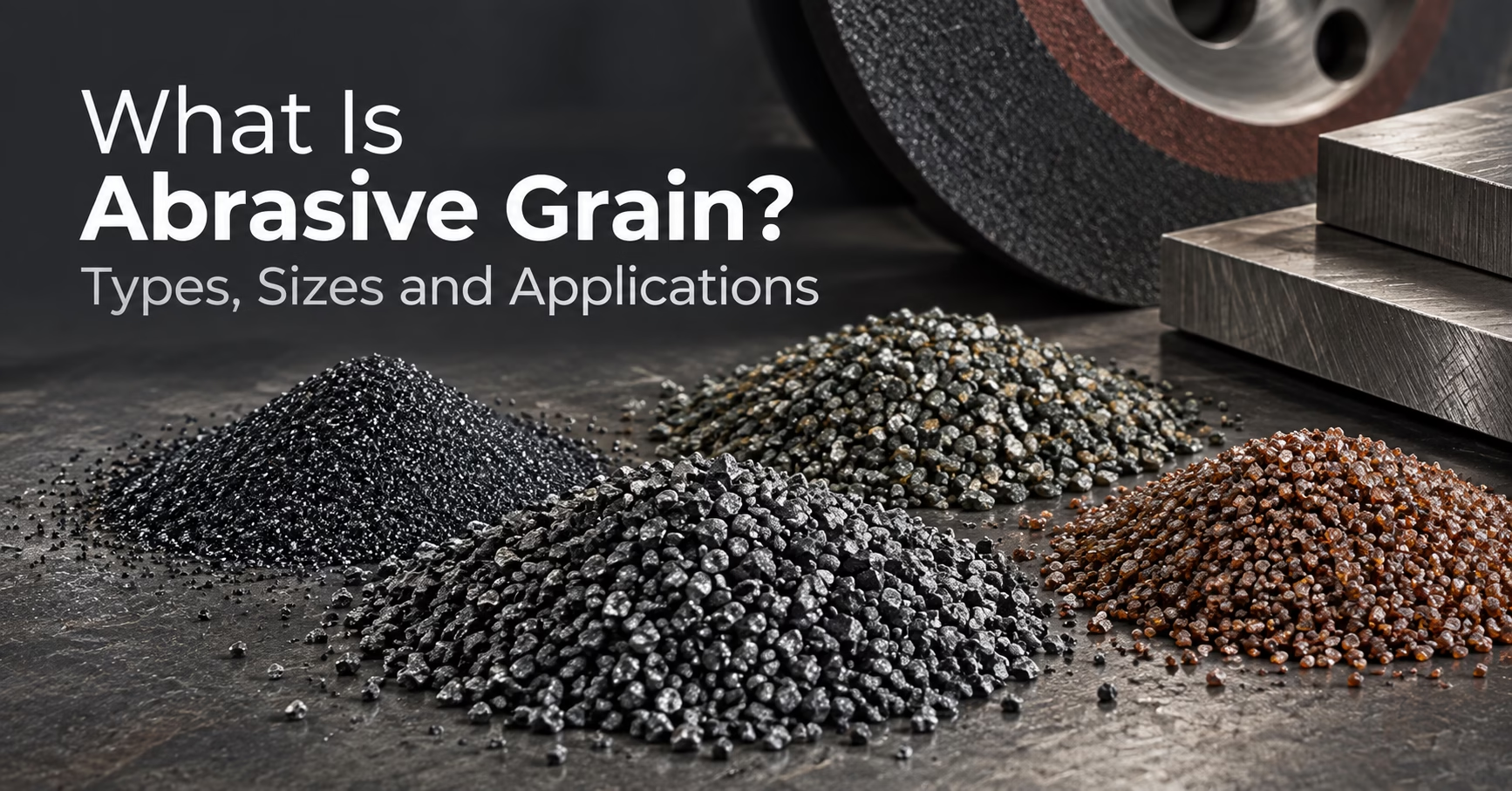
연마 입자 란 무엇입니까??
간단히 말해서, abrasive grain is the cutting component of an abrasive system. Each grain acts like a microscopic cutting tool that scratches, cuts, fractures, or removes material from the surface of a workpiece.
When an abrasive particle comes into contact with another material under sufficient pressure and movement, its sharp cutting edges penetrate the surface and remove a very small amount of material. Thousands or millions of these cutting actions create the grinding, sanding, 폭파, 랩핑, or polishing result we see on the finished component.
I find it useful to think of abrasive grains as very small cutting tools rather than simply hard particles. Unlike a conventional steel cutting tool, however, an abrasive grain may fracture during use. In many applications, that fracture is actually useful because it can expose fresh cutting edges instead of allowing the abrasive to become completely dull.
This helps explain why two abrasive materials with similar hardness can behave very differently. One grain may be tough enough to withstand repeated impact, making it useful for aggressive blasting or heavy stock removal. Another may be more friable and break down gradually, continuously exposing new sharp edges during precision grinding.
이러한 이유로, understanding what abrasive grain is requires looking at more than hardness alone.
Why Abrasive Grain Properties Matter
Whenever I evaluate an abrasive grain, I normally consider hardness, 강인함, 부서지기 쉬움, 입자 모양, chemical composition, 열 안정성, and particle size distribution. These properties work together and determine whether the abrasive is suitable for a particular manufacturing process.
경도 determines whether an abrasive can effectively scratch or cut the workpiece. 일반적으로, the abrasive must be harder than the material being processed. Very hard grains such as silicon carbide are therefore useful for materials including ceramics, 유리, 결석, carbide, and certain non-ferrous materials.
인성 describes the grain’s ability to resist fracture under mechanical pressure or impact. Tough grains can remain intact for longer periods and are often selected for heavy grinding, 폭파, and other operations involving repeated impact.
부서지기 쉬움, on the other hand, refers to how readily the abrasive grain fractures. A friable abrasive is not necessarily weak. Controlled fracture can create new cutting points and help maintain cutting efficiency during use.
Grain shape is equally important. Sharp and angular particles tend to provide more aggressive cutting action, while blockier grains may withstand impact differently. In precision applications, even small differences in grain shape can influence surface finish and material removal rate.
Finally, particle size distribution affects cutting speed, surface roughness, processing consistency, and the risk of unexpected scratches. This is why I rarely recommend evaluating industrial abrasive materials only by a nominal grit number.
Main Types of Abrasive Grain
There is no single abrasive grain that performs best in every situation. The correct material depends on the workpiece, required removal rate, 표면 마무리, process pressure, 장비, and production cost.
The table below provides a practical comparison of several common abrasive grain types.
| Abrasive Grain | Main Characteristics | 일반적인 애플리케이션 |
|---|---|---|
| 브라운 용융 알루미나 | Tough, durable, strong cutting performance | 연마, 폭파, 코팅된 연마재, 접착 연마재 |
| 흰색 융합 알루미나 | 고순도, 날카로운, relatively friable | 정밀연삭, 세련, 폭파, 연마 도구 |
| 블랙 실리콘 카바이드 | Very hard, 날카로운, relatively brittle | 연마, 폭파, 결석, 유리, 도예 |
| 녹색 실리콘 카바이드 | 더 높은 순도, very hard and sharp | 정밀연삭, 랩핑, 세련, technical ceramics |
| Zirconia Alumina | High toughness and good fracture resistance | Heavy grinding and high-pressure stock removal |
| Ceramic Alumina | Engineered microstructure and self-sharpening behavior | High-performance grinding and advanced abrasives |
브라운 용융 알루미나
브라운 융합 알루미나, usually abbreviated as BFA, is one of the most widely established synthetic abrasive materials. It is generally produced by melting alumina-rich raw materials in an electric arc furnace, followed by cooling, 눌러 터뜨리는, 자기 분리, 상영, 및 분류.
I normally consider brown fused alumina when the application requires a combination of hardness, 강인함, 내구성, and cost efficiency. Compared with more friable abrasive materials, BFA can withstand relatively heavy mechanical loads, making it suitable for aggressive grinding and blasting operations.
Common applications include grinding wheels, 코팅된 연마재, sandblasting media, 디버링, 표면 준비, 내화물, and general metal processing.
For buyers who require standard industrial grit sizes, YUMO supplies brown fused alumina abrasive-grade sizes for grinding, 폭파, 코팅된 연마재, 접착 연마재, 세련, and other industrial applications.
The main reason I would choose BFA is not simply that it is hard. Its toughness allows the grain to remain useful under conditions where a more brittle abrasive might break down too quickly.
흰색 융합 알루미나
백색 용융 알루미나, commonly known as WFA or white aluminum oxide, is another important aluminum oxide abrasive. It is produced from high-purity alumina and is known for its hardness, sharp cutting edges, relatively high friability, and low level of certain impurities.
Compared with brown fused alumina, white fused alumina generally provides a cleaner and more controlled cutting action. I often consider WFA when the process requires higher material purity, controlled grain breakdown, lower contamination, or a finer surface finish.
접착 연마재에 널리 사용됩니다., 코팅된 연마재, 정밀 연삭, abrasive blasting, 랩핑, 세련, 도예, 내화물, and surface finishing.
One of the advantages of WFA is the wide range of available particle sizes. Coarse grains can be used for aggressive material removal, standard abrasive grits can be used for grinding and blasting, while micro powders can be used for fine grinding, 정밀 마무리, 그리고 폴리싱.
If you want to understand this material in more detail, our guide to white fused alumina uses and grade selection explains how different WFA grades are matched with grinding, 폭파, 세련, 내화 물질, and ceramic applications.
실리콘 카바이드
실리콘 카바이드, normally abbreviated as SiC, is an extremely hard synthetic abrasive. Compared with conventional aluminum oxide abrasives, silicon carbide is generally sharper and more brittle, allowing it to cut hard or brittle materials efficiently.
I often consider silicon carbide when aluminum oxide does not provide the cutting behavior required for the workpiece. It is commonly used for glass, 도예, 결석, carbide materials, certain cast irons, non-ferrous metals, and technical ceramic components.
The two most familiar industrial types are black silicon carbide and green silicon carbide.
Black silicon carbide offers strong cutting performance and is widely used in grinding, abrasive blasting, 석재 가공, 내화물, 코팅된 연마재, 표면 준비. Green silicon carbide is usually selected where higher purity, sharper cutting action, or more controlled precision processing is required.
Industrial buyers looking for both types can review YUMO’s silicon carbide product range, which includes black silicon carbide, 녹색 실리콘 카바이드, standard abrasive grits, and fine powders for grinding, 폭파, 랩핑, 세련, 세라믹, and refractory applications.
녹색 실리콘 카바이드
Although green and black silicon carbide belong to the same general abrasive family, I would not treat them as interchangeable materials.
녹색 실리콘 카바이드 is generally selected for applications where high hardness, sharp cutting action, 고순도, and controlled finishing are important. Typical workpieces include technical ceramics, 광학 유리, hard alloys, 초경 공구, quartz materials, and other hard or brittle components.
Fine green silicon carbide powders can also be used for lapping and polishing applications where particle-size control becomes particularly important.
In practice, choosing between black and green silicon carbide usually comes down to balancing performance requirements with processing cost. Green SiC may provide advantages in more demanding precision applications, while black SiC is often a practical choice for general industrial grinding and surface treatment.
Zirconia Alumina and Ceramic Abrasive Grain
Zirconia alumina is known for toughness and is frequently used when high grinding pressure and heavy stock removal are required. Rather than fracturing too quickly, the grain can progressively expose new cutting surfaces during use.
Ceramic abrasive grains take this principle further through engineered microstructures. These grains are designed to continuously generate new microscopic cutting points, which can help maintain grinding performance under demanding conditions.
They are frequently used in high-performance sanding belts, grinding discs, 그라인딩 휠, and other applications where productivity may justify a higher abrasive cost.
For many general industrial applications, however, fused alumina and silicon carbide remain practical and widely available solutions.
How Abrasive Grain Sizes Work
After abrasive material type, grain size is probably the specification that causes the most confusion.
As a general rule, a lower grit number indicates a coarser abrasive, while a higher grit number indicates a finer abrasive. A coarse grain removes material more aggressively, while a finer grain generally produces a smoother finish with shallower individual cutting marks.
하지만, I would never recommend assuming that the same grit number always means exactly the same particle size. Abrasive grains are classified according to different standards and grading systems.
그만큼 Federation of European Producers of Abrasives (밥을 먹이다) distinguishes between different abrasive grain systems. In FEPA terminology, bonded abrasives commonly use F-grit designations, while coated abrasives commonly use P-grit designations. FEPA also defines grit sizes as controlled particle-size distributions rather than a single exact particle diameter.
For coated abrasives, ISO 6344-2:2021 specifies methods for determining and testing the grain-size distribution of electro-fused aluminum oxide and silicon carbide macrogrits from P12 to P220 used in coated abrasive products.
For bonded abrasives and related industrial applications, the ISO 8486 series is particularly relevant. ISO 8486-2, for example, addresses fused aluminum oxide and silicon carbide microgrits from F230~F2000.
This is why a purchasing request that simply says “120 grit aluminum oxide” may still leave important questions unanswered. I would normally confirm whether the customer requires FEPA F, FEPA P, 그, 안시, a mesh designation, a micron specification, or another particle-size standard.
조잡한, 중간, Fine and Micro Abrasive Grains
Although exact classifications depend on the abrasive standard and application, grain sizes can be understood more easily by looking at the processing result they are intended to achieve.
| Grain Category | General Processing Behavior | Typical Uses |
|---|---|---|
| Coarse Grain | Aggressive cutting and rapid stock removal | 무거운 연삭, rough blasting, surface profiling |
| Medium Grain | Balance of cutting speed and surface quality | 일반연삭, 디버링, 표면 준비 |
| Fine Grain | Lower cutting depth and smoother finish | 미세한 연삭, 마무리 손질, controlled blasting |
| Microgrit / Powder | Precise and controlled material removal | 랩핑, 세련, 정밀 마무리, 도예 |
I use this classification only as a starting point. A coarse abrasive is not automatically better because it removes material faster, just as the finest abrasive is not automatically the best choice for producing a useful surface.
예를 들어, a metal surface that will later receive a protective coating may require a defined anchor profile. Making that surface too smooth can actually work against the next manufacturing stage.
A precision ceramic component, on the other hand, may require tightly controlled fine abrasive powder to achieve the required dimensional accuracy and surface roughness.
The right abrasive grain size is therefore connected to the entire manufacturing process, not just the abrasive operation itself.
What Is Abrasive Grain Used For?
Once we understand what abrasive grain is, it becomes easier to understand why these materials appear in so many manufacturing processes.
Abrasive grains are used wherever manufacturers need controlled material removal, surface modification, cleaning, 모양, 절단, or finishing.
Grinding and Cutting
Grinding is one of the most familiar abrasive grain applications.
Abrasive particles can be bonded together to manufacture grinding wheels, 커팅 디스크, 마운트 포인트, and other abrasive tools. During operation, individual particles contact the workpiece and remove small amounts of material.
The correct abrasive depends heavily on the workpiece. Aluminum oxide abrasives are widely used for steels and many general metalworking applications, while silicon carbide can be particularly effective on hard, 다루기 힘든, 세라믹, 유리, 결석, and certain non-ferrous materials.
Coarse and tough grains tend to suit aggressive stock removal, while finer or more friable grains may provide better control during finishing operations.
Grinding efficiency is therefore not simply a question of choosing the hardest possible abrasive. The grain must fracture, cut, and wear in a way that matches the grinding pressure and workpiece.
Abrasive Blasting
In abrasive blasting, grains are accelerated through compressed air, centrifugal equipment, or another blasting system and projected against a workpiece.
The impact can remove rust, mill scale, 코팅, oxidation, burrs, and surface contamination. Blasting can also create a controlled surface profile before painting, coating, bonding, or another finishing process.
When selecting blasting media, I normally consider particle shape, 강인함, 크기, contamination requirements, desired surface profile, blasting pressure, and whether the abrasive is expected to be reused.
Brown fused alumina is often selected for aggressive and durable blasting, while white fused alumina can be useful where cleaner processing and controlled contamination are important. Silicon carbide provides a very aggressive cutting action for harder surfaces and specialized applications.
Lapping and Polishing
Lapping and polishing require a very different approach from heavy grinding or blasting.
Instead of removing a large volume of material as quickly as possible, the goal may be to improve flatness, remove fine machining marks, reduce surface roughness, or achieve a specific optical or cosmetic finish.
Fine white fused alumina and silicon carbide powders are commonly used in these processes. Depending on the system, the abrasive may be applied as loose grain, mixed with a liquid to create a slurry, or incorporated into a polishing compound.
Particle-size distribution becomes particularly important at this stage. If a fine polishing powder contains unwanted oversized particles, those grains can leave deeper scratches that are difficult to remove in the next processing stage.
This is one reason why precision classification and consistent quality are important when selecting abrasive micro powders.
Abrasive Grain for Surface Cleaning and Preparation
Abrasive grain is also widely used before coating, bonding, 그림, thermal spraying, and other surface treatments.
The objective is not always to make a surface appear visually smooth or clean. In many industrial processes, the abrasive is used to remove contamination while creating a controlled texture that helps the next coating or treatment interact with the substrate.
This means the abrasive grain must match the required surface profile.
If the grain is too coarse, it may create an unnecessarily deep profile, increase material consumption, or damage sensitive components. 너무 괜찮다면, it may not provide enough cleaning action or surface texture.
이러한 이유로, I prefer to work backward from the required finished surface rather than simply selecting the most aggressive available abrasive.
Abrasive Grain in Refractories, Ceramics and Other Industries
Although abrasive grain is usually associated with grinding and polishing, fused minerals are used in many other industrial applications.
Fused alumina and silicon carbide can also be found in refractory materials, technical ceramics, wear-resistant components, investment casting, 기능성 필러, and high-temperature applications.
In these industries, the material may be selected for a combination of hardness, 열 안정성, chemical composition, 내마모성, and particle-size characteristics rather than its cutting ability alone.
This is why the term “abrasive grain” can sometimes be misleading. The same mineral produced for an abrasive wheel may also serve as an industrial raw material in a completely different manufacturing process.
How I Choose the Right Abrasive Grain
When I help evaluate an abrasive grain, I prefer to start with the application rather than the product name.
The first question is what material is being processed? 강철, 스테인레스 스틸, 유리, 세라믹, 결석, carbide, 알류미늄, and technical ceramics all respond differently to abrasive materials.
The second question is what result is required? Heavy stock removal, 녹 제거, 디버링, coating preparation, 정밀 연삭, 랩핑, and mirror-like finishing all require different abrasive behavior.
I then consider the operating pressure, equipment type, abrasive speed, desired surface finish, contamination limits, grain durability, and acceptable processing cost.
For aggressive grinding or blasting, a tough abrasive such as brown fused alumina may provide a useful balance of cutting ability and durability. For controlled grinding or cleaner surface processing, white fused alumina may be more suitable. When processing very hard or brittle materials, silicon carbide is often worth considering.
Only after answering these questions do I narrow down the grain size.
This approach is more reliable than selecting an abrasive because one product has a lower price per kilogram. A cheaper abrasive that wears too quickly, removes material slowly, produces inconsistent surfaces, or increases machine time may have a higher total processing cost.
Abrasive Grain vs. Abrasive Powder: Is There a Difference?
The terms “abrasive grain” and “abrasive powder” are often used interchangeably, but they can describe different product forms in industrial purchasing.
Abrasive grain is a broad term that can include coarse, medium, and fine particles used for grinding, 폭파, 절단, and surface treatment. Abrasive powder usually refers to finer materials used for fine grinding, 랩핑, 세련, precision ceramics, or other applications requiring smaller particle sizes.
There is no single universal particle size where a grain officially becomes a powder across every supplier, country, and industrial standard.
이러한 이유로, I recommend checking the actual grit designation, 입자 크기 분포, chemical composition, and applicable standard instead of relying only on whether a supplier calls the material “grain,” “grit,” or “powder.”
Why Particle Size Distribution Matters
Nominal grit size is important, but it does not tell the whole story.
Two abrasive products carrying the same nominal designation can still behave differently if their particle-size distributions, grain shapes, impurities, or production controls differ.
예를 들어, excessive oversized particles in a fine abrasive can produce unwanted deep scratches. At the opposite extreme, too many undersized particles may reduce material-removal efficiency.
In grinding and blasting, inconsistent grading can change cutting behavior and surface profiles. In lapping and polishing, particle-size consistency may directly affect surface quality.
산업용 구매자를 위한, I therefore prefer to evaluate abrasive grain as a complete specification. Material type, chemical composition, 입자 모양, particle size distribution, application requirements, 포장, and batch-to-batch consistency should be considered together.
Common Mistakes When Selecting Abrasive Grain
One mistake I see regularly is choosing an abrasive only by hardness. Hardness is important, but an extremely hard abrasive is not automatically the most efficient solution.
Another common mistake is comparing grit numbers from different standards as though they were identical. A number without the grading system can create confusion, especially when a buyer and supplier work with different regional standards.
Buyers may also focus heavily on the lowest purchase price while overlooking abrasive consumption, machine time, labor, surface consistency, and reject rates.
Finally, I would avoid assuming that one abrasive should handle every stage of a manufacturing process. A coarse grain may be ideal for initial stock removal, while a second finer abrasive may provide a much better finishing result.
Thinking about the full processing sequence usually produces a more practical solution than trying to make one abrasive specification do everything.
최종 생각: Understanding Abrasive Grain Makes Selection Easier
So, what is abrasive grain? I would describe it as much more than a hard mineral particle. It is the working cutting element that determines how an abrasive process removes material, how quickly it works, what surface it leaves behind, and how consistently the process performs.
Choosing the right abrasive requires balancing hardness, 강인함, 부서지기 쉬움, 청정, 입자 모양, particle size, 공작물 재료, and processing conditions. Brown fused alumina offers toughness and versatility, white fused alumina provides high purity and controlled cutting behavior, while silicon carbide provides very high hardness and sharp cutting action for difficult materials.
The grit number is only one part of that decision. The grading standard, 입자 크기 분포, grain consistency, and actual manufacturing process can be just as important.
산업용 구매자를 위한, my recommendation is simple: define the application before defining the abrasive. Tell your supplier what material you are processing, what result you need, what equipment you use, and which particle-size standard your production process follows. This usually leads to a much more accurate abrasive specification than selecting a grit number from a catalogue alone.
Need Abrasive Grain? YUMO Can Support Your Application
If you are sourcing abrasive grain for grinding, 폭파, 세련, 랩핑, abrasive tool manufacturing, refractory production, 도예, or other industrial applications, YUMO can help you match the abrasive material and particle size to your processing requirements.
At YUMO, we supply white fused alumina, 갈색 용융 알루미나, 검은색 실리콘 카바이드, 녹색 실리콘 카바이드, abrasive grits, and fine powders for industrial buyers. Different particle sizes, grades, and packaging options can be selected according to specific production requirements.
We understand that industrial customers are not simply buying abrasive particles. What matters is whether the material provides stable cutting performance, predictable particle size, consistent quality, and reliable results from one batch to the next.
Whether you need coarse abrasive grain for aggressive surface treatment, standard grit for grinding or blasting, or fine powder for precision finishing and polishing, we can discuss your workpiece material, application, grit standard, particle-size requirements, 포장, and purchasing volume before recommending a suitable product.
If you are developing a new abrasive product, comparing abrasive materials, or looking for a reliable long-term supplier, YUMO can provide abrasive grain solutions based on your actual application rather than simply offering a standard catalogue product. Contact our team with your required material, 입자 크기, application, and expected quantity, and we can help you determine a suitable abrasive solution for your production process.
Frequently Asked Questions About Abrasive Grain
What is abrasive grain made of?
Abrasive grain can be manufactured from natural or synthetic materials. Modern industrial abrasives frequently use synthetic materials such as fused aluminum oxide, 흰색 융합 알루미나, 갈색 용융 알루미나, 실리콘 카바이드, zirconia alumina, and engineered ceramic alumina because their chemistry, grain size, and processing properties can be controlled more consistently.
What is the most common abrasive grain?
Aluminum oxide is one of the most widely used abrasive materials because it offers a practical combination of hardness, 강인함, availability, and cost. Brown fused alumina and white fused alumina are both widely used, although they provide different cutting characteristics and purity levels.
Is a higher grit number finer or coarser?
In commonly used abrasive grading systems, a higher grit number generally indicates a finer abrasive, while a lower number indicates a coarser abrasive. 하지만, the standard should always be confirmed because different grading systems should not automatically be treated as interchangeable.
What is the difference between F grit and P grit?
F-grit designations are generally associated with bonded abrasives under FEPA grading systems, while P-grit designations are used for coated abrasives. Even when an F and P designation contain the same number, they should not automatically be assumed to represent exactly the same particle-size distribution.
Which abrasive grain should I use for polishing?
The correct abrasive depends on the workpiece and required surface finish. Fine white fused alumina, alumina powders, and silicon carbide powders can all be used in lapping or polishing processes. For precision finishing, particle-size distribution and oversized-particle control are often as important as the nominal grit size.
Which abrasive grain is suitable for sandblasting?
브라운 융합 알루미나, 흰색 융합 알루미나, and silicon carbide can all be used as blasting media. The correct material depends on the substrate, required surface profile, blasting pressure, contamination limits, desired cutting speed, abrasive reuse, and total processing cost.
What abrasive grain is suitable for hard materials?
Silicon carbide is commonly considered for hard and brittle materials such as glass, 도예, 결석, 초경 공구, and technical ceramics. 하지만, the exact abrasive should still be selected according to the workpiece and required finish rather than hardness alone.
Why does abrasive grain size affect surface finish?
Larger abrasive grains generally penetrate deeper into the workpiece and remove more material, producing a rougher surface. Finer grains usually make shallower cuts and can produce a smoother finish. 입자 모양, 압력, 속도, and particle distribution also influence the final surface.


하나의 응답