
백색 용융 알루미나 properties make this synthetic mineral a preferred raw material for precision grinding, abrasive blasting, 세련, 접착 연마재, advanced ceramics and high-temperature refractory products.
Also known as white fused aluminum oxide, white corundum or WFA, the material combines high alumina purity, Mohs hardness of approximately 9, sharp grain geometry, controlled friability, chemical stability and a melting point of about 2,050°C.
하지만, these numbers do not tell the whole story. 입자 크기 분포, 나트륨 함량, 입자 모양, bulk density and manufacturing consistency can have just as much influence on actual performance.
This guide explains the main physical, 화학적인, mechanical and thermal properties of white fused alumina and shows how each property affects industrial applications.
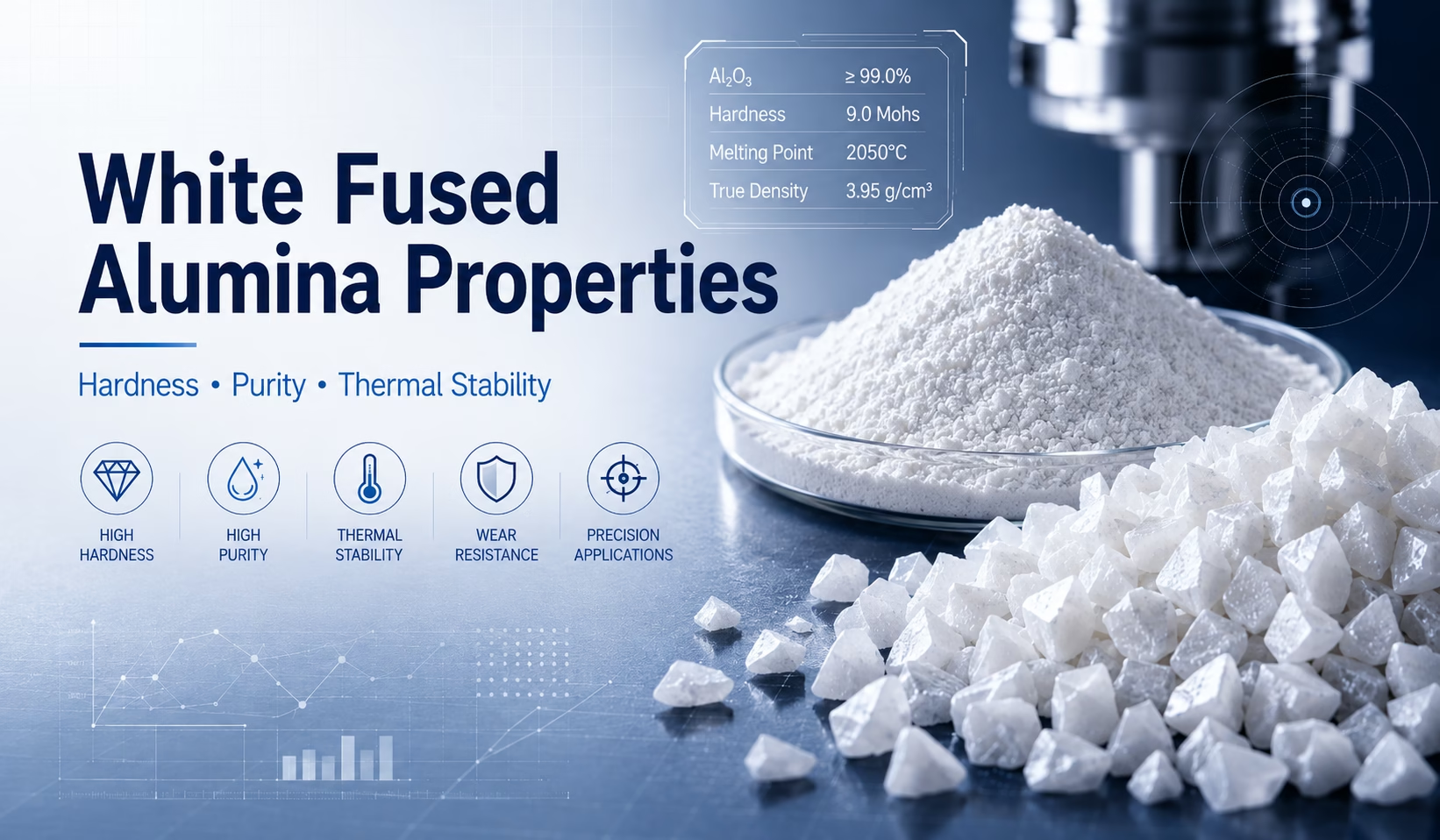
빠른 답변: What Are the Main White Fused Alumina Properties?
White fused alumina is a high-purity, electrically fused form of aluminum oxide. Its most important properties include:
- Al₂O₃ content commonly above 99%
- Mohs hardness of approximately 9
- High wear and abrasion resistance
- 날카로운, angular grain shape
- Controlled friability and self-sharpening behavior
- Low iron and other coloring impurities
- High chemical stability
- High-temperature resistance
- Melting point of approximately 2,050°C
- True density of approximately 3.9–4.0 g/cm³
- Good dimensional and volume stability
- White color and clean cutting performance
White fused alumina is especially useful when an application requires a cleaner and more precise abrasive action than brown fused alumina can normally provide.
Washington Mills lists fused alumina at approximately 9 on the Mohs hardness scale, while Imerys highlights the sharp-edged grains, load-bearing capacity, shock resistance and thermal stability of fused alumina materials.
Typical White Fused Alumina Property Table
The following values are representative industry ranges rather than a universal specification. Exact results depend on the raw material, furnace process, particle size and product grade.
| 재산 | Typical Value or Description |
| Main chemical composition | 산화알루미늄, Al₂O₃ |
| Typical Al₂O₃ content | Approximately 99.2%–99.7% |
| Main crystal phase | Alpha aluminum oxide, α-Al₂O₃ |
| Mohs hardness | Approximately 9 |
| 녹는점 | Approximately 2,050°C |
| 실제 밀도 | Approximately 3.9–4.0 g/cm³ |
| 색상 | 하얀색 |
| 입자 모양 | Angular, sharp-edged or blocky depending on processing |
| Fracture behavior | Relatively friable and self-sharpening |
| 화학적 안정성 | High |
| Iron contamination | Generally low |
| Thermal stability | High |
| 일반적인 형태 | Macrogrits, fine powders, microgrits and refractory aggregates |
High-purity commercial WFA products commonly report Al₂O₃ contents around or above 99.5%, but the actual purchasing specification should always be confirmed through a technical data sheet and batch certificate of analysis.
What Is White Fused Alumina?
백색 용융 알루미나 is manufactured by melting high-purity calcined alumina in an electric arc furnace at temperatures above 2,000°C.
After fusion, the material is cooled into a solid block. It is then crushed, magnetically cleaned, milled and classified into controlled grain sizes. Further washing, air classification or chemical treatment may be used for fine powders and precision microgrits.
The fusion process produces a dense crystalline material dominated by alpha alumina. Because the starting alumina contains relatively few coloring impurities, the finished mineral appears white rather than brown or black.
Its production method gives WFA a different performance profile from calcined alumina, 판형 알루미나, brown fused alumina and silicon carbide. Yumo describes WFA as a material produced by fusing high-purity calcined alumina and characterized by high hardness, 부서지기 쉬움, chemical stability and a high melting point.
1. High Aluminum Oxide Purity
High purity is one of the most important white fused alumina properties.
Abrasive and refractory grades commonly contain more than 99% Al₂O₃. Premium and low-sodium grades may reach approximately 99.5% or higher, although purity varies by grade and particle size.
The low concentration of iron oxide, titanium oxide and silica provides several practical advantages:
- Reduced risk of discoloring the workpiece
- Lower potential for iron-related surface contamination
- Better suitability for stainless steel and non-ferrous materials
- Cleaner refractory formulations
- More consistent high-temperature behavior
- White or light-colored finished products
Purity should not be judged from Al₂O₃ content alone. Industrial buyers should also review Na₂O, Fe₂O₃, SiO2, magnetic material and loss on ignition.
Fine powders may show different impurity levels from coarse grains because impurities can become concentrated during crushing and classification. A certificate of analysis should therefore correspond to the exact particle size being purchased.
2. High Hardness and Abrasion Resistance
White fused alumina has a Mohs hardness of approximately 9, making it one of the hardest conventional abrasive minerals used in industrial manufacturing.
This hardness allows the grain to penetrate, scratch and remove material from surfaces such as:
- Hardened steel
- Stainless steel
- Tool steel
- High-alloy metals
- 유리
- 도예
- 내화물
- 하드 코팅
High hardness also contributes to wear resistance in refractory linings, ceramic components and wear-resistant products.
하지만, hardness and toughness are not the same property.
Hardness describes resistance to scratching or indentation. Toughness describes the ability to resist cracking or impact. WFA is very hard, but it is generally less tough and more friable than brown fused alumina.
This difference is why white fused alumina often performs well in precision grinding, while brown fused alumina is frequently chosen for heavier grinding where the grain must withstand greater mechanical impact.
3. Controlled Friability and Self-Sharpening
Friability is the tendency of an abrasive grain to fracture under pressure.
White fused alumina is relatively friable compared with tougher fused alumina grades. During grinding, worn edges can fracture and expose new sharp cutting points. This behavior is often described as self-sharpening.
Controlled friability can provide:
- Consistent cutting action
- Lower grinding pressure
- Reduced risk of excessive heat generation
- Better surface finish
- Less glazing of the abrasive tool
- Improved performance on hard or heat-sensitive materials
High friability is not automatically better for every process. A grain that fractures too quickly may be consumed rapidly in aggressive blasting or high-pressure grinding.
The correct balance depends on wheel bond, grinding speed, contact pressure, workpiece hardness and required surface finish.
4. Sharp and Angular Grain Shape
After crushing, white fused alumina normally has an angular particle shape with multiple cutting edges.
Sharp grains improve the material’s ability to cut into the workpiece instead of merely rubbing against it. This is important in:
- Precision grinding wheels
- 코팅된 연마재
- Lapping compounds
- Abrasive blasting
- 표면 준비
- Polishing processes
Particle shape is influenced by the furnace block, crushing method, milling equipment and classification process. Two products with the same nominal grit designation may perform differently if one contains sharper grains and the other contains more blocky particles.
Sharp grains usually provide a more aggressive cut, while relatively blocky grains may offer better durability and lower breakdown rates.
For critical applications, buyers should evaluate grain shape together with particle size distribution rather than relying on the grit number alone.
5. Low Iron and Clean Cutting Performance
One of the major differences between white and brown fused alumina is the impurity profile.
Because WFA is produced from high-purity alumina rather than bauxite, it normally contains less iron oxide and fewer dark mineral phases. This gives the product its white appearance and reduces the risk of transferring iron-bearing contaminants to the processed surface.
Low-contamination performance is valuable when blasting or grinding:
- Stainless steel
- 알류미늄
- Titanium alloys
- Aerospace components
- Medical components
- Electronic ceramics
- Decorative surfaces
- Light-colored refractory products
A white appearance alone does not prove that a product meets a low-iron requirement. Magnetic content and Fe₂O₃ limits should be included in the purchase specification when contamination control is important.
6. High Melting Point and Thermal Stability
White fused alumina has a melting point of approximately 2,050°C and retains useful stability under high-temperature conditions.
Its high alumina content and corundum crystal structure support:
- High refractoriness
- Abrasion resistance at elevated temperatures
- Dimensional stability
- Resistance to thermal degradation
- Long service life in selected refractory environments
These characteristics make WFA suitable for refractory castables, shaped refractory products, 가마 가구, furnace components and other high-temperature formulations.
Imerys identifies thermal shock resistance, stable thermal expansion, chemical stability and abrasion resistance as important characteristics of white fused alumina used in refractory applications.
A high melting point does not mean that every WFA-based product can operate continuously near 2,050°C. The working temperature of a finished refractory also depends on binders, cement, additives, porosity, atmosphere, mechanical load and contact with slag or molten metal.
7. Chemical Stability and Corrosion Resistance
Alpha alumina is chemically stable and resistant to many industrial environments.
WFA is widely selected where the raw material must resist:
- Oxidation
- Abrasive wear
- Many acidic environments
- Many alkaline environments
- Chemical attack at elevated temperatures
- Reactions that could introduce unwanted color or contamination
Chemical resistance remains application-specific. Strong acids, strong alkalis, molten salts, slags and reactive metals may behave differently at high temperatures.
Refractory buyers should therefore evaluate complete service conditions, including operating temperature, furnace atmosphere, slag chemistry and thermal cycling frequency.
8. Density, Bulk Density and Porosity
Density values are often misunderstood in white fused alumina specifications.
The true or specific density of WFA is generally close to 3.9–4.0 g/cm³. This value represents the density of the solid mineral itself.
Bulk density is different. It measures the mass of loose particles within a given volume and includes the empty spaces between those particles.
Bulk density changes according to:
- 입자 크기
- 입자 크기 분포
- 입자 모양
- Packing behavior
- Crushing method
- Test procedure
- Moisture content
A fine powder, a narrow-sized grit and a mixed refractory aggregate will not have the same bulk density, even when all three products are made from the same white fused alumina.
이러한 이유로, a buyer should never compare a supplier’s bulk-density figure with another supplier’s true-density value.
Higher bulk density can be useful in some refractory products because it can support tighter packing and lower open porosity. In abrasive applications, however, cutting behavior and particle distribution may be more important than bulk density alone.
9. Electrical and Thermal Characteristics
Alumina is widely known as an electrically insulating ceramic material. 백색 용융 알루미나 may therefore be used as a raw material in certain ceramic, insulation and filler systems.
하지만, the electrical and thermal performance of a finished component depends on more than the WFA grain itself. Important variables include:
- 청정
- Porosity
- Particle packing
- Binder composition
- Firing temperature
- Final ceramic microstructure
- 수분
- Testing frequency and temperature
Abrasive-grade WFA should not automatically be treated as an electrical-grade ceramic powder. Applications involving electrical insulation should use a validated grade and appropriate finished-component testing.
How Particle Size Affects White Fused Alumina Performance
Particle size can change the cutting rate, 표면 마무리, packing density and reaction behavior of WFA.
Coarse Grits
Coarse grains provide deeper cutting and faster material removal. They are commonly used for:
- Heavy surface preparation
- Coarse blasting
- 거친 연삭
- Refractory aggregates
- Removal of scale or coatings
Medium Grits
Medium-sized grains provide a balance between cutting speed and surface quality. They are often used for:
- 일반연삭
- 표면 청소
- 접착 연마재
- 코팅된 연마재
- Preparation before coating
Fine Grits and Microgrits
Fine powders provide smaller scratches and more controlled finishing. 일반적인 응용 분야는 다음과 같습니다.:
- 정밀연삭
- 랩핑
- 세련
- 세라믹 제제
- Surface finishing
- Refractory matrix additions
The grit designation must match the product standard. FEPA explains that F-grit designations are used for bonded abrasives, while P-grit designations are used for coated abrasives. FEPA also treats macrogrit size as a particle distribution range rather than one exact particle diameter.
ISO 6344-2:2021 covers electro-fused aluminum oxide macrogrits from P12 to P220 for coated abrasives, ISO 동안 6344-3:2021 covers microgrits from P240 to P5000.
A buyer should specify the standard, grit designation and test method rather than asking only for a mesh size.
White Fused Alumina vs Other Industrial Abrasives
| 재료 | Main Performance Characteristic | Relative Toughness | Typical Selection Reason |
| 백색 용융 알루미나 | 딱딱한, clean and relatively friable | Medium to low | 정밀연삭, clean blasting and high-purity refractories |
| 브라운 융합 알루미나 | Hard and tougher | High | 무거운 연삭, general blasting and cost-sensitive applications |
| 실리콘 카바이드 | Very sharp and harder than fused alumina | Relatively brittle | Grinding hard, brittle or non-metallic materials |
| Tabular alumina | Dense sintered alumina with controlled porosity | Application-dependent | High-performance refractory formulations |
백색 용융 알루미나와 갈색 용융 알루미나
Choose WFA when purity, low contamination, sharper cutting and a finer finish are important.
Choose brown fused alumina when toughness, grain life, aggressive stock removal and cost efficiency are more important.
White Fused Alumina vs Silicon Carbide
Silicon carbide is harder and often cuts hard, brittle or non-metallic materials quickly. 하지만, it can also fracture more readily and may not be the best choice for every steel-grinding application.
WFA provides a useful balance of hardness, controlled fracture and chemical cleanliness.
White Fused Alumina vs Tabular Alumina
Both are high-alumina materials, but they are produced differently.
WFA is made through electric fusion and crushing. Tabular alumina is produced through high-temperature sintering and develops a different microstructure and porosity profile.
They should not be treated as automatically interchangeable in refractory formulations.
Applications Linked to White Fused Alumina Properties
Precision Grinding
The combination of hardness, friability and sharp grain edges helps WFA cut hardened steels and alloys while continually exposing new cutting points.
Abrasive Blasting
Angular grains create a controlled surface profile and remove scale, oxidation or coatings. Low iron content is useful where ferrous contamination must be minimized.
Bonded Abrasives
WFA is used in vitrified and resin-bonded grinding wheels, mounted points and other abrasive tools requiring clean, cool and precise cutting.
코팅된 연마재
Paper, cloth and film-backed products can use white aluminum oxide where controlled finishing and lower contamination are required.
래핑 및 폴리싱
Fine powders and microgrits are used for controlled surface refinement. Particle size distribution and oversized-particle control are especially important in these applications.
내화물
고순도, abrasion resistance and thermal stability make WFA suitable for refractory castables, bricks, precast shapes and high-temperature wear-resistant components.
Ceramics and Investment Casting
WFA may be used in ceramic formulations and casting systems where high alumina content, low contamination and thermal stability are required. Imerys notes that white fused alumina can be used in investment casting applications requiring high density and low porosity.
Which White Fused Alumina Properties Matter Most When Buying?
The most important property depends on the application.
For Grinding-Wheel Production
Check:
- Grit standard
- 입자 크기 분포
- 입자 모양
- 부서지기 쉬움
- 부피 밀도
- Magnetic material
- 화학 성분
For Abrasive Blasting
Check:
- Angularity
- Cutting rate
- Surface-profile requirement
- Dust generation
- Reusability
- Iron contamination
- 부피 밀도
For Precision Polishing
Check:
- 중앙 입자 크기
- Oversized-particle limit
- 입자 크기 분포
- Cleanliness
- 응집
- 수분
- Suspension behavior
For Refractory Applications
Check:
- Al₂O₃ 함량
- Na2O 함량
- Fe₂O₃ and SiO₂
- 실제 밀도
- 부피 밀도
- Apparent porosity
- Grain-size distribution
- Volume stability
How to Specify White Fused Alumina
A complete purchasing inquiry should include more than the product name.
Provide the supplier with:
- Intended application
- Required grit or particle-size range
- Applicable FEPA, ISO, 그, ANSI or GB standard
- Chemical composition limits
- Bulk-density requirement
- Magnetic-content limit
- Moisture or loss-on-ignition requirement
- 필요한 입자 모양
- Packaging format
- Annual or monthly purchasing volume
For precision processes, request a representative sample and test it under actual production conditions.
A laboratory result can confirm chemistry and particle size, but only an application trial can show grinding ratio, 표면 마무리, blasting profile, polishing defects or refractory service performance.
Common Mistakes When Evaluating WFA Properties
Comparing Only Al₂O₃ Content
Two products with similar alumina percentages can perform differently because of grain shape, 나트륨 함량, particle distribution and magnetic impurities.
Treating Mesh and FEPA Grit as Identical
Mesh, F-grit, P-grit and micron values are based on different systems. They should not be converted through a rough online chart for precision purchasing.
Confusing Hardness With Toughness
WFA is extremely hard, but brown fused alumina is generally tougher. The harder material is not automatically the longer-lasting choice under impact.
Confusing True Density With Bulk Density
True density refers to the solid mineral. Bulk density includes spaces between loose particles.
Using One Specification for Every Application
폭파 미디어, grinding-wheel grain, polishing powder and refractory aggregate require different quality controls.
Conclusion
White fused alumina properties are defined by more than high hardness and high purity.
Its industrial performance comes from the combination of:
- 높은 Al₂O₃ 함량
- Sharp grain geometry
- Controlled friability
- 낮은 철 오염
- Stable particle-size distribution
- High-temperature resistance
- 화학적 안정성
- Consistent manufacturing control
WFA is often the right choice for precision grinding, 깨끗한 발파, 세련, advanced ceramics and high-purity refractory products. 하지만, the ideal grade should always be selected according to the workpiece, process pressure, required finish, operating temperature and applicable particle-size standard.
자주 묻는 질문
What are the main properties of white fused alumina?
The main white fused alumina properties are high purity, Mohs hardness of approximately 9, sharp grain shape, controlled friability, high wear resistance, 낮은 철 오염, chemical stability and high-temperature resistance.
흰 융합 알루미나의 경도는 무엇입니까??
White fused alumina has a Mohs hardness of approximately 9. Its actual abrasive performance also depends on grain shape, 강인함, 부서지기 쉬움, particle size and the workpiece material.
What is the density of white fused alumina?
The true density is generally approximately 3.9–4.0 g/cm³. Bulk density is lower and varies according to particle size, 입자 모양, packing and test method.
What is the melting point of white fused alumina?
Its melting point is approximately 2,050°C. The maximum operating temperature of a finished product will also depend on binders, porosity, atmosphere and mechanical loading.
백색 용융 알루미나는 갈색 용융 알루미나보다 단단합니다.?
Both materials have a Mohs hardness close to 9. The more important difference is that WFA is generally purer and more friable, while brown fused alumina is usually tougher.
Which WFA grit size should I choose?
Choose the grit according to the required removal rate, surface finish and applicable standard. Coarse grains remove material faster, while fine grains create a smoother finish.
What documents should a WFA supplier provide?
For industrial orders, request a technical data sheet, certificate of analysis, particle-size report, safety data sheet and packaging information. Application-specific test data may also be necessary.


하나의 응답