
Abrasive grain is easy to overlook because the individual particles are small, but those particles are responsible for nearly every cutting action in a grinding wheel, sanding belt, blasting system or lapping process. Each grain acts as a microscopic cutting tool: it contacts the workpiece, penetrates the surface and removes a small amount of material. When millions of grains work together, they can remove heavy scale from steel, sharpen a cutting tool, prepare a surface for coating or produce a fine finish on glass and ceramics.
The difficulty is that not all abrasive grains behave in the same way. Aluminum oxide, silicon carbide, zirconia alumina and ceramic alumina differ in hardness, toughness, fracture behavior and cutting characteristics. Grain size matters as well. A coarse grain may remove material quickly but leave a deeper surface profile, while a fine grain cuts more slowly and is generally selected when dimensional control or surface finish becomes more important.
For anyone choosing abrasives for manufacturing, grinding, sandblasting, surface preparation or polishing, understanding these differences is more useful than simply asking which abrasive is “hardest.” This guide explains what abrasive grain is, how common grain materials differ, how abrasive grit sizes are classified and how to select a suitable grain for a specific industrial application.
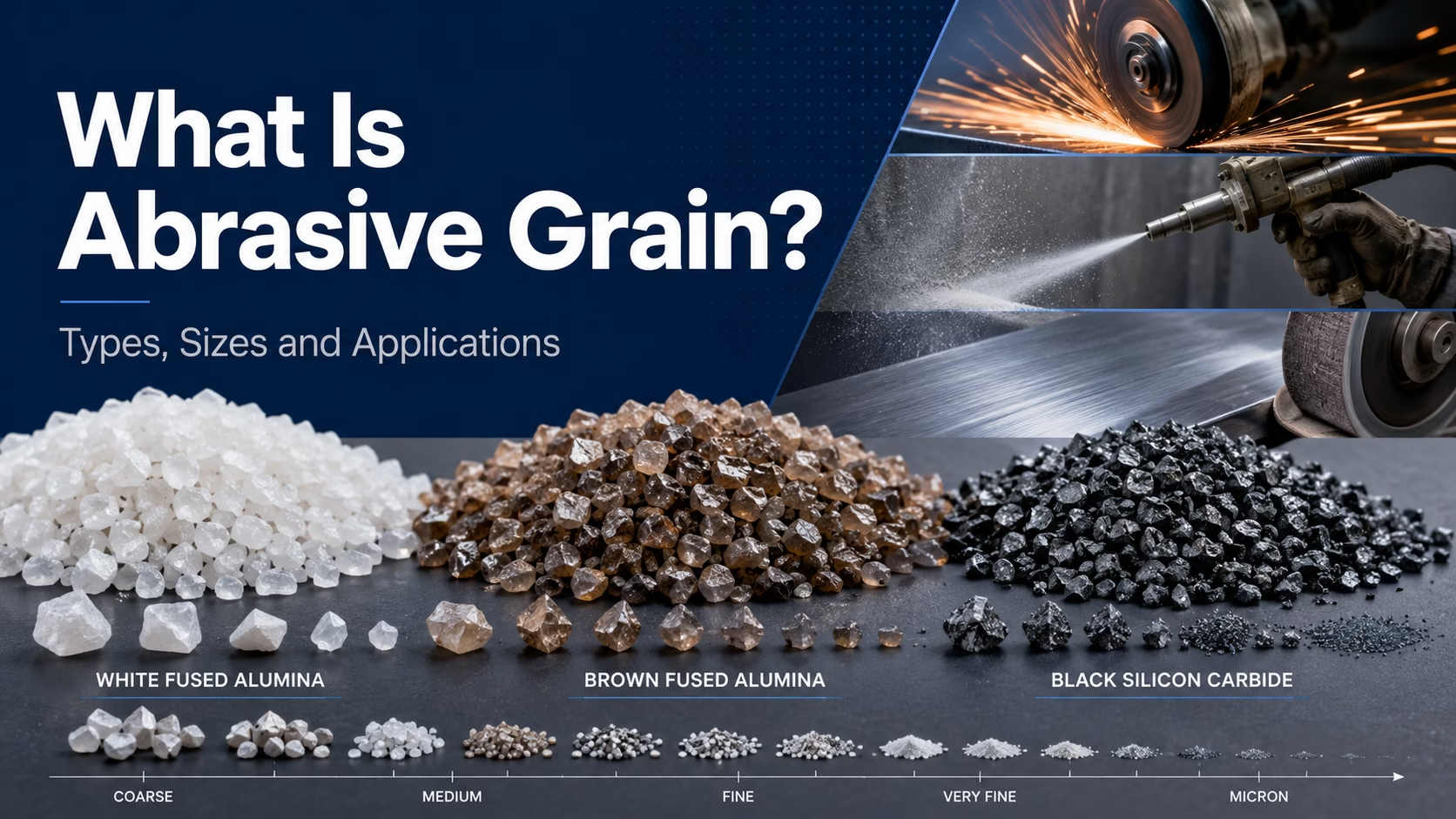
What Is Abrasive Grain?
Abrasive grain is a hard, wear-resistant particle used to cut, grind, clean, abrade, lap or polish another material. Depending on the process, the grains may be bonded together inside a grinding wheel, attached to a paper or cloth backing, propelled against a surface as blasting media or used loose in a lapping or polishing compound.
Modern industrial abrasive grains are normally manufactured and classified rather than simply collected as naturally occurring sand. Materials such as fused aluminum oxide and silicon carbide are produced under controlled conditions and then crushed, shaped, cleaned and separated into defined particle-size ranges. The resulting product can then be supplied according to an abrasive standard or according to a customer-specific particle-size requirement.
FEPA, the Federation of European Producers of Abrasives, maintains widely recognized abrasive grain standards covering bonded abrasives, coated abrasives and superabrasives. Its grading system distinguishes F-grit for bonded abrasives and P-grit for coated abrasives, while diamond and cubic boron nitride use separate designations.
For buyers working with fused alumina materials, our fused alumina overview provides a closer look at the available forms, including abrasive grit, powder, micro powder and refractory aggregate.
How Does Abrasive Grain Actually Cut?
The easiest way to understand abrasive grain is to think of each particle as a very small cutting edge. When pressure is applied and the abrasive moves relative to the workpiece, a sharp point on the grain penetrates the surface and removes material. The effectiveness of that cutting action depends on considerably more than the nominal grit size.
Four properties are especially important: hardness, toughness, friability and grain shape.
Hardness
An abrasive must normally be hard enough to penetrate the material being processed. If the grain is too soft, it will wear rapidly rather than cutting effectively. This is one reason materials such as aluminum oxide and silicon carbide are widely used: both are sufficiently hard for a broad range of industrial grinding and finishing operations.
Hardness alone, however, does not tell you which abrasive will perform best. Selecting the hardest possible grain can result in unnecessary cost or unsuitable cutting behavior. The correct choice depends on the workpiece, the required material removal rate, grinding pressure, contact area and desired surface finish.
Toughness
Toughness describes a grain’s ability to resist breaking under impact and mechanical load. A tougher grain generally remains intact for longer, which can be useful during heavy stock removal, high-pressure grinding and other demanding applications.
There is a trade-off. A grain that resists fracture too strongly can eventually develop rounded cutting edges and begin rubbing rather than cutting efficiently. Abrasive design therefore involves finding the right balance between durability and the ability to renew sharp edges.
Friability
Friability refers to how readily an abrasive grain fractures during use. In abrasive technology, controlled fracture is not necessarily a weakness. When a grain breaks in a controlled way, the fracture can expose new sharp cutting points and allow the abrasive to continue cutting instead of becoming progressively dull.
White aluminum oxide is a familiar example of a comparatively friable conventional abrasive. Norton notes that white aluminum oxide became widely used in grinding because of its sharp, easily fractured character, while later ceramic alumina grains were engineered around controlled micro-fracturing to improve grinding performance.
Grain Shape
Particle shape determines how the cutting force is concentrated at the workpiece. Angular grains tend to create sharp cutting points and can produce aggressive material removal. More blocky grains may withstand mechanical stress better but can behave differently under the same grinding pressure.
Modern engineered abrasives demonstrate how significant grain geometry can become. 3M’s Precision-Shaped Grain technology uses controlled geometric shapes designed to fracture into new cutting edges during use rather than relying only on randomly crushed particles. The company describes this as a way to reduce plowing behavior and maintain a more efficient cutting action.
This does not mean conventional crushed abrasive grains are obsolete. It simply illustrates an important principle: two abrasive products with similar chemistry and grit size can still cut differently because of grain shape, fracture behavior and manufacturing method.
Main Types of Abrasive Grain
There are many specialty abrasive materials, but most industrial users repeatedly encounter a smaller group: aluminum oxide, silicon carbide, zirconia alumina, ceramic alumina, diamond and cubic boron nitride.
Aluminum Oxide Abrasive Grain
Aluminum oxide is one of the most widely used conventional abrasive materials because it offers a useful combination of hardness, mechanical strength, availability and cost. It is found in grinding wheels, sanding belts, flap discs, blasting media, lapping compounds and many other abrasive products.
Several grades fall under the broader aluminum oxide family, and their behavior is not identical. Brown fused alumina is generally known for its toughness and durability, making it suitable for general-purpose grinding, blasting and heavy industrial applications. White fused alumina is produced from high-purity alumina and is more friable, which gives it a sharper, cleaner cutting action in applications where controlled grinding or reduced contamination is important.
For a material-level comparison, see our Brown Fused Alumina product guide and White Fused Alumina product guide.
Aluminum oxide is particularly common in metalworking. Norton notes that aluminum oxide grains are conventionally used for many ferrous-metal grinding applications, although the complete wheel specification—including bond, structure, grain size and operating conditions—also affects the final result.
Silicon Carbide Abrasive Grain
Silicon carbide has a harder and generally sharper cutting character than conventional aluminum oxide, but it is also more brittle. Because it fractures relatively readily, fresh cutting edges can be exposed during operation. This combination makes silicon carbide particularly useful for hard, brittle materials and for applications where a sharp cutting action is desirable.
Typical applications include glass, ceramics, stone, cast iron, cemented carbide, some non-ferrous metals, lapping and polishing. Silicon carbide is also widely used outside conventional abrasive tools, including refractory materials and technical ceramic applications.
Two common industrial varieties are black silicon carbide and green silicon carbide. Green silicon carbide is normally produced to a higher purity and is often selected for precision grinding, hard materials and finer technical applications. Our Green Silicon Carbide grade and size guide provides more detail on available applications and particle-size options.
A common question is whether silicon carbide is simply “better” than aluminum oxide. In practice, that comparison is too broad. Norton recommends choosing the grain according to the material being ground and notes the conventional use of aluminum oxide for many ferrous materials and silicon carbide for many non-metallic and non-ferrous applications
Zirconia Alumina
Zirconia alumina is a tough abrasive designed for demanding stock-removal applications. It is commonly found in abrasive belts, flap discs and grinding products used on carbon steel, stainless steel and other metals where the abrasive operates under relatively high grinding pressure.
Its advantage becomes more apparent when the process is aggressive enough to encourage controlled fracture. As the abrasive wears, new cutting surfaces can develop rather than the entire grain becoming blunt immediately. For this reason, zirconia alumina is often chosen for weld grinding, heavy deburring and other applications where productivity and abrasive life are more important than achieving the lowest initial abrasive price.
It is not automatically the most economical option for light finishing. If the process does not generate sufficient pressure to activate the grain effectively, a conventional aluminum oxide abrasive may provide better value.
Ceramic Alumina
Ceramic alumina is another high-performance abrasive family used heavily in advanced grinding applications. Its microstructure is designed to fracture progressively at a much smaller scale than traditional fused grains, creating new cutting edges while retaining more of the useful abrasive particle.
This controlled micro-fracturing can improve material removal rates and abrasive life in difficult grinding operations. Ceramic abrasives are widely used for hardened steels, stainless steel, aerospace alloys, precision grinding and high-production metalworking.
The economic calculation is therefore different from conventional abrasives. A ceramic abrasive product may have a higher purchase price, but manufacturers often evaluate it according to total grinding cost: abrasive life, material removed per unit time, changeover frequency, machine utilization and labor all matter.
Norton identifies ceramic alumina as an important grain for precision grinding, while 3M’s development of precision-shaped ceramic abrasive grains demonstrates how grain structure and fracture behavior can be engineered to improve cutting efficiency.
Diamond and CBN
Diamond and cubic boron nitride, commonly abbreviated as CBN, are normally grouped under superabrasives. They are selected for applications where conventional aluminum oxide or silicon carbide cannot provide the required combination of hardness, wear resistance or precision.
Diamond is widely used for carbide, ceramics, glass, stone and other hard non-ferrous materials. CBN is particularly important for hardened steels and other ferrous materials that are difficult to grind efficiently with conventional abrasives.
FEPA uses specific grain designations for these materials: D for diamond and B for cubic boron nitride.
For general blasting, bonded abrasives, coated abrasives and many industrial grinding processes, however, fused aluminum oxide and silicon carbide remain more economical and widely used.
Abrasive Grain Types Compared
| Abrasive Grain | General Characteristics | Typical Applications |
|---|---|---|
| Brown Fused Alumina | Tough, durable, economical | Blasting, grinding, bonded abrasives, refractory products |
| White Fused Alumina | High purity, sharp, relatively friable | Precision grinding, blasting, lapping, polishing |
| Black Silicon Carbide | Hard, sharp, brittle | Stone, glass, cast iron, blasting, refractory applications |
| Green Silicon Carbide | High-purity SiC, sharp cutting action | Carbide, ceramics, glass, precision grinding |
| Zirconia Alumina | Very tough, suited to high-pressure grinding | Weld removal, heavy grinding, steel and stainless steel |
| Ceramic Alumina | Micro-fracturing, high-performance grain | Precision and high-production grinding |
| Diamond | Extremely hard superabrasive | Carbide, ceramics, glass, composites |
| CBN | Thermally stable superabrasive | Hardened steels and ferrous alloys |
This table should be treated as a starting point rather than a final material specification. The same abrasive mineral can produce different results depending on grain size, particle shape, bond type, grinding pressure and the design of the abrasive product.
What Does Abrasive Grain Size Mean?
Abrasive grain size describes the controlled particle-size distribution of an abrasive product. In most conventional grit systems, a lower grit number corresponds to a coarser abrasive and a higher number corresponds to a finer abrasive.
For example, an F24 abrasive is considerably coarser than an F120 abrasive. The coarse grain removes material more aggressively and leaves deeper scratches or a rougher surface profile, while the finer grain removes smaller amounts of material and is normally selected for finishing or more controlled grinding.
One important point is often missed: a grit number does not mean that every particle has exactly the same diameter. Industrial abrasive standards define acceptable particle-size distributions. FEPA explains that macrogrit sizes are specified as ranges and are typically evaluated using sieving, while finer microgrit sizes require different measurement methods.
This is why two materials described only as “80 grit” should not automatically be assumed to be identical. Buyers should also know which standard is being used and whether the product is intended for bonded abrasives, coated abrasives, blasting or another application.
For a more detailed example, our White Aluminium Oxide Grit Sizes guide explains how different F-grit ranges can be matched with grinding, blasting and finishing applications.
F Grit vs P Grit: What Is the Difference?
The distinction between F grit and P grit is particularly important when abrasive materials are purchased internationally.
Under FEPA classification:
- F-grit is used for bonded abrasive grains.
- P-grit is used for coated abrasive grains.
Bonded abrasives include products such as grinding wheels and sharpening stones, while coated abrasives include sandpaper, abrasive belts, flap discs and related products. FEPA currently lists F4–F220 macrogrits and F230–F2000 finer bonded abrasive grain ranges, while coated abrasive classifications include P12–P220 and finer P-grit ranges.
The practical lesson for buyers is simple: do not send a purchase request that says only “80 grit aluminum oxide.” A more useful specification would be:
White Fused Alumina F80, FEPA standard, for bonded abrasives
or:
Brown Fused Alumina P80, FEPA standard, for coated abrasives
This immediately gives the supplier more information about the intended grading system and end use.
Coarse vs Fine Abrasive Grain
Grain size should be selected according to the job the abrasive needs to perform rather than according to the idea that finer is always better.
Coarse abrasive grain
Coarse grains are generally chosen when the priority is rapid stock removal. Typical applications include removing rust, scale or coatings, rough grinding, heavy deburring and creating a relatively deep anchor profile during surface preparation.
Because each particle is larger, it can penetrate the surface more deeply. The trade-off is a rougher finish that may require additional processing.
Medium abrasive grain
Medium grit ranges are often used when manufacturers need a balance between cutting speed and surface finish. They are common in general grinding, surface preparation, deburring and intermediate finishing.
This range can be particularly useful in multi-step processes because it removes scratches from a coarse operation without immediately jumping to a very fine abrasive.
Fine abrasive grain
Fine grains are generally selected when dimensional control and surface quality become more important than aggressive stock removal. Fine grinding, tool finishing, lapping and polishing preparation are typical examples.
A common processing mistake is to jump directly from a very coarse grit to an extremely fine one. The finer abrasive then spends too much time removing deep scratches left by the earlier operation. A sensible grit progression usually produces a better finish more efficiently.
How to Choose the Right Abrasive Grain
There is no single “best abrasive grain.” The correct material and size depend on the complete process. When selecting an abrasive, five questions usually provide a better starting point than hardness alone.
1. What Material Are You Processing?
The workpiece is the first consideration. Aluminum oxide is a practical starting point for many steel and general metalworking applications, while silicon carbide is often selected for harder, brittle or non-metallic materials. Ceramic alumina, zirconia alumina and superabrasives become useful when conventional grains cannot provide the required productivity or precision.
Norton similarly lists workpiece material as the first factor when determining an appropriate grinding wheel specification.
2. How Much Material Must Be Removed?
Heavy stock removal normally favors a coarser grit and a grain capable of withstanding substantial mechanical load. If the operation is primarily finishing, an aggressive abrasive may create unnecessarily deep scratches and increase the number of later processing steps.
Material removal rate should therefore be considered together with the final finish rather than as an isolated target.
3. What Surface Finish Is Required?
Blasting a steel structure before coating and polishing a precision ceramic component may both involve abrasive grain, but they require completely different particle sizes and cutting characteristics.
Where a specified surface roughness or anchor profile is required, buyers should evaluate the entire grain-size distribution rather than simply selecting the nominal grit number.
4. What Grinding Pressure and Contact Area Are Involved?
Some abrasive grains perform best under substantial grinding pressure because the applied force helps fracture the grain and reveal new cutting surfaces. Zirconia and ceramic abrasives can be particularly dependent on operating conditions.
A premium high-pressure abrasive may therefore provide little advantage in a low-pressure finishing process. The correct grain should match the machine, contact area and process parameters.
5. How Is the Grain Being Used?
Loose blasting media, grinding-wheel grain, coated-abrasive grain and lapping powder are not interchangeable simply because they share the same chemical composition.
In a grinding wheel, performance also depends on the bond and wheel structure. Norton describes a grinding wheel as a combination of abrasive grain, bonding material and porosity, all of which influence how the tool behaves in operation.
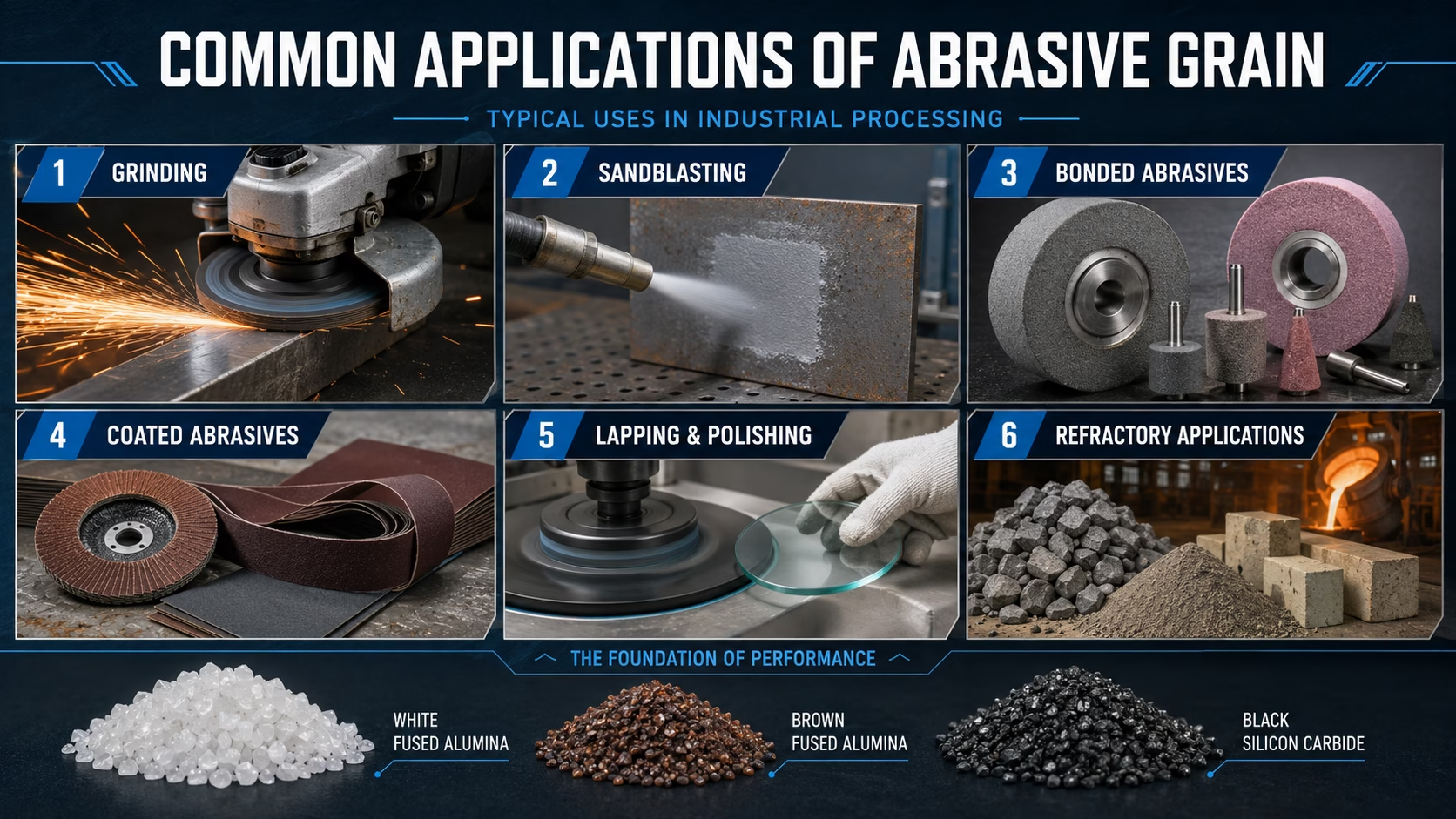
Common Applications of Abrasive Grain
Grinding
Grinding remains one of the most important abrasive applications. In a grinding wheel, thousands of abrasive particles create cutting points while the bond holds them in place. As grains wear or fracture, new cutting edges may be exposed and worn grains may eventually release from the bond.
General steel grinding frequently uses aluminum oxide, while ceramic alumina, zirconia, silicon carbide, CBN and diamond are selected where the workpiece or process requires different properties.
Sandblasting and Surface Preparation
In abrasive blasting, loose grains are propelled at high velocity against a surface. The impact can remove corrosion, mill scale, paint and other contamination while also creating a surface profile suitable for subsequent coating.
Aluminum oxide is widely used when aggressive, reusable blasting media is required. Grain size affects both cleaning speed and the resulting profile: a coarse abrasive generally produces a deeper surface pattern, while a finer abrasive provides more controlled finishing.
Bonded Abrasives
Bonded abrasive products include grinding wheels, cut-off wheels, mounted points, honing stones and similar tools. In these products, the abrasive grains are held together using a vitrified, resin or other bonding system.
Selecting the grain is only one part of designing the tool. Grain size, bond, wheel hardness, structure, porosity and operating speed all influence performance.
Coated Abrasives
Coated abrasives include sanding belts, discs, sheets and flap products in which abrasive grains are attached to a paper, cloth, film or other backing.
Aluminum oxide, zirconia alumina and ceramic alumina are especially common in metalworking products. The grain may also be applied at different densities depending on whether the process requires aggressive cutting or additional space for chips and debris.
Lapping and Polishing
Fine abrasive grains are widely used in lapping, polishing and precision finishing, where particle-size consistency becomes critical. Fine aluminum oxide, silicon carbide and diamond powders may all be used depending on the workpiece and target finish.
At very fine sizes, a small proportion of oversized particles can have a noticeable effect because they may leave scratches much deeper than the intended finish. For precision applications, particle-size distribution and batch consistency therefore matter as much as the nominal grade.
Refractory Applications
Fused aluminum oxide and silicon carbide are also important refractory raw materials. In this field they are often purchased in aggregate fractions such as 0–1 mm, 1–3 mm, 3–5 mm or 5–8 mm rather than conventional abrasive grit classifications.
This illustrates why the term “abrasive grain” does not always provide enough information for a purchase specification. The same material may be processed into abrasive grit, micro powder or refractory aggregate depending on the end use.
Abrasive Grain vs Abrasive Powder
There is no universal industrial boundary that separates a “grain” from a “powder.” In common commercial usage, grain or grit often refers to relatively coarse, classified particles, while powder and micro powder describe finer material. The terminology can vary between suppliers, industries and grading systems.
For that reason, buyers should avoid specifications such as “fine aluminum oxide powder” when particle size is critical. A defined grading system or actual particle-size range is much more useful.
For example:
White Fused Alumina F120, FEPA
is more precise than:
fine white abrasive grain
and:
White Fused Alumina 10–20 μm
provides substantially more information than simply requesting:
micro powder.
Why Grain Consistency Matters in Industrial Purchasing
For many industrial users, repeatability is more valuable than maximum cutting aggression. A batch of abrasive that performs very well once but behaves differently on the next shipment can create production problems that outweigh a small difference in purchase price.
Two batches carrying the same nominal grit number may still perform differently if their particle-size distribution, chemistry, grain shape or magnetic content is inconsistent. In blasting, this may affect surface profile. In grinding, it may influence cut rate and wheel behavior. In lapping and polishing, oversized particles can create scratching and additional rework.
Depending on the application, buyers may therefore review:
- chemical composition;
- particle-size distribution;
- bulk density;
- magnetic content;
- moisture;
- grain shape;
- grading standard;
- batch-to-batch consistency;
- certificate of analysis.
Not every parameter is equally important for every application. A refractory manufacturer and a precision polishing company may purchase the same base mineral while requiring very different quality controls.
How Should You Specify Abrasive Grain to a Supplier?
A good abrasive inquiry should describe the application rather than only the product name. The more technical information the supplier receives, the easier it is to identify an appropriate material and prepare an accurate quotation.
A useful inquiry might include:
Material: White Fused Alumina
Grit: F80
Standard: FEPA
Application: Surface preparation
Workpiece: Stainless steel
Quantity: 5 MT
Packaging: 25 kg bags on pallets
Documents: TDS and COA required
Sample: Required before bulk purchase
If you do not yet know the required grit size, provide the workpiece material, current abrasive, process, desired finish and equipment information. Those details are usually more valuable than guessing a grit number.
Final Thoughts
Abrasive grain may be a small component, but it has a major influence on grinding efficiency, surface quality and production consistency. Choosing the right grain requires more than comparing hardness or buying the finest grit available. Material chemistry, grain size, toughness, friability, particle shape and the way the abrasive is used all influence the final result.
For general industrial work, aluminum oxide and silicon carbide remain two of the most important abrasive families. Brown and white fused alumina cover a wide range of grinding, blasting and refractory applications, while silicon carbide provides a sharper cutting option for many hard, brittle and non-metallic materials. Zirconia, ceramic alumina and superabrasives extend the range further when productivity or precision requirements become more demanding.
A practical selection process should therefore begin with three questions: What material are you processing? How much material must be removed? What surface condition do you need at the end? Once those answers are clear, choosing the abrasive material, grit size and specification becomes much easier.
Frequently Asked Questions About Abrasive Grain
What is abrasive grain made of?
Industrial abrasive grains are manufactured from hard materials such as aluminum oxide, silicon carbide, zirconia alumina, ceramic alumina, diamond and cubic boron nitride. The material used depends on the workpiece and the required cutting behavior.
What is the most commonly used abrasive grain?
Aluminum oxide is one of the most widely used conventional abrasive grains because it provides a practical balance of hardness, toughness, availability and cost. It is commonly used in grinding, coated abrasives, blasting and general metalworking.
Does a higher grit number mean a finer abrasive?
Yes, in common abrasive grading systems, increasing the grit number generally means that the abrasive particles become finer. A coarse grit removes material faster, while a fine grit is normally selected when a smoother finish is required.
What is the difference between aluminum oxide and silicon carbide abrasive grain?
Aluminum oxide is generally tougher and is widely used for steel and other metalworking applications. Silicon carbide is harder, sharper and more brittle, making it particularly useful for glass, ceramics, stone, cast iron and many non-ferrous applications. The right choice depends on the workpiece and process rather than hardness alone.
What abrasive grain is best for steel?
Conventional aluminum oxide is widely used for general steel grinding. Zirconia alumina and ceramic alumina can provide higher performance where heavy stock removal, stainless steel or demanding grinding conditions justify a more advanced abrasive.
What abrasive grain is best for sandblasting?
Aluminum oxide is a common choice for industrial blasting because it is hard, angular and reusable. However, the correct abrasive depends on the substrate, required surface profile, blasting equipment and whether contamination restrictions apply.
What is friability in abrasive grain?
Friability describes how readily an abrasive grain fractures during use. Controlled fracture can be beneficial because it exposes new sharp cutting edges and helps prevent the grain from becoming permanently dull.
What is the difference between F grit and P grit?
FEPA uses F-grit classifications for bonded abrasives and P-grit classifications for coated abrasives. Because the grading requirements are different, an F80 abrasive and a P80 abrasive should not automatically be treated as equivalent.
What is the hardest abrasive grain?
Diamond is the hardest widely used abrasive material, but it is not the best choice for every application. CBN, ceramic alumina, silicon carbide and conventional aluminum oxide all have applications where their combination of thermal behavior, toughness, cutting characteristics and cost makes them more suitable than diamond.


3 Responses