
Abrasive grains play an important role in grinding, 抛光, 喷砂, surface preparation and refractory manufacturing. Although they may look like simple mineral particles, their performance depends on a series of carefully controlled manufacturing processes, from raw material selection and high-temperature treatment to crushing, particle-size classification and quality inspection. Understanding these processes helps industrial buyers evaluate product specifications, compare suppliers and select abrasive materials that meet their production requirements.
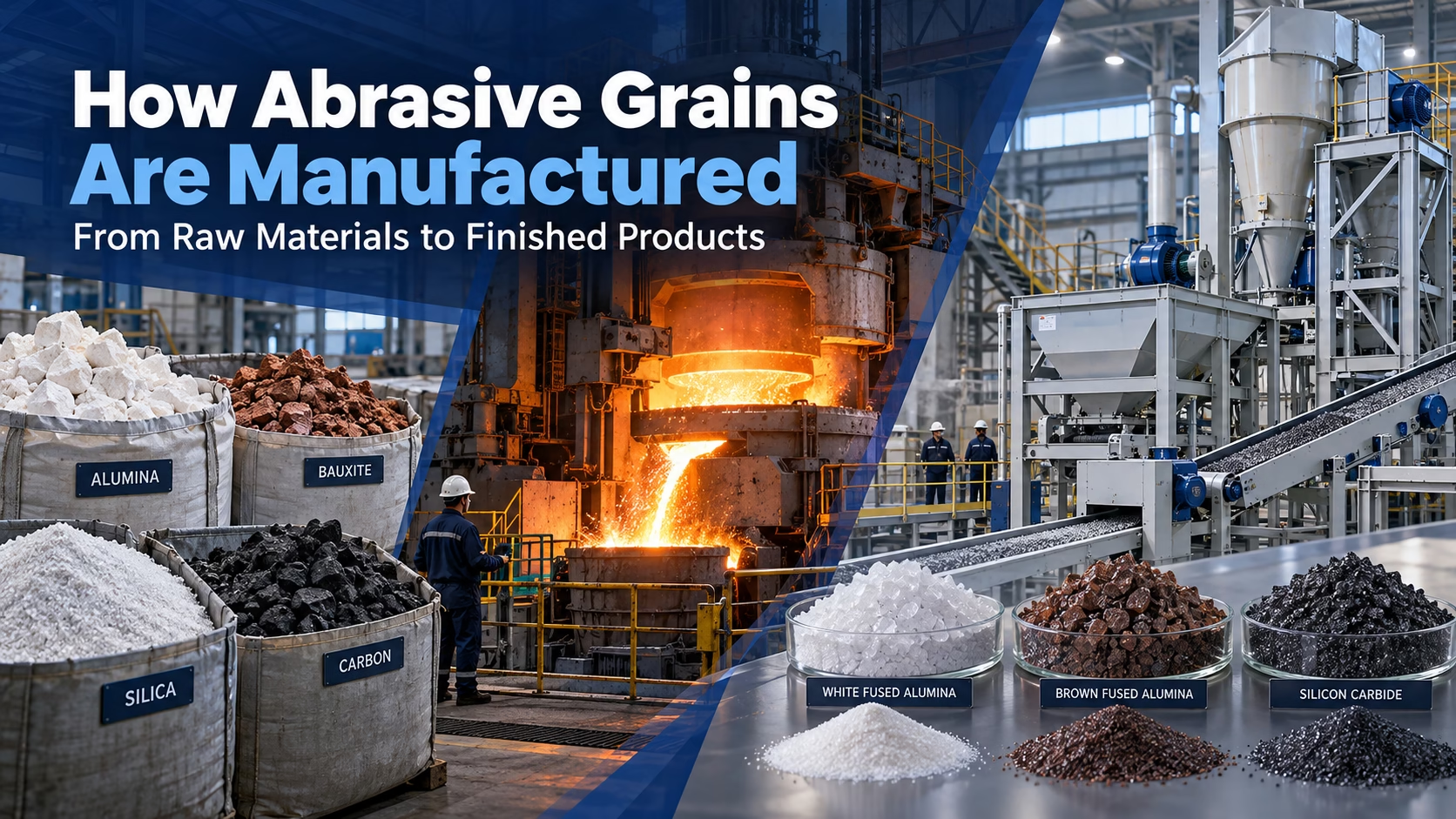
The manufacturing route varies according to the abrasive material. White fused alumina and brown fused alumina are produced through electric arc furnace melting, while silicon carbide is generally synthesized through a high-temperature reaction between silica and carbon. After the primary material has been produced, further processing determines the final grain size, particle distribution and suitability for different applications.
For manufacturers of grinding wheels, 涂附磨具, refractory products and precision polishing materials, the quality of the finished abrasive grains can directly affect processing efficiency and product consistency. This guide explains how common abrasive grains are manufactured, what happens at each production stage and which technical factors buyers should check before selecting a supplier.
1. What Are Abrasive Grains?
Abrasive grains are hard particles used to remove material from a workpiece through grinding, 切割, polishing or blasting. They can be produced from natural minerals or synthetic materials, with synthetic abrasives widely used in industrial manufacturing because their chemical composition, particle size and other properties can be controlled to suit specific applications.
Common industrial abrasive materials include white fused alumina, brown fused alumina and silicon carbide. White fused alumina is made from high-purity alumina and is commonly selected for precision grinding, polishing and refractory applications. Brown fused alumina is generally produced from bauxite-based raw materials and is widely used in grinding wheels, coated abrasives and surface preparation. Silicon carbide has a different manufacturing route and is valued for its hardness and cutting characteristics in applications involving glass, ceramics and other hard materials.
The manufacturing process determines more than the appearance of the finished grains. Raw material purity, furnace conditions, crystal formation, crushing methods and particle classification all influence the properties of the final product. For buyers, understanding these differences provides a practical starting point for selecting the right abrasive grain for an industrial application.
2. The Main Stages of Abrasive Grain Manufacturing
Although individual production methods differ, most synthetic abrasive grain manufacturing processes involve several related stages. The first is raw material preparation, where manufacturers select and prepare materials according to the chemical and physical requirements of the intended product. This stage is important because variations in raw material quality can affect the consistency of the finished abrasive.
The next stage involves either melting or synthesizing the abrasive material. White and brown fused alumina are produced by high-temperature fusion, whereas conventional industrial silicon carbide is generally formed through a chemical reaction at high temperatures. After the primary material has cooled or been recovered from the reaction process, it is prepared for downstream processing.
The material is then crushed, ground, screened and classified into specified grain sizes. 取决于产品, manufacturers may also use magnetic separation, washing or other processing steps to remove unwanted material or improve product quality. Finally, the finished grains undergo appropriate testing before packaging and shipment.
These stages should not be treated as an identical production recipe for every abrasive. The equipment, process parameters and quality-control requirements vary according to the material, grade and intended application.
3. How White Fused Alumina and Brown Fused Alumina Are Manufactured
白刚玉制造工艺
白刚玉 (世界足协), also known as white aluminium oxide or white corundum, is typically manufactured by melting high-purity alumina in an electric arc furnace. The molten material is allowed to solidify and cool, forming a hard fused mass that can subsequently be processed into abrasive grains or powder. The finished material is mainly composed of alpha-alumina, and its chemical purity is an important characteristic for many industrial applications.
After cooling, the fused alumina is broken into smaller pieces and processed through crushing, screening and classification. Depending on the required grade, manufacturers may also use magnetic separation to remove metallic impurities before the material is divided into different size fractions. These processing stages help produce consistent grains for bonded abrasives, 涂附磨具, surface treatment and refractory applications. The general production route is also described in CUMI’s technical information on white fused alumina.
The quality of WFA depends on several factors, including the purity of the starting alumina, furnace conditions, contamination control and the accuracy of the final classification process. 对于细粉, particle-size distribution becomes particularly important because oversized particles can affect surface finish and polishing consistency. Buyers comparing products should therefore examine both the chemical composition and particle-size data rather than relying on the product name alone.
For industrial buyers looking for different grades and sizes, YM Corundum provides information about its white fused alumina products, including materials for abrasive and refractory applications.
Brown Fused Alumina Manufacturing Process
棕刚玉 (博鳌亚洲论坛) is commonly manufactured using bauxite-based raw materials in an electric arc furnace. The raw material composition and furnace conditions are controlled to produce fused alumina with the chemical and physical characteristics required for the target grade. After cooling, the fused mass is crushed and classified into different grain sizes.
Compared with white fused alumina, brown fused alumina generally contains more impurities and additional oxide components associated with its raw materials. Its properties make it suitable for a wide range of conventional abrasive applications, including grinding wheels, 涂附磨具, blasting media and surface preparation. The exact chemical composition varies according to the manufacturing process and grade, so buyers should request the relevant specification for the product they intend to purchase.
Following fusion, crushing and classification determine the range of grain sizes available. Different applications may require coarse grains for material removal, medium sizes for general grinding or finer particles for more controlled surface finishing. Refractory-grade materials may also have different grading and acceptance requirements from abrasive-grade products.
When sourcing BFA, buyers should confirm the intended application, 化学限量, grain-size standard and allowable particle distribution. YM Corundum provides additional information about brown fused alumina abrasive grain sizes, which can help buyers compare specifications for industrial use.
4. How Silicon Carbide Grains Are Manufactured
碳化硅 (碳化硅) follows a different production route from fused alumina. In conventional industrial production, silica and carbon-containing raw materials react at high temperatures in an electric resistance furnace. The Acheson process is a widely used method for producing silicon carbide in commercial quantities.
The overall reaction can be represented as:

During the process, electrical resistance generates the heat required for the reaction. The temperature varies throughout the furnace, so the resulting material may contain different crystalline forms and regions with different compositions. Once the heating cycle is complete and the furnace has cooled, the crude silicon carbide is recovered and separated from unreacted material and other fractions. The crude material is then processed into finished grains or powders. A detailed explanation of this manufacturing route is available in Washington Mills’ silicon carbide production guide.
Black Silicon Carbide vs. 绿碳化硅
Black silicon carbide and green silicon carbide are widely used grades of industrial SiC. Their manufacturing conditions, composition and final specifications vary according to the producer and intended application. Green silicon carbide is commonly associated with high-purity applications and precision grinding of hard, brittle materials, while black silicon carbide is widely used for conventional abrasive applications, ceramics and refractory products.
The difference between these grades should not be assessed by colour alone. Buyers need to check the chemical composition, particle-size distribution and application requirements for the specific product. A grade suitable for general grinding may not provide the required performance for precision lapping or fine polishing.
From Crude Silicon Carbide to Finished Grains
Once the crude material has been recovered, it undergoes further processing to produce commercial grain sizes. Crushing and milling reduce the material to the required size range, while screening and classification separate particles according to the applicable specification. Additional cleaning or separation steps may be used where required by the product grade.
Fine silicon carbide powders require particularly careful control of particle distribution because oversized particles can create scratches or inconsistent surface finishes. Buyers sourcing SiC should therefore specify both the nominal grade and the relevant particle-size requirements.
For product-specific information, see YM Corundum’s black silicon carbide abrasive grains 和 green silicon carbide grit pages.
5. How Abrasive Grains Are Crushed, Shaped and Classified
Producing the primary abrasive material is only part of the manufacturing process. The subsequent crushing, grinding and classification stages determine whether the material can be supplied in the particle sizes required by industrial customers.
Crushing breaks larger fused or synthesized material into smaller pieces. Different crushing methods and operating conditions can produce different particle shapes and size distributions. The material is then screened or classified to separate it into specified fractions. Manufacturers may recycle certain oversize or undersize fractions for further processing, depending on the material and production system.
Particle-size classification is particularly important for abrasive grains used in grinding wheels, coated abrasives and precision finishing. A product with excessive oversized particles may produce a rougher surface than expected, while too many fines can change the cutting behaviour and processing characteristics. For micro powders, particle-size measurement and distribution control become even more important because small variations can influence the final result.
Industrial buyers should also understand that grit designations are not always directly interchangeable between standards. 这 FEPA abrasive grain standards distinguish between F-grit sizes for bonded abrasives and P-grit sizes for coated abrasives. FEPA describes macrogrit distributions using sieving methods and microgrit distributions using appropriate measurement methods.
When requesting quotations, specify the grading standard and, where relevant, the particle-size distribution or micron range. This helps suppliers provide comparable quotations and reduces the risk of receiving material that does not meet the intended application requirements.
6. Quality Control in Abrasive Grain Manufacturing
Quality control verifies that the finished abrasive meets the requirements established for its intended application. The appropriate tests depend on the material and grade, but chemical composition and particle-size distribution are common considerations for industrial abrasive grains.
Chemical analysis helps confirm whether the material meets the specified limits for its principal component and relevant impurities. For fused alumina, buyers may need information about alumina content and selected oxide impurities. For silicon carbide, the required SiC content and other chemical parameters depend on the grade and application.
Particle-size testing checks whether the material falls within the agreed grading specification. 取决于产品, testing may include sieve analysis, particle-size distribution measurements or other methods suitable for the material. Buyers should confirm which method is used and whether the reported results correspond to the product specification they have approved.
Other quality parameters may also matter. Grain shape and friability can influence abrasive behaviour, while contamination control is important in applications where unwanted particles could affect the workpiece. Not every product requires the same testing programme, so the acceptance criteria should be based on the intended use rather than a generic checklist.
For repeat purchases, batch consistency is especially important. A supplier should be able to provide appropriate technical documentation, such as a Technical Data Sheet (总固体溶解度) and a batch-specific Certificate of Analysis (COA), where available and agreed. Buyers should review the documents alongside sample testing and confirm that the supplied material matches the approved specification.
7. How Manufacturing Affects Abrasive Grain Performance
The manufacturing process influences how abrasive grains behave during use. Chemical composition and crystal structure contribute to the material’s hardness and other physical characteristics, while crushing and classification affect grain shape and particle-size distribution. These factors work together, so no single property can fully predict the performance of an abrasive in every application.
例如, grinding-wheel manufacturers may focus on grain durability, cutting behaviour and compatibility with the bonding system. A polishing compound producer may place greater emphasis on fine particle distribution and contamination control. Refractory manufacturers may prioritise chemical composition, grading and suitability for the final formulation.
This is why the most expensive or highest-purity abrasive is not necessarily the best choice for every customer. The correct grade is the one that meets the application’s technical requirements and provides consistent results under the intended operating conditions. Sample testing is often the most practical way to confirm whether a proposed material is suitable before committing to a large order.
8. How to Choose a Reliable Abrasive Grain Manufacturer
Selecting a supplier requires more than comparing the price per ton. Buyers should first establish whether the company manufactures the primary abrasive material, processes crude material into finished grains, or distributes products from another source. Each business model can be suitable, but the supplier’s actual role should be clear when manufacturing origin and production capability matter to the purchase.
Next, check whether the supplier can provide the required material grade, particle-size specification and quality documents. Ask for a representative sample where practical, and test it under the conditions in which the abrasive will be used. 对于重复订单, confirm the batch acceptance criteria, 包装, lead time and arrangements for handling quality issues.
It is also worth checking whether the supplier can support your expected purchasing volume and maintain the required specification over time. A manufacturer may have substantial overall production capacity but limited availability of a particular micro powder or custom grade. The relevant question is whether the supplier can reliably provide the exact material you need.
For a more detailed purchasing checklist, read our guide on how to select a reliable abrasive grain supplier. A structured qualification process can help reduce supply risks and make quotations easier to compare.
结论
Abrasive grain manufacturing involves several interconnected stages, and the process varies significantly between fused alumina, silicon carbide and other abrasive materials. Raw material selection and primary processing establish the material’s basic characteristics, while crushing, classification and quality control determine whether the finished grains meet the requirements of a particular industrial application.
For buyers, understanding these stages makes it easier to compare suppliers, interpret technical data and identify the factors that matter most to production performance. Rather than relying on a product name or nominal grit size alone, purchasers should review the material specification, 粒度分布, quality documentation and sample performance before placing a bulk order.
Whether sourcing white fused alumina, brown fused alumina or silicon carbide, the objective is the same: select a material that matches the application and a supplier that can consistently deliver the agreed specification.


