
Choosing the right abrasive grain for metal finishing plays an important role in achieving the desired surface quality, material removal rate, and production efficiency. Different abrasive materials, including brown fused alumina, 白い融合アルミナ, 炭化ケイ素, ジルコニア・アルミナ, and ceramic alumina, offer different cutting characteristics for industrial metalworking. The right choice depends on the workpiece material, finishing objective, abrasive grain size, and processing conditions.
When I evaluate abrasive materials for metal finishing, I look beyond hardness and price. A grain that performs well on carbon steel may not deliver the same results on stainless steel or aluminum. Similarly, an abrasive that removes material quickly during heavy grinding may create an unnecessarily rough surface during fine finishing.
このガイドでは, I will explain the main abrasive grain types used in metal finishing, compare their properties, and explore how manufacturers select suitable materials for grinding, deburring, weld finishing, およびその他の産業用途. I will also discuss grain-size specifications and the quality factors buyers should consider before sourcing abrasive materials.
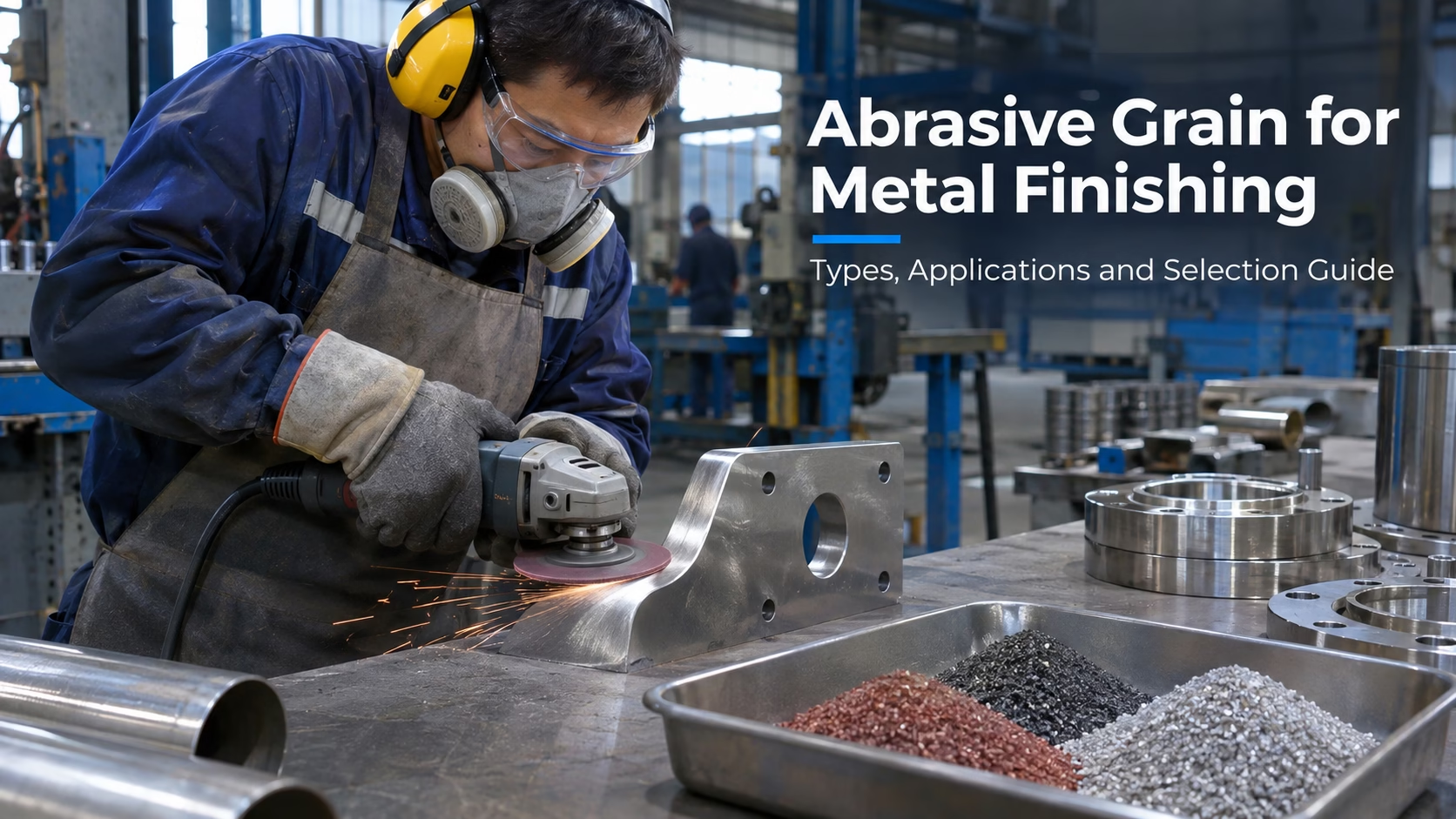
1. What Is Abrasive Grain for Metal Finishing?
Abrasive grain refers to hard mineral or synthetic particles that remove material from a workpiece through mechanical action. In metal finishing, these particles act as microscopic cutting tools. They remove small amounts of metal, eliminate surface imperfections, and help manufacturers achieve the required finish.
Manufacturers incorporate abrasive grains into different products, 砥石を含む, サンディングベルト, abrasive discs, and loose abrasive media. Each product design supports different metalworking operations and production requirements.
What Is Metal Finishing?
Metal finishing includes a range of processes that improve the surface condition, appearance, or functional properties of metal components. Common operations include grinding, deburring, weld blending, 研磨, and surface refinement.
Each process serves a different purpose. Grinding removes material and corrects surface irregularities, while deburring eliminates sharp edges from machined components. Weld finishing helps blend welded areas with surrounding surfaces, and polishing improves surface smoothness and appearance.
How Abrasive Grains Work on Metal Surfaces
When abrasive grains contact a metal surface under pressure and movement, their cutting edges penetrate the material and remove small particles. The combined action of numerous grains gradually changes the surface profile and appearance.
Several grain characteristics influence this process:
- 硬度: Determines how well a grain resists scratching and indentation.
- 靭性: Influences how well a grain withstands mechanical loading without excessive fracture.
- 粒形状: Affects contact with the workpiece and cutting behavior.
- 破砕性: Describes how readily a grain fractures and exposes fresh cutting edges.
- 粒度分布: Influences cutting consistency and the resulting surface texture.
For a broader introduction to abrasive materials and their applications, explore our guide to 砥粒とは? 種類, サイズと用途.
2. Common Types of Abrasive Grains for Metal Finishing
Different abrasive materials offer different combinations of hardness, 靭性, cutting ability, and cost. Manufacturers should consider both material properties and the intended metalworking process when selecting abrasive grains.
| Abrasive material | Main characteristics | Typical metalworking applications |
|---|---|---|
| 茶色の融合アルミナ | 厳しい, durable, and versatile | Carbon steel grinding and general metal processing |
| 白色電融アルミナ | High purity and sharp cutting characteristics | Selected precision grinding and controlled finishing |
| 炭化ケイ素 | Very hard, sharp, and relatively brittle | Cast iron, non-ferrous metals, and specialized finishing |
| Zirconia alumina | High toughness under demanding conditions | Heavy-duty steel grinding and weld removal |
| セラミックアルミナ | Engineered grain with controlled fracture behavior | High-performance industrial grinding |
These descriptions provide general application guidance. Actual performance depends on grain specifications, abrasive-tool construction, operating conditions, and the workpiece.
酸化アルミニウム砥粒
Aluminum oxide ranks among the most widely used abrasive materials in industrial metalworking. Its combination of hardness, 靭性, and versatility makes it suitable for various grinding and finishing applications.
Two important types include brown fused alumina (BFA) and white fused alumina (WFA).
Manufacturers produce brown fused alumina by melting bauxite-based raw materials in an electric arc furnace, followed by crushing and grain classification. This material offers toughness and practical cutting performance for general industrial applications. Manufacturers incorporate BFA into grinding wheels, コーティングされた研磨材, and other abrasive products.
YUMO supplies Brown Fused Alumina Abrasive Grades in different particle-size classifications for industrial applications.
Producers manufacture white fused alumina from high-purity alumina. Its high purity and sharp cutting characteristics make it a potential choice for selected precision grinding and finishing applications, particularly when manufacturers prioritize material purity and contamination control.
For more information, explore our guide to 白い融合アルミナ: 用途, 用途とグレードの選択.
炭化ケイ素砥粒
炭化ケイ素 (SiC) is a hard synthetic abrasive with sharp cutting characteristics. Its hardness and relatively brittle structure make it suitable for processing various hard or brittle materials.
In metalworking, manufacturers may choose silicon carbide for certain cast iron, non-ferrous metal, and specialized finishing applications. しかし, it does not automatically outperform aluminum oxide in every steel grinding operation.
Black and green silicon carbide have different typical specifications and application requirements. Buyers should compare purity, 粒径, and processing conditions before selecting a grade.
YUMO also supplies Black Silicon Carbide Abrasive Grain 産業用途向け.
Zirconia Alumina and Ceramic Alumina
Zirconia alumina and ceramic alumina serve demanding grinding operations that require specific grain characteristics.
Zirconia alumina offers high toughness and performs well in heavy-duty metal removal applications. Manufacturers commonly select it for steel grinding, weld removal, and operations that involve substantial mechanical loading.
Ceramic alumina features an engineered microstructure that supports controlled grain fracture and cutting performance. It serves high-performance grinding applications where the abrasive tool and operating conditions can take advantage of its properties.
Neither material offers a universal solution. Buyers should compare workpiece materials, production requirements, tool design, and total operating costs before making a decision.
3. How to Choose Abrasive Grain for Different Metal Finishing Applications
When I evaluate abrasive grain for metal finishing, I start with the workpiece and the result that the process needs to achieve. Different metals respond differently to abrasive contact, so choosing a material based only on hardness can lead to unnecessary wear, heat, or surface damage.
Carbon Steel Grinding and Finishing
Carbon steel manufacturers rely on grinding, deburring, weld removal, and general surface finishing to improve component quality. Brown fused alumina offers a practical option for many of these operations because of its toughness, cutting ability, and cost characteristics.
For heavier stock removal, manufacturers may also consider zirconia alumina and ceramic alumina, particularly when their abrasive tools support demanding grinding conditions.
The selection process should account for steel grade, material removal requirements, machine power, operating speed, and target surface condition.
Stainless Steel Surface Finishing
Stainless steel finishing requires particular attention to surface appearance, heat generation, and contamination control.
Excessive heat can cause discoloration and affect the finished surface. In applications with strict cleanliness requirements, manufacturers should also choose abrasive materials and tooling that minimize unwanted contamination.
酸化アルミニウム, ジルコニア・アルミナ, and ceramic alumina offer options for different stainless steel grinding and finishing operations. The right choice depends on the alloy, abrasive-tool design, プレッシャー, and desired finish.
For visible stainless steel components, consistency matters. Uneven abrasive contact or inconsistent grain size can create scratches and an irregular appearance.
Aluminum and Non-Ferrous Metal Finishing
Aluminum, 銅, and other non-ferrous metals present different challenges because some of these materials have relatively soft and ductile structures.
One common issue is abrasive loading. During this process, removed material accumulates between abrasive grains and reduces their cutting effectiveness. This buildup can increase friction, generate heat, and produce an inconsistent surface.
For these applications, I recommend evaluating the abrasive material alongside the product structure, open-coat design, anti-loading treatment, and processing conditions. Manufacturers may consider silicon carbide or suitable aluminum oxide abrasive products depending on the workpiece and finishing objective.
Weld Grinding and Deburring
Weld finishing and deburring require controlled material removal. The objective is to remove excess weld material, eliminate sharp edges, or blend transitions without unnecessarily reducing the thickness of the base metal.
Coarser abrasive grades can handle initial material removal, while medium and finer grades help manufacturers blend surfaces and improve their appearance.
The correct selection depends on weld geometry, material thickness, tool type, and final appearance. Excessive grinding can damage the workpiece, so operators must control the process as carefully as they select the abrasive.
4. How Abrasive Grain Size Affects Metal Finishing Results
Abrasive grain size directly influences material removal and surface texture. Larger particles generally provide more aggressive cutting action, while finer particles support controlled material removal and surface refinement.
Coarse, Medium, and Fine Abrasive Grains
| Grain category | General cutting behavior | Typical metalworking objective |
|---|---|---|
| Coarse | Aggressive material removal | Heavy grinding and weld removal |
| Medium | Balanced cutting and finishing | Deburring and intermediate finishing |
| 大丈夫 | More controlled surface refinement | Fine grinding and scratch reduction |
| Very fine | Specialized finishing | Precision finishing and polishing preparation |
This table provides a general explanation rather than a universal grit specification. Buyers should define the actual particle-size range according to the applicable grading system and application.
Understanding Grit Size and Surface Roughness
When purchasing abrasive materials, buyers need to distinguish between grit size and surface roughness.
Grit describes the abrasive particle-size classification, while surface roughness describes the texture of the finished workpiece. Common profile parameters include Ra, which represents the arithmetic mean deviation of a measured profile, and Rz, which describes a profile-height parameter under the applicable measurement standard.
These values do not convert directly into abrasive grit numbers. 粒形状, material properties, プレッシャー, speed, equipment, and the finishing sequence all influence the final surface.
の FEPA official abrasive standards explain the grading systems for bonded and coated abrasives. FEPA assigns F-grit designations to bonded abrasives and P-grit designations to coated abrasives.
For surface texture terminology and measurement parameters, manufacturers can consult ISO 21920-2:2021, which specifies terms, definitions, and parameters for determining surface texture through profile methods.
When a project requires a specific Ra or Rz value, I recommend confirming the measurement method and testing the finished workpiece rather than relying on a generic grit-to-roughness chart.
For more information about abrasive particle classifications, read our article on 砥粒サイズの説明: 餌, ANSIとJIS.
5. Factors That Affect Abrasive Grain Performance in Metal Finishing
The same abrasive material can produce different results under different operating conditions. このため, I evaluate the complete grinding process rather than examining grain properties in isolation.
Hardness and Toughness
Hardness determines how well an abrasive grain resists wear and penetration by the workpiece. Toughness describes its ability to withstand mechanical loads without excessive breakage.
Abrasive selection requires a balance between these characteristics. A grain that fractures too easily may lose its useful particle size rapidly under heavy loading. 一方で, a grain that cannot expose fresh cutting edges when needed may gradually lose cutting effectiveness.
Grain Shape and Fracture Characteristics
Particle shape influences how abrasive grains contact the metal surface. Angular grains can create different cutting behavior from more blocky particles.
Fracture characteristics also matter. Controlled fracture can expose fresh cutting edges, but excessive breakdown may increase abrasive consumption and reduce process consistency.
Grinding Pressure and Heat Generation
Pressure, rotational speed, contact area, and equipment condition all influence grinding performance. Excessive pressure or an unsuitable operating speed can generate additional heat and affect the surface quality of the workpiece.
For heat-sensitive applications, I recommend evaluating the abrasive tool, grinding conditions, and cooling method together.
Consistency and Particle-Size Distribution
A consistent abrasive specification helps manufacturers maintain repeatable production quality. Variations in particle-size distribution or contamination can affect cutting behavior and the finished surface.
Industrial buyers should examine particle-size reports, 化学組成, oversized-particle limits, and batch documentation whenever their applications require these controls.
6. How to Select and Buy Abrasive Grain for Metal Finishing
A clear purchasing specification helps buyers compare suppliers and reduces the risk of receiving materials that do not match their production processes.
Before requesting a quotation, I recommend defining the following requirements:
| 仕様 | Buyer requirements |
|---|---|
| Workpiece material | Carbon steel, ステンレス鋼, aluminum, 銅, or other metals |
| Abrasive material | 茶色の融合アルミナ, 白い融合アルミナ, 炭化ケイ素, or another material |
| 粒度 | Required grit or micron specification |
| Grading standard | 餌, ANSI, 彼, ISO, or customer-specific requirements |
| 応用 | 研削, deburring, weld finishing, or surface refinement |
| Quality requirements | 純度, particle distribution, and contamination limits |
| 量 | Trial order or regular production volume |
| 包装 | Standard bags or customized packaging |
Common Purchasing Mistakes
One common mistake is comparing suppliers only by price per kilogram. A cheaper abrasive may require more frequent replacement, produce inconsistent results, or increase processing time. I recommend comparing the total cost of achieving the required finish rather than looking at the purchase price alone.
Another mistake is selecting an abrasive based only on hardness. A harder material does not necessarily provide better cutting performance or surface quality for every metal.
Finally, some buyers overlook grain-size standards and particle distribution. A specification that simply states “80 グリット” may not provide enough information for international purchasing.
I recommend confirming the exact grading system, requesting technical documentation, and testing samples under representative production conditions before approving a large order.
Safety also matters. Operators must follow the intended application and manufacturer’s instructions when using grinding wheels and other abrasive tools. In the United States, OSHA 29 CFR 1910.215 establishes requirements for abrasive wheel machinery, including guarding and related equipment requirements. Manufacturers and employers should also follow the workplace safety regulations that apply in their locations.
最終的な考え: Choosing the Right Abrasive Grain for Metal Finishing
Choosing the right abrasive grain for metal finishing requires more than comparing grit numbers or selecting the hardest available material. The workpiece, processing objective, abrasive properties, 粒度分布, and operating conditions all influence the final result.
茶色の融合アルミナ, 白い融合アルミナ, and silicon carbide each have different characteristics and industrial applications. By defining the required finish and selecting the abrasive according to the actual process, manufacturers can improve consistency and make more informed purchasing decisions.
Need Abrasive Grain for Metal Finishing? YUMO Can Help
At YUMO, we supply brown fused alumina, 白い融合アルミナ, and silicon carbide in different abrasive grades for industrial applications. Our products are available in different particle-size specifications to support grinding, 表面処理, 研磨, and other manufacturing requirements.
If you are sourcing abrasive materials for metal grinding, deburring, weld finishing, or surface refinement, share your workpiece material, required grain size, 応用, and estimated quantity with our team.
We can help you review available specifications and identify a suitable abrasive material for your production requirements. Whether you need brown fused alumina for general metalworking, white fused alumina for selected precision applications, or silicon carbide for specialized finishing, we are ready to discuss your requirements.
Contact YUMO to discuss your metal finishing abrasive requirements and request product specifications or a quotation.


