
碳化硅是砂轮制造商的重要原材料, 涂附磨具, 耐火制品, 技术陶瓷和精密加工材料. When purchasing it in bulk, however, finding a company that lists silicon carbide on its website is only the beginning. Buyers also need to establish whether the company manufactures the material, processes imported crude into finished grains or simply distributes products from another supplier.
India has an established silicon carbide industry serving domestic and international markets. Companies such as Grindwell Norton, Carborundum Universal and SNAM have manufacturing operations involving silicon carbide, although their production structures and product portfolios differ. These differences matter when a buyer needs a particular grain size, purity level, manufacturing origin or long-term supply arrangement.
例如, a refractory manufacturer purchasing coarse black silicon carbide may prioritize chemical composition, carbon content and delivery volume. A precision lapping company will usually be more concerned about particle-size distribution, oversized grains, contamination and consistency between shipments. Even when both companies purchase silicon carbide, their supplier requirements can be very different.
This guide introduces three established silicon carbide manufacturing groups in India, explains their production capabilities and provides practical advice for international buyers comparing Indian and Chinese suppliers. It also covers the specifications, quality documents and commercial terms worth checking before placing a bulk order.
For a broader introduction to the material itself, our 碳化硅磨料: 特性, Uses and Industrial Buying Guide explains the differences between abrasive grades, particle sizes and common industrial applications.
Silicon Carbide Manufacturing in India
India has both primary silicon carbide production and downstream processing operations. Primary production generally involves manufacturing crude silicon carbide in an electric resistance furnace, while downstream processing converts crude material into usable grain sizes through crushing, 筛选, classification and other treatments.
This distinction matters because a company selling finished silicon carbide powder may not operate the furnace in which the original material was produced. It may purchase crude silicon carbide from another factory, process it into controlled particle sizes and supply the finished material to industrial customers.
That business model is not necessarily a disadvantage. For customers buying fine powder, the accuracy of the classification process may be more important than ownership of the original furnace. 然而, buyers requiring Indian-origin raw material must confirm where the silicon carbide was actually manufactured, not simply where it was packaged or shipped.
Grindwell Norton’s 2024–25 annual report identifies India, 中国, Vietnam and Russia among the supply sources serving the Indian silicon carbide market. The same report confirms that Grindwell Norton manufactures silicon carbide at its Tirupati plant in Andhra Pradesh.
This provides useful context for buyers: a quotation from an Indian company does not automatically establish Indian origin for every product grade.
Quick Comparison of 3 印度碳化硅制造商
制造商 | Indian manufacturing location | Main products and operations |
|---|---|---|
Grindwell Norton Limited | Tirupati, Andhra Pradesh | Silicon carbide production, abrasive grains and industrial grades |
Carborundum Universal Limited (CUMI) | Koratty, Kerala | Silicon carbide production, macrogrits, microgrits and specialty materials |
SNAM Group | Hosur, Tamil Nadu; Attibele, Karnataka | Silicon carbide grain processing, black and green SiC, microgrits |
The locations and production activities above are based on the companies’ published manufacturing information. SNAM’s group structure also includes a silicon carbide crude manufacturing operation in Vietnam, which should be distinguished from its Indian processing facilities.
The following profiles are presented as a sourcing shortlist rather than a ranking by revenue, production capacity or product performance.
1. Grindwell Norton Limited

Location: Tirupati, Andhra Pradesh, India
Grindwell Norton Limited is an Indian industrial materials and abrasives company associated with Saint-Gobain. Its silicon carbide operations include manufacturing at Tirupati in Andhra Pradesh, while its subsidiary operates an additional silicon carbide facility in Bhutan. The company supplies silicon carbide materials used in abrasive manufacturing, 耐火材料, foundries and stone polishing.
For buyers considering Grindwell Norton, the main purchasing questions concern the required SiC grade, the specific manufacturing facility supplying the order, available particle sizes and the documentation accompanying the shipment.
2. Carborundum Universal Limited (CUMI)

Carborundum Universal Limited operates a dedicated Electro Minerals division manufacturing silicon carbide and other industrial minerals. Its official manufacturing history records the establishment of a silicon carbide plant at Koratty in 1984, followed by a microgrit plant in 1988. The company’s portfolio also includes high-purity silicon carbide products developed for advanced technical applications.
CUMI is relevant to buyers sourcing conventional abrasive grains, microgrits and specialized silicon carbide materials. Because these products serve different applications, purchasers should confirm the exact grade and production facility before comparing quotations.
3. SNAM Group

Location: Hosur, Tamil Nadu, and Attibele, Karnataka, India
Website: SNAM 磨料
SNAM Group operates silicon carbide manufacturing and processing businesses in India and Vietnam. SNAM Abrasives manufactures silicon carbide grains, while SNAM Micro Abrasives specializes in microgrits. The group’s product range includes black and green silicon carbide for grinding, 抛光, 研磨, refractory and other industrial applications.
Buyers should distinguish Indian grain processing from the group’s Vietnamese crude silicon carbide production. This is especially relevant when a purchase order requires a particular country of origin or a specific manufacturing route.
What Should Buyers Compare Before Choosing a Silicon Carbide Manufacturer?
The three manufacturers above represent established industrial production businesses, but company reputation alone cannot establish whether a particular shipment will meet your requirements.
An effective purchasing decision starts with a clear material specification. Once that has been established, buyers can compare manufacturers according to their ability to supply the exact grade, maintain consistent quality and support the required delivery schedule.
1. Confirm the Silicon Carbide Grade
Black and green silicon carbide are the two main conventional abrasive varieties encountered in industrial purchasing.
Black silicon carbide is commonly used for grinding, 爆破, refractory formulations, 陶瓷, stone processing and general abrasive applications. It offers a combination of high hardness, sharp cutting characteristics and availability across different particle sizes.
Green silicon carbide is generally associated with higher purity and is frequently used for grinding hard and brittle materials, precision finishing and more demanding lapping applications. Its higher purchase price may be justified where the process requires characteristics that cannot be achieved economically with conventional black silicon carbide.
然而, the color of the material alone does not provide a complete specification. 化学成分, 粒度分布, 游离碳, iron content and the requirements of the particular application should all be considered.
A buyer purchasing coarse silicon carbide for refractory use should not automatically apply the same criteria as a company purchasing fine green SiC for precision grinding.
For a closer look at material selection, 看看我们的 Green Silicon Carbide product guide 和 黑碳化硅粒度砂 规格 .
2. Check Particle Size and Grading Standards
Abrasive suppliers may quote silicon carbide using FEPA, 美国国家标准学会, 他, mesh or micron-based designations. These systems should not be treated as interchangeable without confirming the actual particle-size requirements.
According to the Federation of European Producers of Abrasives (喂养), F-grit sizes are used for bonded abrasives, while P-grit sizes apply to coated abrasives. FEPA also defines macrogrit sizes through particle-size distributions rather than one fixed diameter.

This distinction matters when a buyer changes suppliers or purchases material for a process that is sensitive to oversized particles.
例如, an inquiry stating only “silicon carbide 800 grit” may not provide enough information for the supplier to identify the correct material. A request specifying the grading standard, target particle distribution and intended application is much more useful.
For precision lapping and polishing, buyers should also discuss the allowable coarse-particle content and how particle size is measured. Two powders with a similar nominal average size may produce different surface results if their distributions are not controlled in the same way.
3. Evaluate Chemical Composition and Impurities
Silicon carbide purity is an important purchasing parameter, but the highest available purity is not necessarily required for every industrial application.
Abrasive grinding, refractory manufacturing, technical ceramics and specialized electronic materials may all require different chemical specifications.
取决于应用, buyers should consider the following parameters:
范围 | Why it may matter |
|---|---|
SiC content | Confirms the silicon carbide concentration in the product |
Free carbon | May affect suitability for some refractory and ceramic formulations |
Free silicon | Relevant to certain specialized material specifications |
Iron and metallic impurities | May affect contamination-sensitive applications |
SiO₂ and other impurities | May influence chemistry-sensitive processing |
Particle-size distribution | Influences cutting behavior, surface finish and consistency |
A buyer should not request an arbitrary purity limit simply because another manufacturer advertises it.
反而, confirm the material requirements of your existing process or downstream customer and use those values to prepare the RFQ.
If the supplier proposes an alternative grade, ask for the relevant analysis and conduct a representative production trial before approving the substitution.
4. Review Manufacturing and Classification Capability
Manufacturing capacity is often presented as one annual tonnage figure, but this does not necessarily indicate how much of your required grade a company can deliver.
A manufacturer may have substantial crude silicon carbide production capacity while having relatively limited capacity for a particular fine-grain classification process. Another company may specialize in processing purchased crude material into highly controlled microgrits.
用于工业采购, it is more useful to ask about available output for the exact grade you intend to buy.
例如, if your requirement is F80 black silicon carbide, ask whether the grade is regularly produced or manufactured only against confirmed orders. If the product is a fine powder, ask which classification method is used and whether a batch-specific particle-size report can be provided.
The important issue is whether the supplier can consistently manufacture the product required by your operation, rather than whether it advertises the largest total production capacity.
Buying Silicon Carbide from India vs China
India and China both offer industrial silicon carbide products, but buyers should compare the actual manufacturing route, product specification, availability and delivered cost rather than making a decision based solely on country.
Indian companies such as Grindwell Norton and CUMI have documented domestic silicon carbide production. SNAM offers Indian grain-processing and microgrit manufacturing capabilities alongside its wider international group operations.
Chinese suppliers provide another sourcing option for conventional silicon carbide grains, powders and refractory materials. Their suitability should be assessed individually, particularly when particle-size customization, smaller trial orders or several different abrasive materials are required.
When comparing quotations, purchasers should check whether they refer to equivalent products. A price for standard black silicon carbide from one supplier should not be compared directly with a higher-purity, tightly classified microgrit from another.
The same principle applies to delivery terms. A quotation covering only the material at the factory is not directly comparable with one that includes inland transport, export handling and ocean freight.
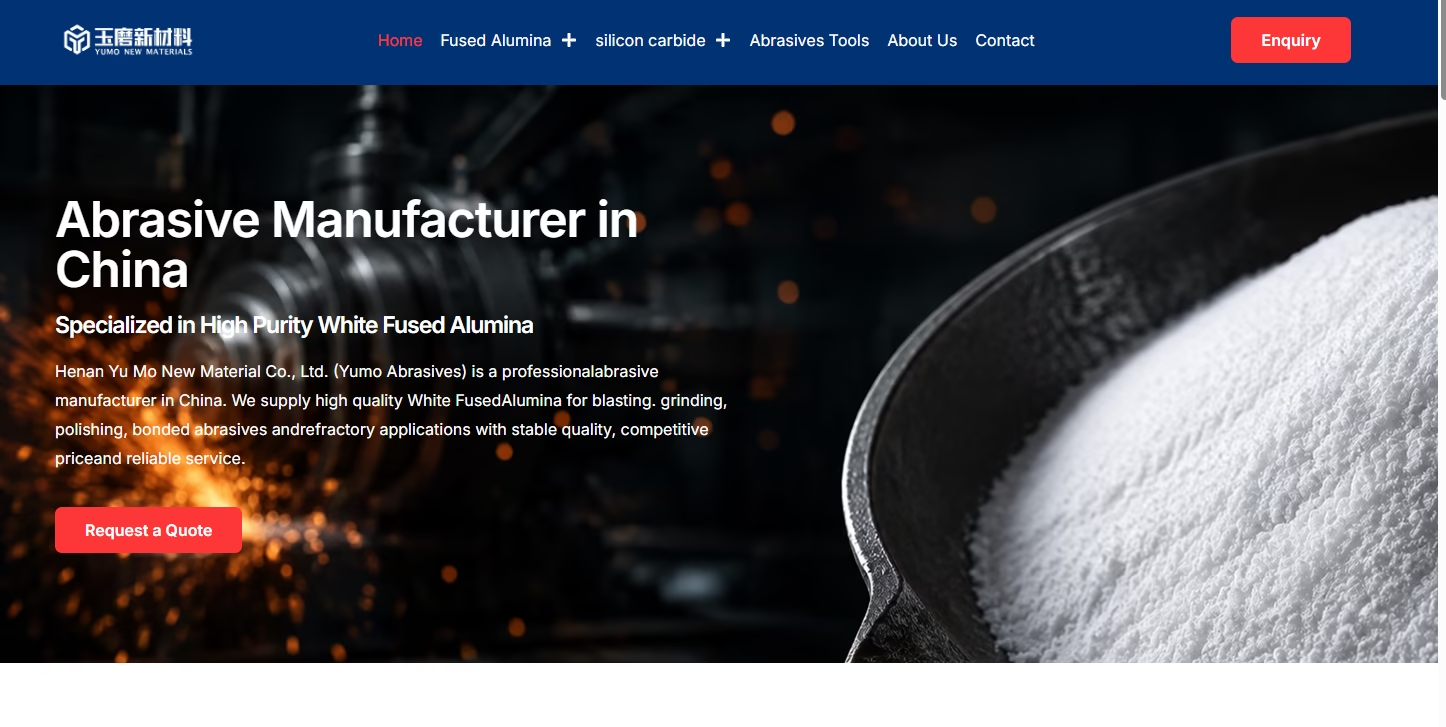
Henan Yumo New Materials: An Alternative Silicon Carbide Supplier in China
Location: 河南省, 中国
Website: YM 刚玉
For international buyers considering alternatives to Indian manufacturers, Henan Yumo New Materials offers silicon carbide and fused alumina products for grinding, 抛光, 爆破, refractory and other industrial applications.
Yumo is a China-based abrasive-materials producer and processor with a particular focus on white fused alumina micro powder and precision particle-size classification. Its published company information describes two production lines, three JZF precision classification systems and annual capacity exceeding 5,000 tons across its abrasive-materials business.
What Should Be Included in a Silicon Carbide RFQ?
A well-prepared request for quotation helps manufacturers respond with the correct grade instead of providing a generic silicon carbide price.
Suppose an industrial buyer is purchasing black silicon carbide for bonded abrasive production. The inquiry could specify the following:
Example: Silicon Carbide Purchase Specification
Illustrative RFQ — not a manufacturer quotation
| 产品 | 黑碳化硅 |
| Grade | F80 |
| 标准 | FEPA bonded abrasive grain |
| 应用 | Grinding wheel manufacturing |
| 数量 | 10 metric tons |
| 包装 | 25 托盘上的公斤袋 |
| 文件 | 总固体溶解度, batch COA, 安全数据表 |
| 样本 | Required before bulk purchase |
| 目的地 | Buyer to specify delivery location |
| Quotation | Price, MOQ, lead time and applicable Incoterms® rule |
If the application requires specific chemical limits, those should be attached to the RFQ rather than left to the supplier’s interpretation.
Buyers sourcing fine powder should also state whether they require a particular grading standard or a micron-based particle-size distribution. When an existing material is being replaced, including its current technical specification can make supplier comparisons much easier.
Silicon Carbide Price: What Affects the Final Cost?
Industrial silicon carbide pricing depends on the grade, 化学, 粒径, 加工要求, order quantity and commercial delivery terms.
A coarse industrial product may require less downstream classification than a carefully controlled micro powder. Additional purification, narrow particle-size limits or customer-specific processing can increase manufacturing costs.
包装, shipment size and delivery conditions also affect the final quotation.
为此原因, buyers should avoid comparing two prices unless they understand what each supplier is quoting.
An inexpensive product with excessive fines or inconsistent particle distribution may increase production costs through additional consumption, slower processing or rework.
Conversely, a more expensive grade does not automatically improve the process if its higher purity or tighter classification provides no measurable benefit in the intended application.
The purchasing objective should be to obtain the required technical performance at the lowest practical total cost, rather than simply selecting the lowest price per metric ton.
最后的想法
India offers several established silicon carbide manufacturing and processing businesses, including Grindwell Norton, Carborundum Universal and SNAM Group. Each has a different production structure and product focus, so buyers should evaluate them according to the material required rather than assuming that all three offer identical manufacturing capabilities.
For international purchasing, the most important questions concern the exact grade, particle-size specification, manufacturing origin, batch consistency and ability to deliver regular orders.
Chinese suppliers provide an additional sourcing option for buyers considering black silicon carbide, 绿碳化硅, conventional abrasive grains and customized powders. Yumo New Materials, 例如, offers silicon carbide alongside fused alumina products and supports discussions around particle-size requirements, samples and bulk industrial supply.
Whether sourcing from India or China, the qualification process should remain consistent: define the technical requirement, verify the production route, review the documentation, test a representative sample and confirm the commercial terms before approving routine supply.
The right purchasing decision is not necessarily the lowest quotation or the largest factory. It is a supply arrangement that consistently delivers material meeting your application requirements without creating avoidable production or quality problems.
Frequently Asked Questions About Silicon Carbide Manufacturers in India
1. Who manufactures silicon carbide in India?
Grindwell Norton, Carborundum Universal Limited and SNAM Group are established companies with documented Indian silicon carbide manufacturing or processing operations. Their business models differ: Grindwell Norton and CUMI have Indian silicon carbide production facilities, while SNAM manufactures abrasive grains and microgrits in India and also has crude SiC production operations in Vietnam.
2. Is silicon carbide produced in India or imported?
Both. India has domestic silicon carbide production facilities and imports silicon carbide from other countries. Buyers requiring Indian-origin material should confirm the original manufacturing location because a supplier may process or distribute silicon carbide produced elsewhere.
3. What is the difference between black and green silicon carbide?
Black silicon carbide is widely used for conventional grinding, 爆破, refractory and ceramic applications. Green silicon carbide generally has higher purity and is often selected for hard-material grinding, lapping and precision finishing. The appropriate grade depends on the workpiece, required particle size, impurity limits and processing conditions.
4. How do I choose a reliable silicon carbide manufacturer in India?
Start by confirming the supplier’s actual manufacturing or processing activities. Request the product specification, relevant quality documents and a representative sample, then test the material under production conditions. Before approving bulk supply, confirm batch consistency, available capacity for the required grade, delivery terms and manufacturing origin.
5. Can Indian manufacturers supply silicon carbide microgrits?
是的. CUMI and SNAM have documented silicon carbide microgrit manufacturing operations in India. Buyers should confirm which grading standards and particle-size ranges are available for their particular application.
6. Is silicon carbide from China cheaper than silicon carbide from India?
There is no universal price advantage for either country. The final purchasing cost depends on material grade, 数量, production requirements, freight, currency, taxes and delivery conditions. Buyers should request comparable quotations based on the same technical specification and delivery terms before making a price comparison.


